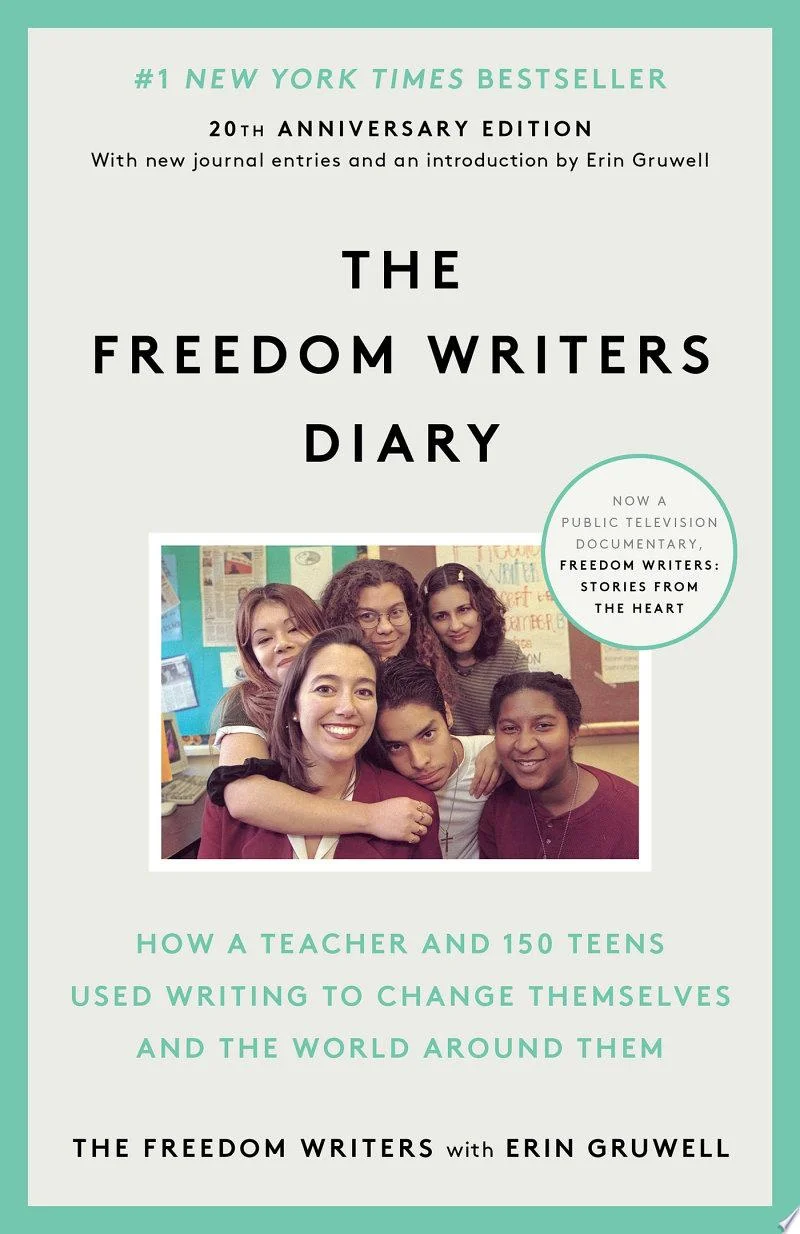
The Freedom Writers Diary
by Erin Gruwell
- Publication Date:
- October 12th, 1999
- Publisher:
- Crown
- ISBN-13:
- 9780385494229
- ISBN-10:
- 038549422X
- Pages:
- 458
Why The Freedom Writers Diary Has Been Challenged
Objections to the book center on the unflinching content of the diary entries themselves. See more ↓
Challenged or banned in 10 states across 28 school districts.
Overview
The Freedom Writers Diary grew out of a single classroom in Long Beach, California, in 1994, where teacher Erin Gruwell was assigned a group of students many had already written off. A racist drawing passed between students became the catalyst for an entirely new approach: rather than follow a standard curriculum, Gruwell asked her students to keep private diaries, giving them a place to put down what they were actually living through.
The book itself is built from those diaries—raw, first-person entries stitched together with connective narration from Gruwell. There is no single protagonist; instead, the collective voice of the students, who came to call themselves the Freedom Writers, carries the book forward as they wrestle with violence, family instability, race, and identity alongside the ordinary business of finishing high school.
This anniversary edition extends the story past graduation, adding new entries and an introduction that trace what became of the original writers—college, careers, children of their own—turning the book into both a snapshot of adolescence in crisis and a longer meditation on what happened next.
A Classroom Experiment That Became a Cultural Touchstone
What distinguishes The Freedom Writers Diary from other coming-of-age or teacher-memoir narratives is its structure: it is not one person's account of a classroom but many, unfiltered and largely unedited from the students' original writing. That choice puts the book in conversation with texts like Anne Frank's diary, which Gruwell used directly with her students—not as a historical artifact to be studied at a distance, but as a model for how ordinary people document extraordinary circumstances.
The book's afterlife has been unusually public. It has sold widely, been adapted into a feature film, and later a documentary, and has been used in classrooms as a teaching tool in its own right—assigned to students not unlike the ones who wrote it. That dual identity, as both memoir and pedagogical model, has kept it in circulation well beyond its original publication, and is part of why a twentieth-anniversary edition exists at all.
Why The Freedom Writers Diary Has Been Challenged
Objections to the book center on the unflinching content of the diary entries themselves. Because the students wrote about their actual lives, the collected entries include firsthand descriptions of gang violence, drug use, sexual abuse, teen pregnancy, and death, along with frank discussions of racism and racial slurs encountered or witnessed by the writers. Critics have argued that this material is too graphic or mature for the school-age readers to whom the book is often assigned, particularly younger students in the same grade range as the original Freedom Writers.
Some challenges have also focused on language, objecting to profanity and racial epithets quoted directly from the students' own writing—material that appears not as editorializing but as testimony to the environments the students describe. Within the catalog tracked here, the book has been the subject of 10 state-level and 28 district-level challenges, reflecting how frequently its classroom use, rather than its general availability, has drawn scrutiny. Defenders of the book counter that its power lies precisely in that rawness, and that sanitizing the entries would undercut the documentary honesty that made the project meaningful to the students who wrote it.
Where to Buy


Affiliate links may generate a small commission at no extra cost to you, which helps support this site.
Banned in Schools
Banned or challenged in 10 states across 28 school districts.
Alaska 1 district
- Matanuska-Susitna Borough School District Banned pending investigation
Florida 11 districts
- Alachua County Public Schools Banned pending investigation
- Charlotte County Public Schools Banned
- Duval County Public Schools Banned pending investigation
- Hillsborough County Public Schools Banned Pending Investigation
- Indian River County Schools Banned
- Orange County Public Schools Banned
- Pinellas County Schools Banned by restriction
- School District of Manatee County Banned
- Seminole County Public Schools Banned
- Union County School District Banned
- Volusia County Schools Banned
Iowa 2 districts
- Cedar Falls Community School District Banned pending investigation
- Dallas Center-Grimes Community School District Banned pending investigation
Maryland 1 district
- Caroll County School District Banned pending investigation
South Carolina 1 district
- Horry County Schools Banned
Tennessee 1 district
- Wilson County Schools Banned
Texas 8 districts
- Conroe Independent School District Banned
- Fort Bend Independent School District Banned by Restriction
- Fort Worth Independent School District Banned pending investigation
- Katy Independent School District Banned
- Lamar Consolidated Independent School District Banned
- Nacogdoches Independent School District Banned by Restriction
- North East Independent School District Banned
- Plano Independent School District Banned
Utah 1 district
- Granite School District Banned pending investigation
Virginia 1 district
Wisconsin 1 district
- Menomonee Falls Schools Banned