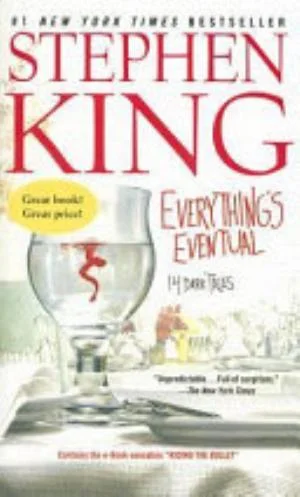
Everything's Eventual
by Stephen King
- Publication Date:
- September 1st, 2005
- Publisher:
- Pocket Books
- ISBN-13:
- 9781416524359
- ISBN-10:
- 1416524355
Why Everything's Eventual Has Been Challenged
Critics of the collection have focused less on any single story than on the cumulative weight of its violence and dark subject matter, questioning whether that intensity belongs in a school library at all. See more ↓
Challenged or banned in 2 states across 5 school districts.
Overview
"Everything's Eventual" gathers more than a dozen short stories that move between haunted hotel rooms, roadside apparitions, and ordinary lives disrupted by something uncanny. Rather than a single sustained narrative, the collection works as a tour through different registers of unease, some stories playing out as classic ghost stories and others settling into slower, more interior dread.
The pieces vary widely in length and tone. Some read as compact crime or noir fiction with only a hint of the supernatural at their edges, while others commit fully to horror, built around a single unsettling premise pushed to its limit. A few stand apart from genre entirely, functioning as character studies where mortality and guilt do the heavy lifting instead of ghosts or monsters.
What ties the collection together is less plot than mood: a recurring interest in how ordinary people react when confronted with something they cannot explain, control, or outrun.
Short Fiction and the Shape of a Career
By the time this collection appeared, Stephen King had spent decades primarily known for doorstop novels, and a return to the short story form read as a deliberate change of pace. Short fiction imposes different constraints than a novel: less room for digression, less time to build a world, and a greater reliance on a single image or idea carrying the whole piece. The collection shows King adapting to those constraints, often trading the slow-burn accumulation of dread found in his longer work for a tighter, more immediate kind of unease.
The stories also reflect a writer working across registers rather than staying inside one genre box. Horror sits alongside crime fiction and quieter literary realism, and the collection as a whole resists being read as a single statement about any one theme. Critical response to the book was generally favorable, with particular attention paid to its range, and it is often cited as evidence that King's reputation as a horror novelist undersells the breadth of what he writes. Read today, the collection also functions as a kind of snapshot of anxieties circulating at the turn of the millennium: technology that outpaces understanding, isolation, and the sense that modern conveniences do not actually protect anyone from older fears.
Why Everything's Eventual Has Been Challenged
A school board review prompted by a parent complaint centered on whether a collection built around violent death, bodily harm, and psychological torment belonged on a high school library shelf at all, with the complaint framing the stories' graphic content as inappropriate exposure rather than literary craft. That framing recurs across the objections tracked in this catalog, which record challenges in two states and five school districts: reviewers and parents have pointed to scenes of graphic violence, descriptions of death and bodily deterioration, and disturbing psychological content as the core of their concern, arguing that the material is simply too intense for the age group with access to it.
A secondary line of objection concerns language, with some complaints citing profanity and crude dialogue in individual stories as further grounds for restriction. Underlying both strands is a broader disagreement about audience: defenders of the collection's place in school libraries have pointed to its status as the work of a major literary figure and its use in studying short fiction, while those who challenged it argued that literary merit does not offset material they considered too graphic or disturbing for students to encounter without restriction.
Where to Buy




Affiliate links may generate a small commission at no extra cost to you, which helps support this site.
About Stephen King
Stephen King is an American author widely known as the 'King of Horror,' having written more than 60 novels and 200 short stories since his 1974 debut with Carrie. He is a recipient of the National Book Award's Medal for Distinguished Contribution to American Letters and the National Medal of Arts, and has won the Bram Stoker, World Fantasy, O. Henry, and Edgar Awards.
Also by Stephen King
 1922
 Apt Pupil
 Bag of Bones
 Billy Summers
 Black House
 Blaze
 Blockade Billy
 Carrie
 Cell
 Christine
 Cujo
 Danse Macabre
 Doctor Sleep
 Dreamcatcher
 Duma Key
 Elevation
 End of Watch
 Finders Keepers
 Firestarter
 Four Past Midnight
 From a Buick 8
 Full Dark, No Stars
 Gerald's Game
 Gwendy's Button Box
 Gwendy's Final Task
 Hearts In Atlantis
 If It Bleeds
 Insomnia
 It
 Joyland
 Just After Sunset
 Lisey's Story
 Misery
 Mr. Mercedes
 Needful Things
 Pet Sematary
Banned in Schools
Banned or challenged in 2 states across 5 school districts.
Florida 4 districts
- Clay County School District Banned
- Escambia County Public Schools Banned pending investigation
- Hillsborough County Public Schools Banned Pending Investigation
- Union County School District Banned