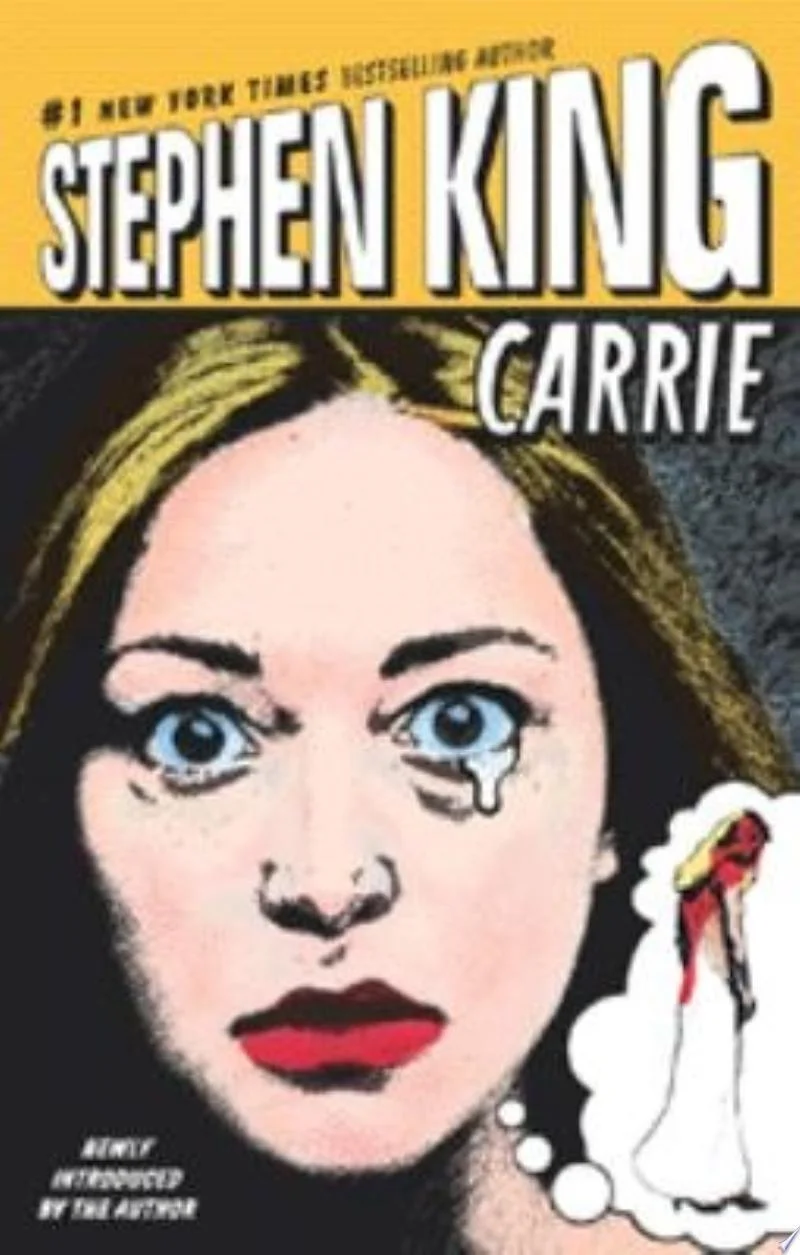
Carrie
by Stephen King
- Publication Date:
- September 1st, 2000
- Publisher:
- Simon and Schuster
- ISBN-13:
- 9780671039738
- ISBN-10:
- 0671039733
- Pages:
- 212
Why Carrie Has Been Challenged
Reviewers have periodically pushed back on assigning this novel to teenagers, pointing to its violent ending, its frank puberty-related content, and its depiction of religion twisted into an instrument of parental control. See more ↓
Challenged or banned in 3 states across 9 school districts.
Overview
Carrie was Stephen King's first published novel, and it introduced the blend of everyday adolescent misery and supernatural dread that would define much of his later work. Told partly through straightforward narrative and partly through fictional news clippings, court testimony, and excerpts from a survivor's memoir, the book follows Carrie White, a friendless high school student tormented by her classmates and controlled at home by a mother whose religious fervor curdles into abuse.
As Carrie discovers and struggles to master a telekinetic ability she barely understands, the novel tracks two collision courses at once: her fragile, dawning sense of self against the casual cruelty of her peers, and her mother's suffocating faith against a daughter who is starting, however tentatively, to want a life of her own. The prom night that closes the book brings both to a violent head.
Structurally, the novel is as notable as its story. By interrupting the plot with documents written after the fact, King builds suspense less around what happens than around how a small town later tries to explain it to itself.
A Debut That Set the Terms
Read now, Carrie functions less as a straightforward horror story than as a study of what happens when ordinary adolescent humiliation is denied any outlet. The novel is unusually attentive to the mechanics of social exclusion: the choreography of a locker-room taunt, the way a rumor moves through a school, the particular loneliness of a girl who is an object of ridicule at school and an object of control at home. King gives Carrie's power a body-based origin, tying its emergence to puberty, which has made the novel a recurring reference point in discussions of how horror fiction handles female adolescence and rage.
The book is also a portrait of religious extremism as a private, domestic force rather than a public one. Margaret White's fundamentalism is not depicted as belief so much as a mechanism of control, and the novel is careful to distinguish her fanaticism from faith in general even as it treats both with unease. Decades on, Carrie is often taught alongside other coming-of-age novels precisely because its horror elements sit on top of a very recognizable account of bullying and an unhappy home, and because it marked the start of a career that would go on to reshape popular fiction.
Why Carrie Has Been Challenged
Most objections to Carrie point toward its use in middle and high school classrooms, arguing that a book taught to young teenagers should not include the level of graphic violence, profanity, and disturbing imagery found in its climactic scenes. Critics who have sought its removal generally frame the concern as one of age-appropriateness: the prom-night sequence in particular, along with an early scene involving Carrie's first menstrual period, has been described as too explicit or too upsetting for readers in that age range, and some have objected to the book's occult and supernatural elements on religious grounds. Others have raised concerns about the novel's unflinching depictions of bullying, self-harm, and suicide, worrying that dwelling on them at length could be distressing rather than instructive for younger readers. In this catalog, the novel's record includes challenges tracked in 3 states and 9 school districts, most arising from parents or committees reviewing required or optional reading lists rather than from library circulation generally. Defenders of the book counter that its frank treatment of cruelty and isolation is precisely what gives it value as a classroom text, allowing students to examine bullying and religious extremism through a story that does not soften their consequences.
Where to Buy




Affiliate links may generate a small commission at no extra cost to you, which helps support this site.
About Stephen King
Stephen King is an American author widely known as the 'King of Horror,' having written more than 60 novels and 200 short stories since his 1974 debut with Carrie. He is a recipient of the National Book Award's Medal for Distinguished Contribution to American Letters and the National Medal of Arts, and has won the Bram Stoker, World Fantasy, O. Henry, and Edgar Awards.
Also by Stephen King




Banned in Schools
Banned or challenged in 3 states across 9 school districts.
Florida 6 districts
- Clay County School District Banned
- Collier County Public Schools Banned
- Escambia County Public Schools Banned pending investigation
- Hillsborough County Public Schools Banned Pending Investigation
- Union County School District Banned
- Volusia County Schools Banned Pending Investigation