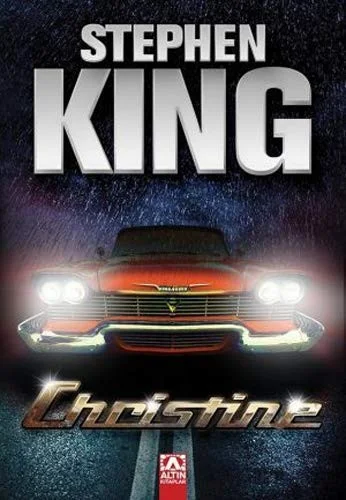
Christine
by Stephen King
- Publication Date:
- February 1st, 2015
- Publisher:
- Altin Kitaplar
- ISBN-13:
- 9789752119185
- ISBN-10:
- 9752119182
- Pages:
- 432
Why Christine Has Been Challenged
Critics have pushed back against the novel's blend of teenage carnage and coarse language, arguing that its horror-movie violence crosses a line for shelves shared with younger readers. See more ↓
Challenged or banned in 3 states across 5 school districts.
Overview
Arnie Cunningham is an unremarkable high school outsider until he sinks his savings into a wrecked Plymouth Fury he finds rotting on a stranger's lawn. As he pours himself into restoring the car, its previous owner's old nickname for it—Christine—starts to feel less like a joke and more like a warning. The Fury seems to fix itself as much as Arnie fixes it, and the boy behind the wheel begins to change alongside it.
What begins as a coming-of-age story about a shy kid gaining confidence curdles into something else entirely. Arnie's new girlfriend and his oldest friend both sense that Christine is not sharing Arnie so much as claiming him, and that the car's affection comes with a body count attached to anyone who threatens its hold.
King builds the novel around an unsettling substitution: the classic symbols of American adolescence—the first car, the first girlfriend, the assertion of independence—are hollowed out and refilled with something possessive and murderous.
An Object of Desire, Turned Predator
Published in 1983, Christine sits at an interesting angle to King's other work of the period, using horror to interrogate a very ordinary teenage milestone: buying a first car. Rather than a haunted house or an ancient evil, the threat here is a piece of Americana, chrome and steel that most readers would associate with freedom and status. The novel asks what happens when that symbol of independence turns out to want a kind of ownership in return, and it uses Arnie's transformation from awkward misfit to someone increasingly cold and controlling as the vehicle for that question.
The book has often been read as a meditation on obsession and codependency, with Christine functioning almost as an abusive partner: charming, generous, and lethal to any rival for Arnie's attention. That framing has helped the novel endure as one of King's more frequently adapted and referenced works, even outside the traditional horror-fan audience, since its central metaphor translates easily to any story about a relationship that consumes the person inside it.
Why Christine Has Been Challenged
Graphic violence is the most frequently cited concern, as the novel includes numerous killings carried out by or through the car, described with the visceral detail typical of King's horror fiction. Some reviewing committees have found the level of gore inappropriate for the younger end of the young-adult readership the book's teenage protagonists might otherwise attract.
Language and sexual content have also drawn objections, with challengers pointing to profanity and depictions of teenage sexuality as unsuitable for school library shelves. Additional complaints have centered on the book's bleak treatment of adolescence, including its portrayal of bullying, parental neglect, and Arnie's descent into violent obsession, which some reviewers have argued glamorizes rather than critiques dangerous behavior. In this catalog, Christine has been the subject of 3 state-level and 5 district-level challenges.
Where to Buy



Affiliate links may generate a small commission at no extra cost to you, which helps support this site.
About Stephen King
Stephen King is an American author widely known as the 'King of Horror,' having written more than 60 novels and 200 short stories since his 1974 debut with Carrie. He is a recipient of the National Book Award's Medal for Distinguished Contribution to American Letters and the National Medal of Arts, and has won the Bram Stoker, World Fantasy, O. Henry, and Edgar Awards.
Also by Stephen King
Banned in Schools
Banned or challenged in 3 states across 5 school districts.
Florida 3 districts
- Clay County School District Banned
- Hillsborough County Public Schools Banned Pending Investigation
- Union County School District Banned