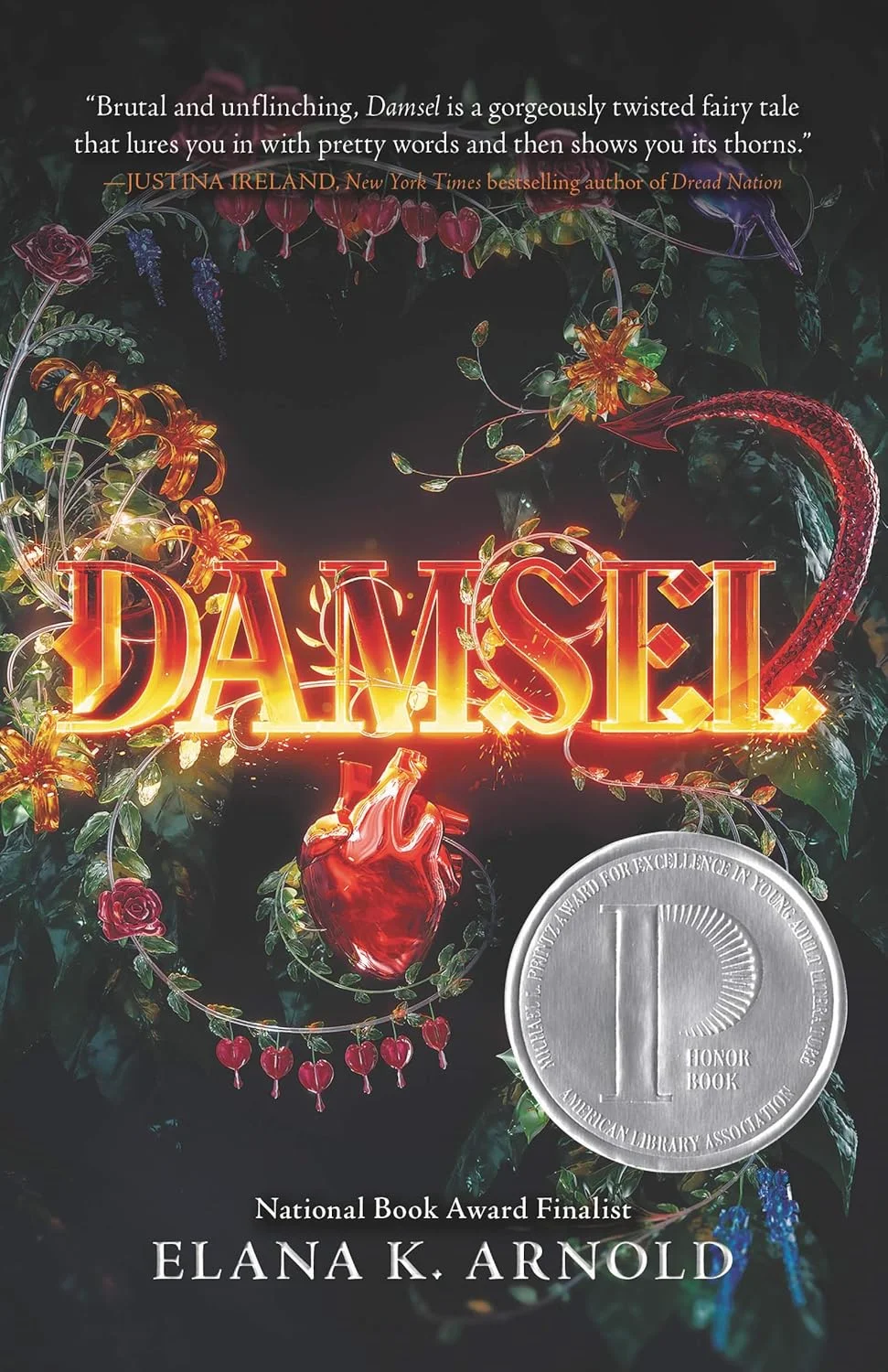
Damsel
- Publication Date:
- January 28th, 2020
- Publisher:
- Balzer & Bray
- ISBN-13:
- 9780062742339
- ISBN-10:
- 0062742337
- Pages:
- 336
About Damsel
Damsel is a 2018 young adult novel by Elana K. Arnold, published by Balzer & Bray. It received a Michael L. Printz Award Honor in 2019. The novel is a dark subversion of the classic fairy tale rescue story, written in lush, sensory prose that gradually transforms from romantic to deeply disturbing.
The story follows a ritual that has governed the kingdom of Harding for as long as anyone can remember: when the old king dies, his son must ride into the gray lands, slay a dragon, and return with a damsel who will become his bride and future queen. When Prince Emory returns with Ama, she has no memory of her life before the dragon's lair. She does not know who she was, where she came from, or what happened to her. She knows only Emory's story — that he saved her.
As Ama settles into the castle and prepares for her marriage to the prince, she begins to observe things that don't add up. The women of the kingdom are docile and compliant in ways that feel less like contentment than erasure. The queen mother moves through the halls with the hollow eyes of someone who has long since stopped expecting anything different. Ama, unable to draw on memory, tries to read the world around her for the truth that everyone seems determined to withhold.
Arnold structures the novel to reveal its horror gradually — the "rescue" that opens the story is not what it seemed, and the prince's role is not heroic. The book dismantles the traditional fairy tale rescue fantasy by asking what it would mean if the story's romantic framework were itself a form of captivity.
Themes and Literary Context
Damsel belongs to a tradition of feminist fairy tale retellings, but it pushes that tradition further than most. Where many retellings center female agency within the familiar structure, Arnold's novel questions the structure altogether. The damsel is not a character who needs help choosing her own path — she is a character from whom path, memory, and selfhood have been stripped.
The novel's use of amnesia is precise and purposeful. Ama's inability to remember anything before her "rescue" is not a plot device but a thematic one: she represents all the women in literary and folk traditions whose inner lives were never recorded, who exist only in relation to the men who claim them. The novel refuses to treat women's silence as romantic or mysterious, insisting instead on the violence underneath it.
The prose style — richly sensory and feminine in its attentiveness to bodies, food, cloth, and landscape — creates a tension with the book's content that is itself part of the argument Arnold is making. Beauty is being used to maintain horror. That contrast is the novel's central engine.
Why Damsel Has Been Banned
Damsel has been banned or challenged in 52 school districts across 11 states, including heavy concentrations in Florida and Iowa. The challenges cite sexual content and violence as the primary concerns. The novel contains both, handled with deliberate unflinching honesty that is integral to its meaning.
The sexual content in Damsel is not gratuitous — it is the ground on which the novel makes its argument. The acts that occur in the book are portrayed as what Arnold understands them to be: violations framed as normal, harm dressed as tradition. To redact or soften that content would be to tell a fundamentally different story, one that made the fairy tale rescue narrative comfortable again rather than interrogating it honestly.
Advocates for the novel argue that its honest treatment of coercion and trauma is precisely what makes it important for young readers — particularly young women — who are navigating cultural narratives about romance, consent, and what it means to be "chosen."
Where to Buy



Affiliate links may generate a small commission at no extra cost to you, which helps support this site.
About Elana K. Arnold
Elana K. Arnold is an American author of children's and young adult fiction who earned her BA from UC Irvine and her MA from UC Davis. Her 2018 novel Damsel received a Michael L. Printz Award Honor, and What Girls Are Made Of (2017) was a National Book Award finalist. Three of her books were banned by the Alpine School District in Utah in 2022.
Banned in Schools
Banned or challenged in 11 states across 51 school districts.
Florida 16 districts
- Brevard Public Schools Banned
- Broward County Public Schools Banned Pending Investigation
- Escambia County Public Schools Banned pending investigation
- Hernando County Schools Banned
- Hillsborough County Public Schools Banned
- Lake County Schools Banned
- Okaloosa County School District Banned pending investigation
- Orange County Public Schools Banned pending investigation
- Pasco County Schools Banned
- Pinellas County Schools Banned
- Polk County Public Schools Banned pending investigation
- Santa Rosa County Schools Banned
- School District of Osceola County Banned
- School District of Palm Beach County Banned
- Seminole County Public Schools Banned
- Union County School District Banned
Iowa 18 districts
- Adel DeSoto Minburn Community School District Banned
- CAM Community School District Banned
- Clarion-Goldfield-Dows Community School District Banned pending investigation
- Clear Lake Community School District Banned
- Council Bluffs Community School District Banned pending investigation
- Dubuque Community School District Banned
- Interstate 35 Community School District Banned
- Iowa City Community School District Banned pending investigation
- Lewis Central Community School District Banned
- Louisa-Muscatine Community School District Banned pending investigation
- Ottumwa Community School District Banned
- Southeast Polk Community School District Banned
- Union Community School District Banned
- Urbandale Community School District Banned pending investigation
- Waterloo Community School District Banned pending investigation
- West Des Moines Community Schools Banned pending investigation
- Winterset Community School District Banned
- Woodward-Granger Community School District Banned
Maine 1 district
- Hermon School Department Banned by restriction
Maryland 1 district
- Caroll County School District Banned pending investigation
Pennsylvania 1 district
- South Middleton School District Banned pending investigation
South Carolina 1 district
Tennessee 2 districts
- Knox County Schools Banned
- Rutherford County Schools Banned
Texas 5 districts
- Fort Bend Independent School District Banned
- Fort Worth Independent School District Banned pending investigation
- Lamar Consolidated Independent School District Banned
- Nacogdoches Independent School District Banned by Restriction
- Plano Independent School District Banned
Virginia 4 districts
- Fluvanna School District Banned pending investigation
- Hanover County Public Schools Banned
- King George County Schools Banned by Restriction
- Spotsylvania County Public Schools Banned
Wisconsin 1 district
- Menomonee Falls Schools Banned
Wyoming 1 district
- Laramie County School District No. 1 Banned by restriction