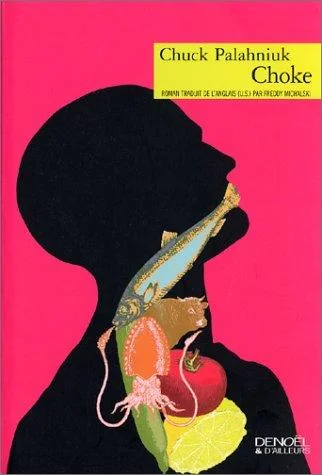
Choke
- Publication Date:
- May 14th, 2002
- Publisher:
- Denoël
- ISBN-13:
- 9782207253632
- ISBN-10:
- 2207253635
- Pages:
- 336
Why Choke Has Been Challenged
Objections to Choke center overwhelmingly on its sexual content, which is graphic, frequent, and tied to the compulsive behavior at the story's core rather than treated as incidental. See more ↓
Challenged or banned in 5 states across 12 school districts.
Overview
Choke follows Victor Mancini, a former medical student who has traded any conventional career for a grift built on other people's guilt. In upscale dining rooms, he deliberately pretends to choke, then lets a fellow diner "rescue" him. The strangers who save him, feeling suddenly and permanently responsible for his survival, keep sending him money afterward — funds Victor uses to cover his mother's care.
Outside the restaurants, Victor's life is a patchwork of dead ends: shifts at a historical theme park, visits to a mother whose mind is unraveling, and stops at sexual addiction support meetings that he treats less as recovery than as a hookup circuit. Palahniuk moves between these threads to build a portrait of a man improvising his way through obligation, shame, and self-sabotage.
The novel keeps the con at its center but uses it as a lens on larger questions — what people owe their parents, what they tell themselves to justify their worst habits, and how easily manufactured crises can be turned into a livelihood.
A Con Artist's Logic
Following his breakout novel Fight Club, Palahniuk returned to familiar territory: a disaffected narrator, an outrageous scheme, and a satirical eye trained on consumer culture and modern masculinity. Where Fight Club channeled male alienation into organized violence, Choke channels it into a more intimate and manipulative performance — one staged for an audience of strangers who mistake a manufactured emergency for a chance at meaning.
The choking scam works because it inverts obligation: rather than asking for help, Victor engineers a scenario in which help is given to him and the giver ends up feeling indebted. That dynamic runs through the book's other relationships as well, particularly Victor's fraught caretaking of his mother, whose own unreliable version of his childhood destabilizes what he thought he knew about himself. The novel has been read as a meditation on addiction in its many forms — not just sex or food, but attention, guilt, and rescue itself — filtered through Palahniuk's characteristically blunt, aphoristic prose.
Why Choke Has Been Challenged
Objections to Choke center overwhelmingly on its sexual content, which is graphic, frequent, and tied to the compulsive behavior at the story's core rather than treated as incidental. Scenes depicting Victor's activity at sex addiction support meetings, along with the novel's blunt, often crude language, have drawn the most sustained criticism from those who consider the book unsuitable for school libraries and classrooms. Some challenges also cite the book's overall vulgarity and its unflinching, satirical treatment of addiction and family dysfunction as inappropriate for younger readers. In total, this catalog tracks challenges to Choke in 5 states and 12 districts, reflecting how frequently its content has been flagged in efforts to restrict access, particularly in school settings.
Where to Buy


Affiliate links may generate a small commission at no extra cost to you, which helps support this site.
About Chuck Palahniuk
Chuck Palahniuk is an American author of transgressive fiction best known for his 1996 novel Fight Club, which was adapted into a celebrated 1999 film by David Fincher. His darkly satirical work explores violence, consumerism, identity, and masculinity and has earned him the Pacific Northwest Booksellers Award and the Oregon Book Award.
Also by Chuck Palahniuk
Banned in Schools
Banned or challenged in 5 states across 12 school districts.
Florida 7 districts
- Broward County Public Schools Banned
- Hillsborough County Public Schools Banned
- Orange County Public Schools Banned pending investigation
- Santa Rosa County Schools Banned
- School District of Palm Beach County Banned
- Seminole County Public Schools Banned
- Union County School District Banned
Iowa 1 district
- West Des Moines Community Schools Banned pending investigation
Maine 1 district
Texas 2 districts
Wisconsin 1 district
- Elkhorn Area School District Banned by restriction