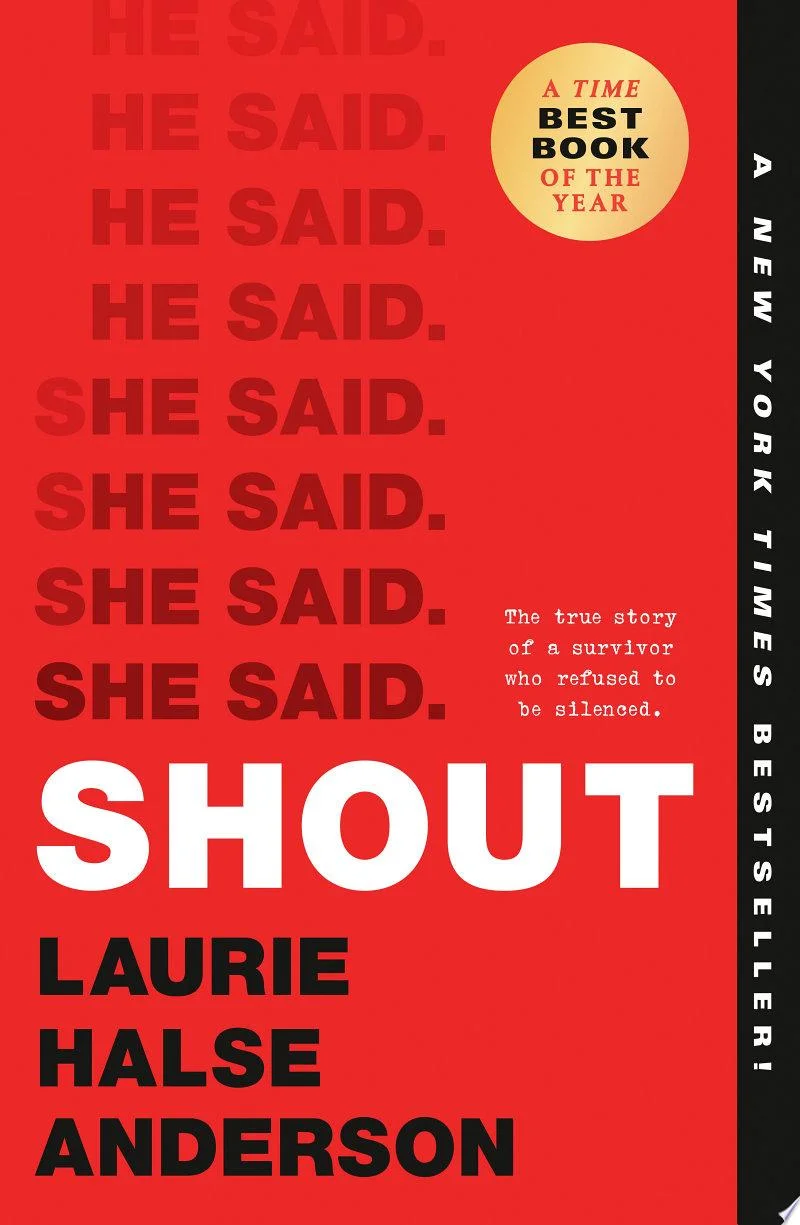
SHOUT
- Publication Date:
- March 10th, 2020
- Publisher:
- Penguin
- ISBN-13:
- 9780142422205
- ISBN-10:
- 0142422207
- Pages:
- 321
Why SHOUT Has Been Challenged
Shout has been challenged or banned in 6 states and 26 districts tracked in this catalog. See more ↓
Challenged or banned in 6 states across 26 school districts.
Overview
Shout is Laurie Halse Anderson's turn from fiction to memoir, written entirely in free verse. Two decades after Speak established her as a defining voice on sexual assault in young adult literature, Anderson returns to the subject directly, drawing on her own history rather than a fictional narrator's.
The book moves between autobiographical fragments and more public-facing pieces: reflections on her childhood and early adulthood sit alongside verses that read as commentary on the culture surrounding survivors of assault. Rather than a linear narrative, it accumulates through short, charged pieces of writing.
Anderson has described the book as a response to two years of encounters with readers of Speak, and to her sense that the underlying issues the novel addressed remain largely unresolved. Shout reads as both a personal accounting and an argument that the conversation is unfinished.
Context and Reception
Shout arrived in 2019 into a cultural moment already reshaped by the #MeToo movement, and much of its critical reception framed the book in those terms: a poet-memoirist's contribution to a broader public reckoning with sexual violence and institutional silence. Critics noted the shift in form as significant in itself — that Anderson chose verse, a genre associated with compression and emotional immediacy, to say what a novel like Speak had approached through a fictional stand-in.
The book also functions as a piece of literary history. Speak has spent over twenty years as both a widely taught text and a frequent target of removal efforts, and Shout gives Anderson occasion to reflect on that afterlife — how a novel becomes a reference point in students' and educators' understanding of assault, and what it means for its author to watch that use unfold from the outside. Reviewers generally treated Shout as a companion volume that recontextualizes Speak rather than a stand-alone departure from it.
Why Shout Has Been Challenged
Shout has been challenged or banned in 6 states and 26 districts tracked in this catalog. The objections raised against it center overwhelmingly on its subject matter: the book discusses sexual assault, including Anderson's own experience, in direct and unsentimental language, and some challengers have characterized this content as inappropriate for school libraries or classrooms regardless of its literary or educational framing.
A related line of objection concerns the book's explicitness about trauma and its aftermath — descriptions of assault and its psychological consequences have been flagged as too graphic for younger readers, even in a genre, memoir, understood to require candor about lived experience. Because Shout is frequently shelved and taught alongside Speak, it has also been swept into broader challenges aimed at Anderson's body of work on this theme, with objections to one title sometimes extending to the other. Advocates for the book counter that its directness is precisely what has made it useful to readers processing similar experiences, and that removing it limits access to one of the few widely available first-person accounts of its kind for teen audiences.
Where to Buy


Affiliate links may generate a small commission at no extra cost to you, which helps support this site.
About Laurie Halse Anderson
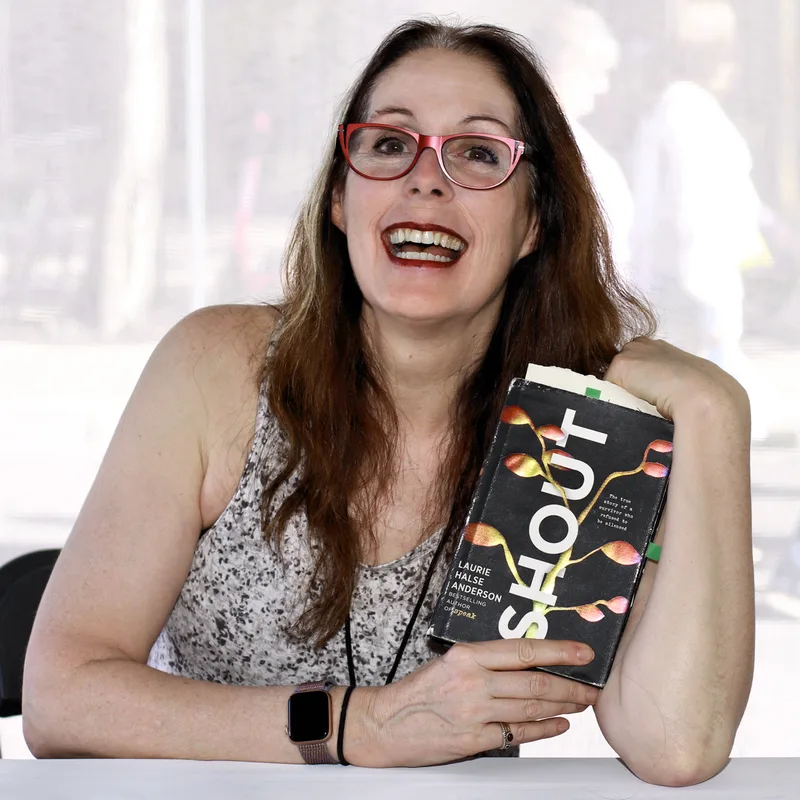
Laurie Halse Anderson is an American author of young adult and historical fiction, best known for Speak (1999), a National Book Award finalist and New York Times bestseller about a teenage rape survivor. Her work has earned the Margaret A. Edwards Award for lifetime contribution to young adult literature and the 2023 Astrid Lindgren Memorial Award, one of the largest cash prizes in children's literature. Her books are among the most challenged in American schools.
Also by Laurie Halse Anderson

Banned in Schools
Banned or challenged in 6 states across 26 school districts.
Florida 7 districts
- Citrus County School District Banned by Restriction
- Collier County Public Schools Banned by restriction
- Escambia County Public Schools Banned pending investigation
- Hillsborough County Public Schools Banned Pending Investigation
- Indian River County Schools Banned
- Union County School District Banned
- Volusia County Schools Banned Pending Investigation
Iowa 9 districts
- Bondurant-Farrar Community School District Banned pending investigation
- Clear Lake Community School District Banned
- Dallas Center-Grimes Community School District Banned pending investigation
- Grundy Center Community School District Banned
- Nevada Community School District Banned pending investigation
- Pocahontas Area Community School District Banned
- Waukee Community School District Banned pending investigation
- West Des Moines Community Schools Banned pending investigation
- Winterset Community School District Banned
Tennessee 3 districts
- Knox County Schools Banned
- Rutherford County Schools Banned
- Wilson County Schools Banned
Texas 4 districts
- Lamar Consolidated Independent School District Banned
- Midland Independent School District Banned
- Nacogdoches Independent School District Banned by Restriction
- North East Independent School District Banned
Virginia 2 districts
- Hanover County Public Schools Banned
- King George County Schools Banned by Restriction
Wisconsin 1 district
- Elkhorn Area School District Banned by restriction