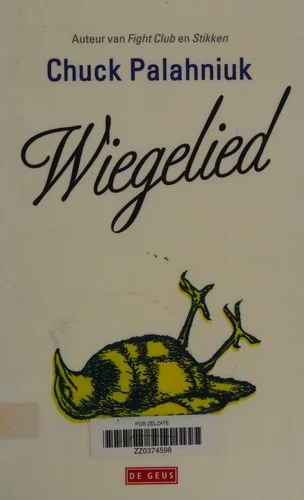
Lullaby
- Publication Date:
- January 1st, 2004
- Publisher:
- De Geus
- ISBN-13:
- 9789044503517
- ISBN-10:
- 9044503510
- Pages:
- 255
Why Lullaby Has Been Challenged
Critics of this novel have focused less on any single scene than on its premise that language itself can function as a weapon, and on the casual, often darkly comic violence that premise licenses. See more ↓
Challenged or banned in 2 states across 10 school districts.
Overview
Carl Streator, a middle-aged journalist still grieving his late wife, is assigned to cover a recurring local tragedy: a cluster of crib deaths with no medical explanation. His reporting turns up one strange constant among the grieving households — each had, somewhere in the house, the same out-of-print collection of poems and rhymes, left open to a particular page. The verse there is identified as an old African "culling song," traditionally used to end suffering quickly and mercifully. Carl realizes, to his horror, that merely reading the lines, aloud or silently, is enough to kill whoever he directs them toward.
Unable to purge the song from his own mind, Carl becomes a reluctant and then a calculating killer, using his new power on people who cross him. He eventually crosses paths with Helen Hoover Boyle, a real estate agent who has built a lucrative niche reselling "distressed" homes — houses with violent histories that buyers snap up out of morbid curiosity — and who lost a child to the same song years before. The two set off together, trailed by Helen's assistant and the assistant's conspiracy-minded boyfriend, on a road trip with an increasingly desperate purpose: locating and destroying every surviving copy of the anthology before the song spreads beyond their control.
What begins as a missing-persons-style investigation shifts into something closer to a dark road comedy, as the group's methods grow more extreme and their reasons for continuing the hunt become harder to separate from grief, guilt, and habit.
Behind the Story
Palahniuk wrote "Lullaby" in the aftermath of "Fight Club" and "Choke," and it carries forward his interest in ordinary people who discover a shortcut to power they are unequipped to handle responsibly. Where his earlier novels used physical violence and self-destruction as the engine, this book makes the engine verbal: a string of words that kills simply by being understood. The premise lets the novel poke at anxieties particular to a media-saturated culture — jingles that lodge in the brain unbidden, headlines that spread faster than anyone can verify them, the unsettling thought that information itself might be dangerous to possess.
The novel also sits inside Palahniuk's recurring fascination with American consumerism and real estate, using Helen's business of flipping haunted houses as a wry comment on a market that will package and resell almost anything, including tragedy. Critics generally place "Lullaby" among the author's more fable-like works, closer to black satire than straightforward horror, and it has been read as a meditation on how grief curdles into obsession when it has nowhere else to go.
Why Lullaby Has Been Challenged
The novel's central conceit — that a short verse, once learned, can be used to kill on command — has drawn objection less for any graphic set-piece than for the practical effect of the premise: the story spends considerable time cataloguing how its characters refine and deploy a method of murder that requires no weapon and leaves no evidence, which some reviewers have argued reads uncomfortably like instruction dressed as fiction. Its opening frame, built around a wave of unexplained infant deaths, has also unsettled some adult readers and gatekeepers, who view that subject matter as too bleak a hook regardless of the fantastical explanation behind it.
Beyond the premise itself, challenges have cited the novel's casual treatment of death generally, its morbid humor around grief and mourning, and scattered adult content and language consistent with Palahniuk's other work. Taken together, these concerns have led the book to be challenged or restricted in 2 states and 10 districts tracked in this catalog, with objections typically framed around age-appropriateness for school library shelves rather than a wholesale case against the novel's literary merit.
Where to Buy




Affiliate links may generate a small commission at no extra cost to you, which helps support this site.
About Chuck Palahniuk
Chuck Palahniuk is an American author of transgressive fiction best known for his 1996 novel Fight Club, which was adapted into a celebrated 1999 film by David Fincher. His darkly satirical work explores violence, consumerism, identity, and masculinity and has earned him the Pacific Northwest Booksellers Award and the Oregon Book Award.
Also by Chuck Palahniuk
Banned in Schools
Banned or challenged in 2 states across 10 school districts.
Florida 9 districts
- Broward County Public Schools Banned Pending Investigation
- Flagler Schools Banned
- Hillsborough County Public Schools Banned
- Orange County Public Schools Banned
- Pasco County Schools Banned
- Pinellas County Schools Banned
- School District of Manatee County Banned
- School District of Palm Beach County Banned
- Union County School District Banned
Iowa 1 district
- West Des Moines Community Schools Banned pending investigation