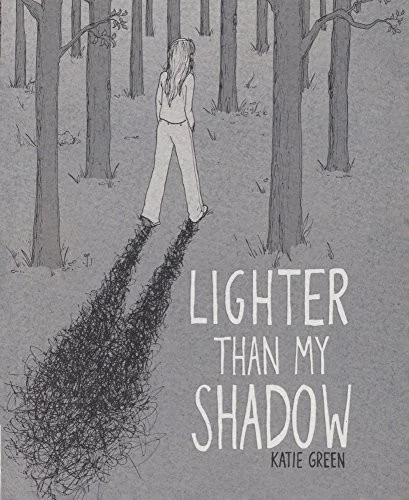
Lighter than my shadow
by Katie Green
- Publication Date:
- October 24th, 2017
- Publisher:
- Turtleback Books
- ISBN-13:
- 9780606406468
- ISBN-10:
- 0606406468
- Pages:
- 516
Why Lighter than my shadow Has Been Challenged
Reviewers and challengers agree on almost nothing except how bluntly this book renders bodily suffering and betrayal, which is exactly what has put it in the crosshairs of school library disputes. See more ↓
Challenged or banned in 6 states across 12 school districts.
Overview
Katie Green's graphic memoir opens with something almost universally familiar: a child who won't eat, who stalls at the dinner table and stashes food rather than swallow it. It is the kind of small domestic standoff every family recognizes, and Green draws it with a light, almost comic touch before letting the reader feel the ground shift beneath it.
That ordinary stubbornness curdles into something the girl can no longer control. Green traces the slow tightening of an eating disorder from adolescence into young adulthood, rendering years of illness, hospitalization, and relapse in dense, obsessively detailed pencil drawings that mirror the claustrophobia of the mind she is describing. The book does not resolve quickly or neatly; recovery, as Green depicts it, is halting and repeatedly undone before it holds.
Woven into this account is a second reckoning: with a period during treatment when someone entrusted with her care exploited that trust. The memoir treats this violation as inseparable from the larger story of illness and healing, refusing to let either strand stand alone.
Illness, Trust, and the Body on the Page
What distinguishes this book from other illness narratives is its form. Green spent years hand-rendering the memoir in graphite, and the resulting pages have a hallucinatory density that comics about interior suffering rarely attempt: obsessive line work standing in for obsessive thought, white space collapsing as the illness tightens its hold. The medium becomes an argument in itself about how eating disorders actually feel from the inside, rather than how they are typically summarized from the outside.
The book also sits inside a broader conversation about who gets to write frankly about disordered eating, medical institutions, and abuse of power within them. Its refusal to soften the account of exploitation by a caregiver, or to treat recovery as a clean redemption arc, has made it a touchstone in discussions of memoir as a tool for processing trauma rather than resolving it. Reception among readers dealing with their own histories of eating disorders has tended to emphasize how rarely the illness is drawn from within, rather than observed from a clinical or family distance.
Why Lighter Than My Shadow Has Been Challenged
The same qualities that reviewers and readers with lived experience have praised as unflinching are the ones that have drawn objection elsewhere: this is a book precisely because it does not look away, and the discomfort that produces is at the root of nearly every complaint against it. Across the six states and twelve districts where the catalog records a challenge, the objections cluster around content rather than message.
Most center on the memoir's graphic depiction of an eating disorder itself, including scenes of purging, self-harm, and hospitalization rendered in unsparing visual detail, with challengers arguing that such imagery risks instructing or triggering vulnerable young readers rather than warning them off. A second, closely related line of objection concerns the book's account of sexual abuse by a person in a position of therapeutic authority, which some challengers have characterized as sexual content unsuitable for a school library regardless of its role in the larger story of survival. Together these objections treat the book's honesty about illness and violation as a liability rather than the source of its value to readers navigating similar experiences.
Where to Buy



Affiliate links may generate a small commission at no extra cost to you, which helps support this site.
Banned in Schools
Banned or challenged in 6 states across 12 school districts.
Florida 3 districts
- Hillsborough County Public Schools Banned Pending Investigation
- School District of Manatee County Banned
- Union County School District Banned
Iowa 2 districts
- Cedar Falls Community School District Banned pending investigation
- Oskaloosa Community School District Banned
Maryland 1 district
- Caroll County School District Banned pending investigation
Tennessee 2 districts
- Knox County Schools Banned
- Oak Ridge Schools Banned
Texas 3 districts
- Katy Independent School District Banned
- Nacogdoches Independent School District Banned by Restriction
- North East Independent School District Banned
Utah 1 district
- Davis School District Banned