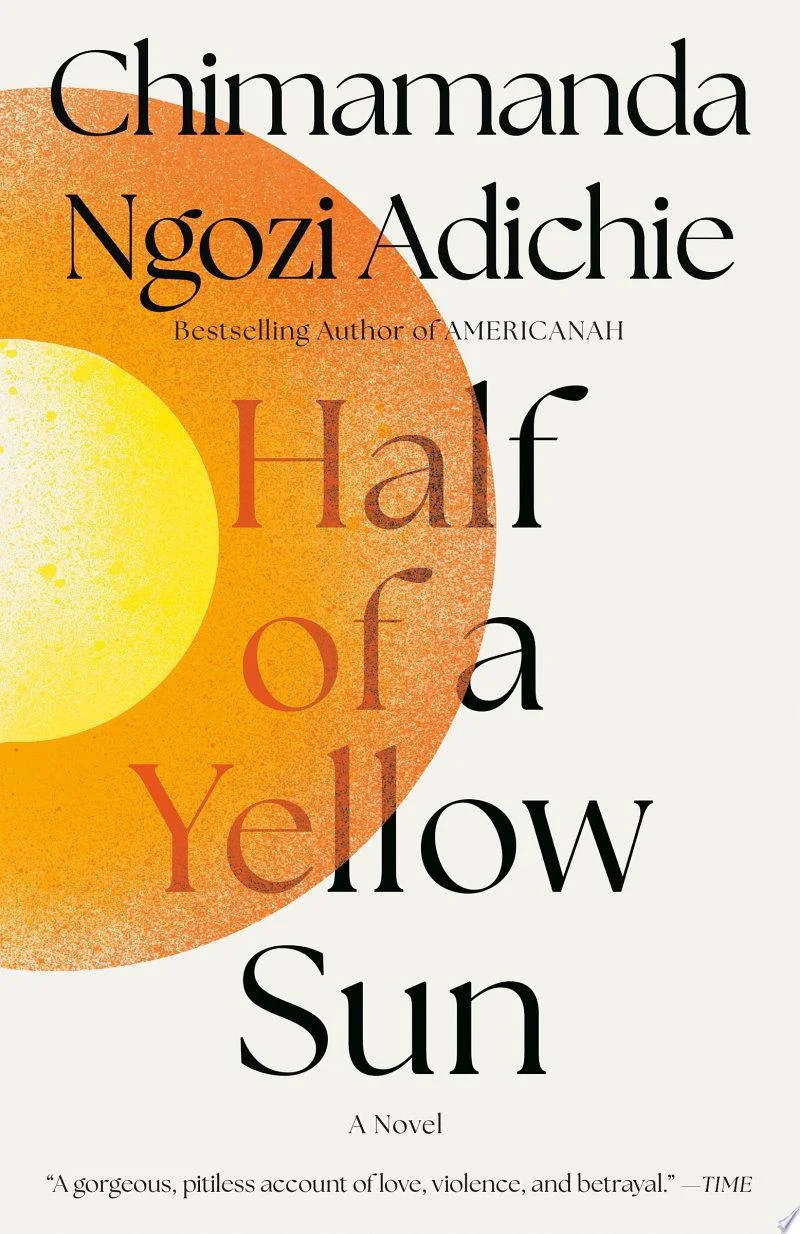
Half of a Yellow Sun
- Publication Date:
- October 29th, 2010
- Publisher:
- Vintage Canada
- ISBN-13:
- 9780307373540
- ISBN-10:
- 0307373541
- Pages:
- 562
Why Half of a Yellow Sun Has Been Challenged
Objections to Half of a Yellow Sun have generally centered on its candid treatment of sex and adult relationships, including an extramarital affair depicted early in the novel, along with scenes of sexual violence connected to the war. See more ↓
Challenged or banned in 6 states across 15 school districts.
Overview
Set in Nigeria during the 1960s, Half of a Yellow Sun follows the collapse of the short-lived republic of Biafra through the eyes of characters bound together by love, ambition, and circumstance. Ugwu, a village teenager who takes a position as a houseboy, comes of age in the household of Odenigbo, a university lecturer given to fiery political conviction. Odenigbo's partner, Olanna, has left behind a comfortable life in Lagos to build a home with him, while her aloof twin sister, Kainene, runs the family business and draws the quiet attention of Richard, an Englishman who has come to Nigeria and finds himself pulled toward a country not his own.
As war engulfs the region, Adichie moves these characters through shifting timelines, tracing how the optimism of independence gives way to famine, displacement, and loss. The novel resists a single vantage point on the conflict, instead letting domestic life, class tension, and personal betrayal unfold alongside the larger historical catastrophe.
The result is a novel less interested in battlefield chronology than in what war does to intimacy, loyalty, and identity over time.
History, Memory, and the Personal Cost of War
Half of a Yellow Sun draws on the Nigerian Civil War of 1967 to 1970, a conflict rooted in ethnic tension and the fractures left by colonial rule, which claimed an enormous number of lives, many through starvation. Adichie approaches this history obliquely, through households and relationships rather than military summary, examining how ordinary people rationalize, resist, and are eventually consumed by political violence they did not choose.
The novel sits within a broader body of work in which Adichie has repeatedly examined Nigerian identity, migration, and gender across borders, and it helped establish her as one of the most closely read novelists writing about postcolonial Africa. It has been widely recognized by critics and literary prizes since its publication, and it remains a frequent touchstone in discussions of historical fiction that centers civilian experience over official narrative.
Why Half of a Yellow Sun Has Been Challenged
Objections to Half of a Yellow Sun have generally centered on its candid treatment of sex and adult relationships, including an extramarital affair depicted early in the novel, along with scenes of sexual violence connected to the war. Its unflinching depictions of wartime brutality, including killings tied to ethnic conflict and the physical toll of famine, have also drawn scrutiny from those who consider the material too graphic for younger readers. Some challenges have additionally pointed to the book's frank language and its handling of race and ethnic hatred as reasons to restrict access. In this catalog, the novel has been the subject of challenges in 6 states and 15 districts, reflecting how these concerns have surfaced repeatedly in debates over which historical fiction belongs in school libraries and classrooms.
Where to Buy


Affiliate links may generate a small commission at no extra cost to you, which helps support this site.
Also by Chimamanda Ngozi Adichie
Banned in Schools
Banned or challenged in 6 states across 15 school districts.
Florida 7 districts
- Duval County Public Schools Banned pending investigation
- Hillsborough County Public Schools Banned Pending Investigation
- Lee County Schools Banned
- Orange County Public Schools Banned
- Polk County Public Schools Banned
- St. John's County School District Banned pending investigation
- Union County School District Banned
Iowa 1 district
- West Des Moines Community Schools Banned pending investigation
Maryland 1 district
- Caroll County School District Banned pending investigation
Tennessee 1 district
Texas 4 districts
- Conroe Independent School District Banned
- Fort Bend Independent School District Banned by Restriction
- Lamar Consolidated Independent School District Banned
- Plano Independent School District Banned