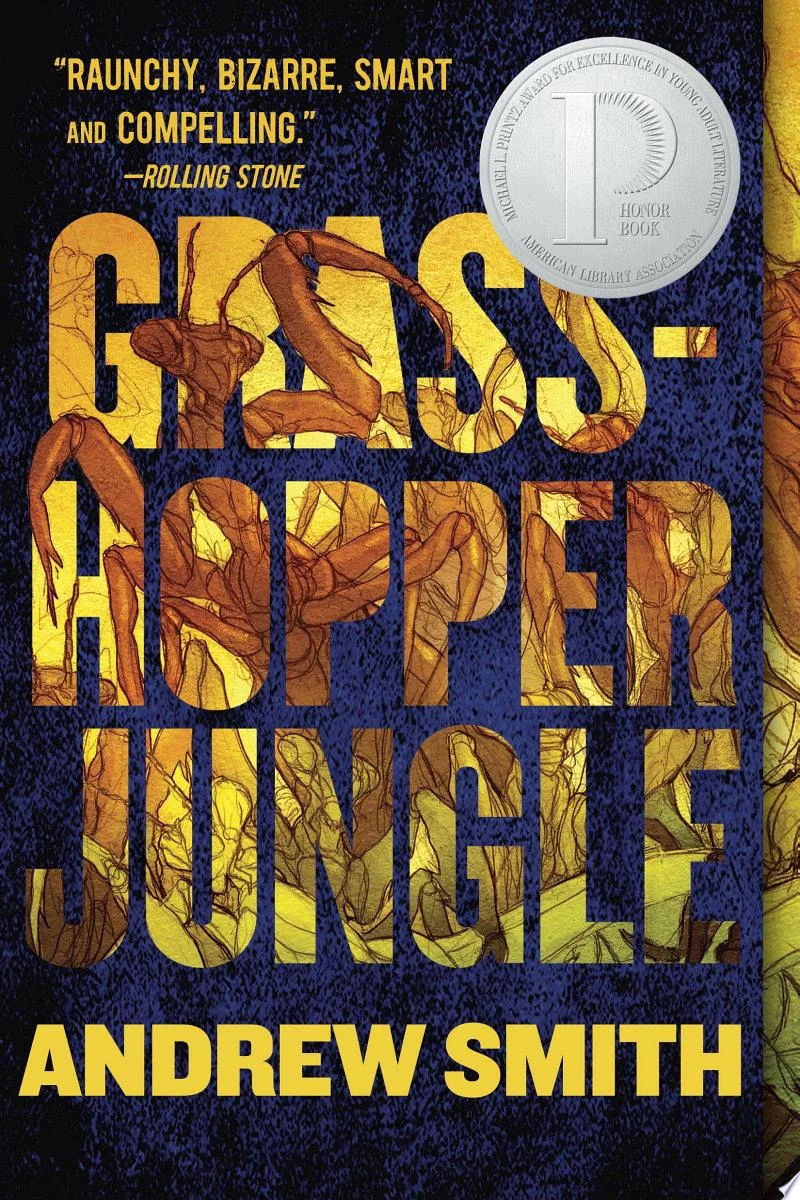
Grasshopper Jungle
by Andrew Smith
- Publication Date:
- February 11th, 2014
- Publisher:
- Penguin
- ISBN-13:
- 9781101590065
- ISBN-10:
- 1101590068
- Pages:
- 418
Why Grasshopper Jungle Has Been Challenged
Critics of the novel have zeroed in on its unguarded depiction of a teenage narrator's sexual confusion and desire, arguing that the material is too explicit and too frank about questions of orientation for a school library setting. See more ↓
Challenged or banned in 6 states across 13 school districts.
Overview
Andrew Smith's novel follows Austin Szerba, a teenager in the fading farm town of Ealing, Iowa, who narrates the end of the world with the same meticulous, digressive attention he gives to his own confused adolescence. When a decades-old genetic experiment is accidentally released, it transforms ordinary people into six-foot praying mantises driven purely by appetite and reproduction, and Austin and his best friend Robby find themselves at the center of the chaos they unleashed.
The book moves between the unfolding insect apocalypse and Austin's own preoccupations: his friendship with Robby, his relationship with his girlfriend Shann, and his growing uncertainty about his own desires. Smith structures the narrative as a kind of obsessive historical record, with Austin repeatedly insisting on his role as a truthful chronicler even as the story veers into the absurd.
Beneath its pulpy premise, the novel operates as a coming-of-age story about a teenager trying to make sense of himself and his hometown's slow decline, using science-fiction disaster as a lens for more ordinary adolescent anxieties.
A Satirical Lens on Small-Town America
Grasshopper Jungle belongs to a tradition of absurdist, apocalyptic satire that treats catastrophe as a magnifying glass for existing social conditions rather than an external threat. The genetically altered corn and failed military experiments that spawn the insect plague read as pointed commentary on industrial agriculture, corporate shortcuts, and the economic hollowing-out of rural communities like Ealing, which Austin describes with both affection and clear-eyed frustration.
The novel has drawn comparisons to Kurt Vonnegut for its blend of deadpan humor, fatalism, and formal eccentricity, particularly Austin's insistence on cataloguing every detail as though compiling an official historical document. That narrative device lets Smith hold slapstick horror and genuine introspection in the same sentence, using the absurdity of the plot to make Austin's quieter struggles with identity, loyalty, and first love feel more exposed rather than less. Critics have noted the book's willingness to let a teenage narrator be contradictory, horny, scared, and sincere all at once, which distinguishes it from more conventional young adult disaster fiction.
Why Grasshopper Jungle Has Been Challenged
Parents raising objections to the novel have typically pointed to a single passage or scene out of context and argued that its explicit sexual content has no place on a library shelf accessible to middle or high schoolers, regardless of the book's literary ambitions. Complaints filed with school boards and library committees have centered on Austin's candid narration of his own sexual thoughts and experiences, including his attraction to both his girlfriend and his best friend, which some reviewers have characterized as inappropriate for a teenage audience.
Beyond the sexual content itself, objections have frequently cited the book's frank language and its matter-of-fact treatment of a teenage boy's uncertainty about his sexual orientation, with some challengers arguing the material promotes behavior rather than simply depicting it. Supporters of the book have countered that its honesty about adolescent sexuality and identity is precisely what makes it valuable to teenage readers navigating similar questions, and that removing it denies students a rare portrayal of bisexuality presented without moralizing. The novel has been formally challenged or restricted in 6 states and 13 school districts tracked in this catalog, with most disputes turning on its suitability for school libraries rather than claims about its literary merit.
Where to Buy




Affiliate links may generate a small commission at no extra cost to you, which helps support this site.
Also by Andrew Smith
Banned in Schools
Banned or challenged in 6 states across 13 school districts.
Florida 7 districts
- Citrus County School District Banned
- Collier County Public Schools Banned
- Escambia County Public Schools Banned pending investigation
- Hillsborough County Public Schools Banned Pending Investigation
- Seminole County Public Schools Banned
- Union County School District Banned
- Volusia County Schools Banned Pending Investigation
Georgia 1 district
- Marietta City Schools Banned
Iowa 1 district
- Council Bluffs Community School District Banned pending investigation
Nation 1 district
Tennessee 1 district
- Wilson County Schools Banned
Texas 2 districts
- Katy Independent School District Banned by Restriction
- Klein Independent School District Banned