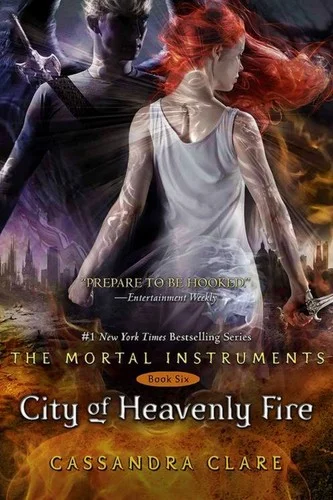
Cover of City of Heavenly Fire

City of Heavenly Fire

by Cassandra Clare

2014 Margaret K. McElderry Books 725 pages English
Publication Date:
January 1st, 2014
Publisher:
Margaret K. McElderry Books
ISBN-13:
9781442416895
ISBN-10:
1442416890
Pages:
725

Why City of Heavenly Fire Has Been Challenged

Critics of the book have pointed to its frank handling of teenage sexuality, a long-simmering incest-adjacent plot thread, and graphic wartime violence as reasons it doesn't belong in younger readers' hands. See more ↓

Challenged or banned in 4 states across 9 school districts.

<h2>Overview</h2> <p>City of Heavenly Fire brings Cassandra Clare's Mortal Instruments series to its conclusion, gathering Clary Fairchild, Jace Lightwood, Simon Lewis, and the rest of their circle for a final confrontation with Sebastian Morgenstern. Clary's brother has turned the ritual of Shadowhunter power against the Nephilim themselves, leaving the institutions meant to protect the world crippled and exposed.</p> <p>With conventional strategy exhausted, the characters choose the one option left to them: crossing into the demon dimensions that spawned Sebastian's strength in the first place. The novel follows that descent, pushing its ensemble cast through alliances, losses, and reversals as the series ties off years of accumulated plotlines.</p> <p>As a closing volume, the book carries the weight of resolving long-running romantic and familial entanglements alongside its central battle, giving the Shadowhunter mythology a definitive, if costly, endpoint.</p> <h2>A Finale Built on Accumulated Stakes</h2> <p>By the time City of Heavenly Fire arrived, Clare had spent five prior books establishing a sprawling urban fantasy built on angels, demons, and a hidden society bound by blood and obligation. The finale's job is less to introduce new ideas than to settle accounts: it resolves the family entanglement at the series' core, in which Clary and Jace discover their relationship is shadowed by the possibility of shared blood, and it closes out Sebastian's arc as a villain whose menace was always personal rather than abstract.</p> <p>The book also reflects the particular demands of young adult fantasy publishing in the early 2010s, when long-running series were expected to deliver spectacle and emotional payoff in equal measure. Clare uses the demon-realm setting to literalize the series' recurring interest in corrupted inheritance — what children owe to, or escape from, the sins of their parents and siblings. The Mortal Instruments books, and this one in particular, have remained commercially durable well past their original publication, feeding an expanded franchise of spin-off series, a film, and a television adaptation, which has kept the original novels in continuous circulation among younger readers and on school and library shelves.</p> <h2>Why City of Heavenly Fire Has Been Challenged</h2> <p>Readers and critics have generally credited the series for its brisk plotting and for giving teenage characters emotionally complicated relationships to navigate, but that same willingness to treat teenagers as sexually and romantically active adults is precisely what has drawn scrutiny from some parents and school boards. Objections to City of Heavenly Fire, tracked here across 4 states and 9 districts, center less on any single shocking scene than on a cumulative discomfort with the series' content as a whole reaching this late, more intense installment.</p> <p>Complaints have focused on sexual content involving teenage characters, including scenes addressing physical intimacy and the earlier plot thread suggesting a sibling relationship between two romantic leads, which some reviewers found uncomfortable regardless of its eventual resolution. The book's violence, a byproduct of its war-and-demon-realm storyline, has drawn similar concern, as has its casual treatment of occult and supernatural elements by characters who use magic and demonic forces as ordinary tools of survival. Taken together, these objections reflect a broader debate over whether fantasy violence and supernatural content aimed at teen readers cross into material better suited to older audiences, rather than any claim about a single isolated passage.</p>

Where to Buy

Affiliate links may generate a small commission at no extra cost to you, which helps support this site.

About Cassandra Clare

Cassandra Clare is the pen name of Judith Rumelt, an American author of young adult fantasy best known for The Mortal Instruments series and its interconnected spinoffs set in the Shadowhunter universe. Her books have sold more than 50 million copies worldwide and have been adapted for film and television.

More about Cassandra Clare →

Also by Cassandra Clare

Banned in Schools

Banned or challenged in 4 states across 9 school districts.