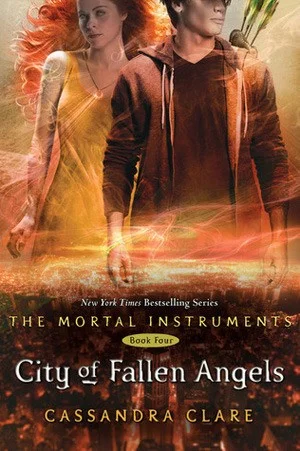
City of Fallen Angels
- Publication Date:
- January 1st, 2013
- Publisher:
- McElderry Books, Margaret K.
- ISBN-13:
- 9781442493094
- ISBN-10:
- 1442493097
Why City of Fallen Angels Has Been Challenged
Critics of this installment have pushed back largely on its frank treatment of teenage intimacy alongside the series' continuing violence, arguing the pairing is unsuited to a young-adult audience. See more ↓
Challenged or banned in 2 states across 3 school districts.
Overview
The fourth entry in Cassandra Clare's Mortal Instruments series finds Clary Fray settling into a life she'd barely dared hope for. The war among Shadowhunters and Downworlders has ended, her mother's wedding is approaching, and her training in the arts of the Shadowhunters is finally underway. Most of all, her relationship with Jace has moved from longing to reality.
That fragile calm doesn't last. A series of killings targeting Shadowhunters threatens to unravel the truce between human and supernatural factions, and the people Clary depends on are suddenly unavailable to help her make sense of it. Simon is contending with a mother who has just learned what he's become, leaving him without a home. Jace, meanwhile, grows distant and guarded in ways he won't explain.
Left to investigate largely on her own, Clary traces the killings back to a discovery that implicates her directly: choices she made earlier in the series have set the present crisis into motion, putting at risk the very relationships and stability she worked to secure.
Shifting Ground in a Series Built on Consequence
Where the earlier Mortal Instruments novels were driven by the urgency of open war, this installment turns toward its aftermath—the harder work of living with what war leaves behind. Clare uses the lull in hostilities to examine how trust frays under pressure, how secrets (even protective ones) corrode intimacy, and how the past refuses to stay settled even after a conflict is officially over.
The novel also deepens its interest in found family and chosen bonds that exist outside conventional domestic structures. Simon's situation with his mother foregrounds a recurring tension in Clare's work: the gap between a parent's expectations and a child's altered, often supernatural, reality. That rupture mirrors Clary's own arc, as she confronts the possibility that her own past decisions—not an external villain alone—have endangered the people she loves. The book's place within the broader series is transitional, reopening questions the earlier volumes seemed to have resolved and setting the stage for the conflicts that follow.
Why City of Fallen Angels Has Been Challenged
Romantic and sexual content involving teenage characters sits at the center of most objections to this book. Clary and Jace's relationship, now physically intimate, has drawn concern from parents and reviewers who consider the material too mature for the young-adult readers the series is marketed toward. Some critics have also pointed to the series' violence—its depiction of ritualized killings and supernatural combat—as inappropriate for the age group, arguing that the combination of sexual content and bloodshed warrants restricted access or removal from school shelves. This volume has been challenged or restricted in 2 states and 3 districts within the collections tracked by this catalog, generally as part of broader efforts to limit the Mortal Instruments series in school libraries.
Where to Buy




Affiliate links may generate a small commission at no extra cost to you, which helps support this site.
About Cassandra Clare
Cassandra Clare is the pen name of Judith Rumelt, an American author of young adult fantasy best known for The Mortal Instruments series and its interconnected spinoffs set in the Shadowhunter universe. Her books have sold more than 50 million copies worldwide and have been adapted for film and television.
Also by Cassandra Clare
Banned in Schools
Banned or challenged in 2 states across 3 school districts.
Florida 2 districts
- Clay County School District Banned by Restriction
- Escambia County Public Schools Banned pending investigation
Iowa 1 district
- Nevada Community School District Banned pending investigation