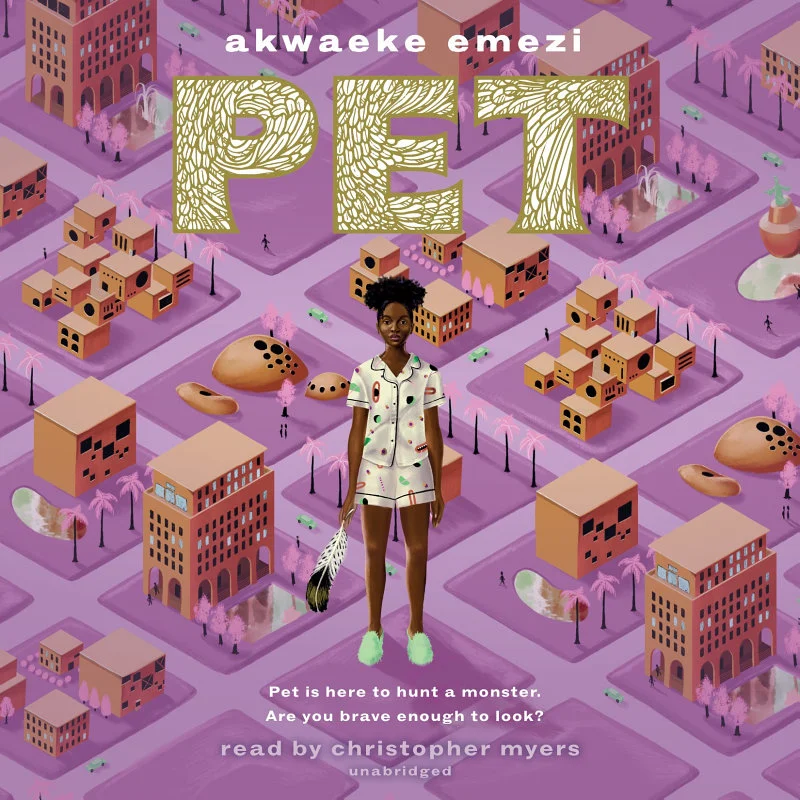
Pet
- Publication Date:
- September 10th, 2019
- Publisher:
- National Geographic Books
- ISBN-13:
- 9780593153994
- ISBN-10:
- 0593153995
Why Pet Has Been Challenged
Objections to Pet generally center on its depiction of family and identity: the presence of transgender and nonbinary characters, a same-gender parental relationship, and discussion of gender-affirming language have all been cited by challengers who argue the content is inappropriate for the book's intended age group. See more ↓
Challenged or banned in 6 states across 15 school districts.
Overview
Akwaeke Emezi's Pet is set in Lucille, a city its residents believe has purged itself of monstrous violence. Jam, a quiet teenager who communicates largely through sign language, has absorbed that belief along with everyone else her age, including her closest friend, Redemption.
The certainty cracks when a strange being steps out of one of Jam's mother's canvases, summoned in part by Jam's own blood. Calling itself Pet, the creature is unsettling to look at and even harder to explain, but it insists that its purpose is to hunt something dangerous that the adults of Lucille refuse to acknowledge.
What follows pushes Jam to weigh inherited comfort against uncomfortable truth, forcing her to ask what "monster" really means and who benefits when a community decides the word no longer applies to them.
Themes and Context
Emezi builds the novel around a pointed question: what happens to danger when a society declares itself finished with it? Lucille's origin as a place reshaped by a prior generation's activism gives the story a distinct texture, imagining a near-utopia and then testing whether utopian self-image can coexist with denial. The book has been discussed for its unusually direct handling of trust, disbelief, and the failure of adults to protect children when doing so would mean admitting their own blind spots.
The novel is also notable for centering a Black, transgender protagonist and a same-gender couple as part of Jam's family life without treating either as the story's central conflict; they are simply features of Jam's world. Critics and educators have pointed to this matter-of-fact representation, alongside the book's speculative premise, as part of what distinguishes it within young adult fiction, and it has drawn attention as an entry point for younger readers into Emezi's broader body of work, which frequently explores identity, embodiment, and the porous line between the ordinary and the uncanny.
Why Pet Has Been Challenged
Objections to Pet generally center on its depiction of family and identity: the presence of transgender and nonbinary characters, a same-gender parental relationship, and discussion of gender-affirming language have all been cited by challengers who argue the content is inappropriate for the book's intended age group. Some objections also point to the novel's handling of abuse within a trusted household as too mature or distressing for younger readers, even though the book approaches the subject obliquely rather than graphically.
Other challenges frame the book's themes more broadly as promoting a particular viewpoint on gender and sexuality, reflecting a wider pattern of scrutiny directed at young adult titles featuring LGBTQ+ characters. In this catalog, Pet has been the subject of 6 state-level and 15 district-level challenge records, consistent with its frequent appearance on lists of recently contested titles in school and library settings.
Where to Buy




Affiliate links may generate a small commission at no extra cost to you, which helps support this site.
About Akwaeke Emezi

Akwaeke Emezi is a Nigerian-born novelist, poet, and visual artist whose work spans speculative fiction, memoir, and young adult literature. Born in Umuahia and of Igbo and Tamil descent, they hold graduate degrees from NYU and Syracuse University and won the Commonwealth Short Story Prize in 2017. Their books, including the bestseller The Death of Vivek Oji and the YA novel Pet, are known for centering transgender and nonbinary characters without treating that identity as a source of conflict.
Banned in Schools
Banned or challenged in 6 states across 15 school districts.
Florida 4 districts
- Alachua County Public Schools Banned pending investigation
- Citrus County School District Banned by Restriction
- Collier County Public Schools Banned by restriction
- Escambia County Public Schools Banned pending investigation
Iowa 6 districts
- Interstate 35 Community School District Banned by restriction
- Lake Mills Community School District Banned
- Norwalk Community School District Banned pending investigation
- Spirit Lake Community School District Banned
- West Burlington Independent School District Banned
- Woodward-Granger Community School District Banned
Kentucky 1 district
- Boyle County Schools Banned
Nation 1 district
Texas 2 districts
- Katy Independent School District Banned by Restriction
- Lamar Consolidated Independent School District Banned
Wisconsin 1 district
- Elkhorn Area School District Banned by restriction