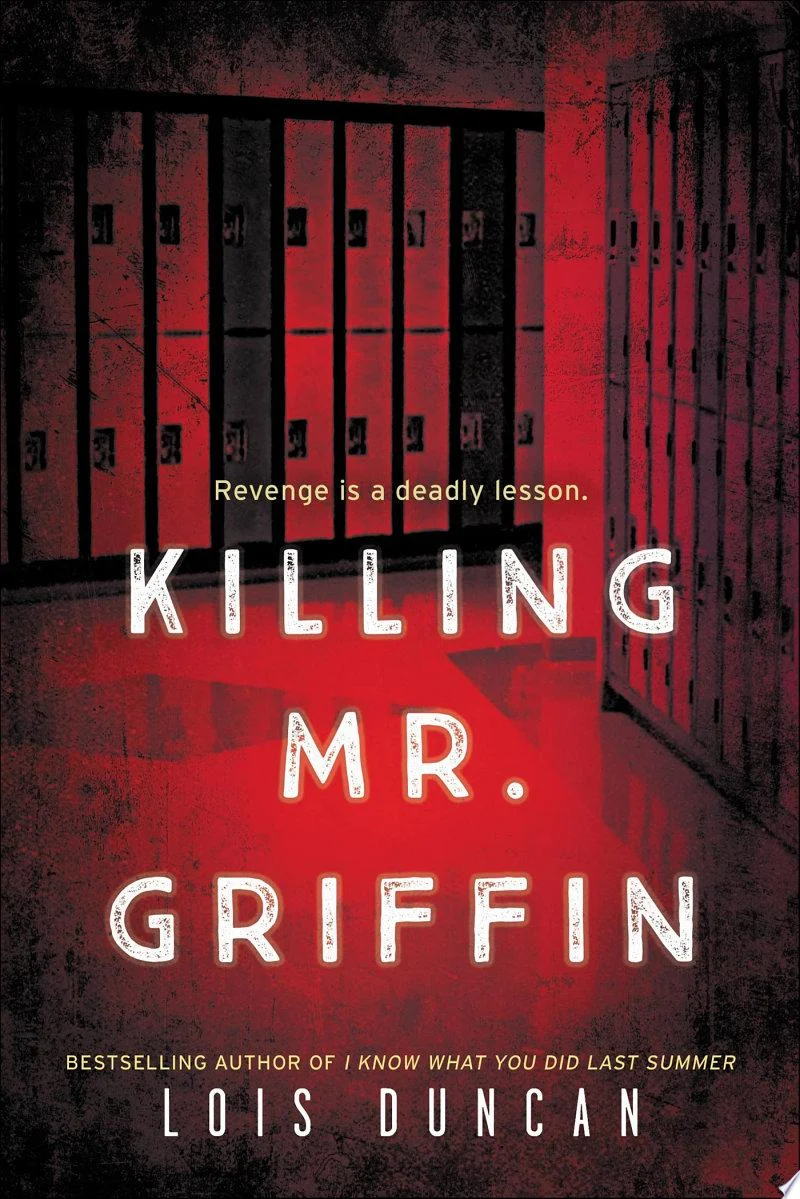
Killing Mr. Griffin
by Lois Duncan
- Publication Date:
- October 5th, 2010
- Publisher:
- Hachette+ORM
- ISBN-13:
- 9780316182645
- ISBN-10:
- 0316182648
- Pages:
- 215
Why Killing Mr. Griffin Has Been Challenged
Some parents and administrators have balked at handing teenagers a story where the adults in charge are dangerous and the students' own moral failures drive the tragedy. See more ↓
Challenged or banned in 3 states across 13 school districts.
Overview
Lois Duncan's Killing Mr. Griffin centers on Susan, a dutiful, high-achieving student at Del Norte High School, and the small circle of classmates who resent their English teacher's rigid, humiliating classroom style. When Susan's crush Dave and the magnetic, manipulative Mark propose a plan to frighten Mr. Griffin into treating students with more respect, Susan reluctantly joins in, telling herself the scheme is nothing more than a prank that will blow over by morning.
The plan is simple on paper: stage a fake kidnapping, hold the teacher just long enough to unsettle him, then let him go. Duncan builds the novel around how quickly that simplicity collapses. A string of small miscalculations turns a supposedly harmless stunt into a crisis none of the teenagers know how to stop, and the group finds itself bound together by a secret with consequences none of them intended.
What follows is less a whodunit than a study of pressure — how fear, loyalty, and self-preservation reshape a group of otherwise ordinary teenagers once a plan goes wrong. Susan's growing unease anchors the story, as she comes to realize that the person orchestrating the cover-up may be far more dangerous than the teacher they set out to punish.
A Story About Power and Its Abuses
Published in the late 1970s, Killing Mr. Griffin belongs to the tradition of YA suspense that Duncan helped define — stories that place recognizable teenagers in escalating, high-stakes trouble rather than supernatural or exotic danger. The novel's tension comes from its plausibility: a school, a strict teacher, a dare that snowballs, and no outside force to blame when things go wrong.
The book is as much about the abuse of authority as it is about the crime that results from resisting it. Mr. Griffin's classroom cruelty sets the plot in motion, but Duncan is careful not to let that cruelty excuse what follows; the novel instead asks readers to sit with the discomfort of a situation where no one involved is simply innocent or simply guilty. That moral ambiguity, paired with Mark's charismatic but coercive hold over the group, has made the book a durable object of classroom discussion about peer pressure, groupthink, and how ordinary people talk themselves into extraordinary acts.
Decades after its original publication, the novel remains one of Duncan's most widely read works, valued by teachers and librarians for the same qualities that unsettle some parents: it refuses easy villains and easy resolutions, asking young readers to reckon with culpability rather than simply root for a hero.
Why Killing Mr. Griffin Has Been Challenged
Much of the pushback against Killing Mr. Griffin centers on whether its subject matter belongs in the hands of the middle- and high-school readers who most often encounter it, and on how it should be shelved or assigned relative to other suspense fiction. Objectors have generally not disputed that the book is well-crafted; their concern is that a story built around a teacher's death, engineered by his own students, sits uneasily in a school setting, particularly when the plot originates in a classroom conflict readers might recognize from their own lives.
The more specific objections tend to fall into a few categories: the violence at the novel's center, including the death itself and the panic that follows it; the portrayal of teenagers deceiving and manipulating adults, and of one student exerting a controlling, almost predatory influence over his peers; and a general worry that the book normalizes retaliation against authority figures by depicting students who plan and carry out harm against a teacher, however unintentional the outcome. Some critics have also pointed to the novel's frank treatment of guilt, fear, and cover-up as too intense for younger adolescent readers.
Records reviewed for this catalog show the book has drawn formal challenges in 3 states and 13 districts, reflecting a persistent but localized pattern of concern rather than a broad consensus against the title. In most cases, the debate has turned less on any single passage than on the book's premise itself — that a lesson meant to humble a teacher can curdle into something none of the students can control.
Where to Buy




Affiliate links may generate a small commission at no extra cost to you, which helps support this site.
Also by Lois Duncan

Banned in Schools
Banned or challenged in 3 states across 13 school districts.
Florida 5 districts
- Charlotte County Public Schools Banned
- Hillsborough County Public Schools Banned Pending Investigation
- Seminole County Public Schools Banned pending investigation
- Union County School District Banned
- Volusia County Schools Banned Pending Investigation
Iowa 7 districts
- Mason City Community Schools Banned pending investigation
- Mediapolis Community School District Banned
- Melcher-Dallas Community School District Banned pending investigation
- Mid-Prairie Community School District Banned
- Northwood Kensett Community School District Banned
- Southeast Warren Community School District Banned
- Spencer Community School District Banned pending investigation
Wisconsin 1 district
- Elkhorn Area School District Banned pending investigation