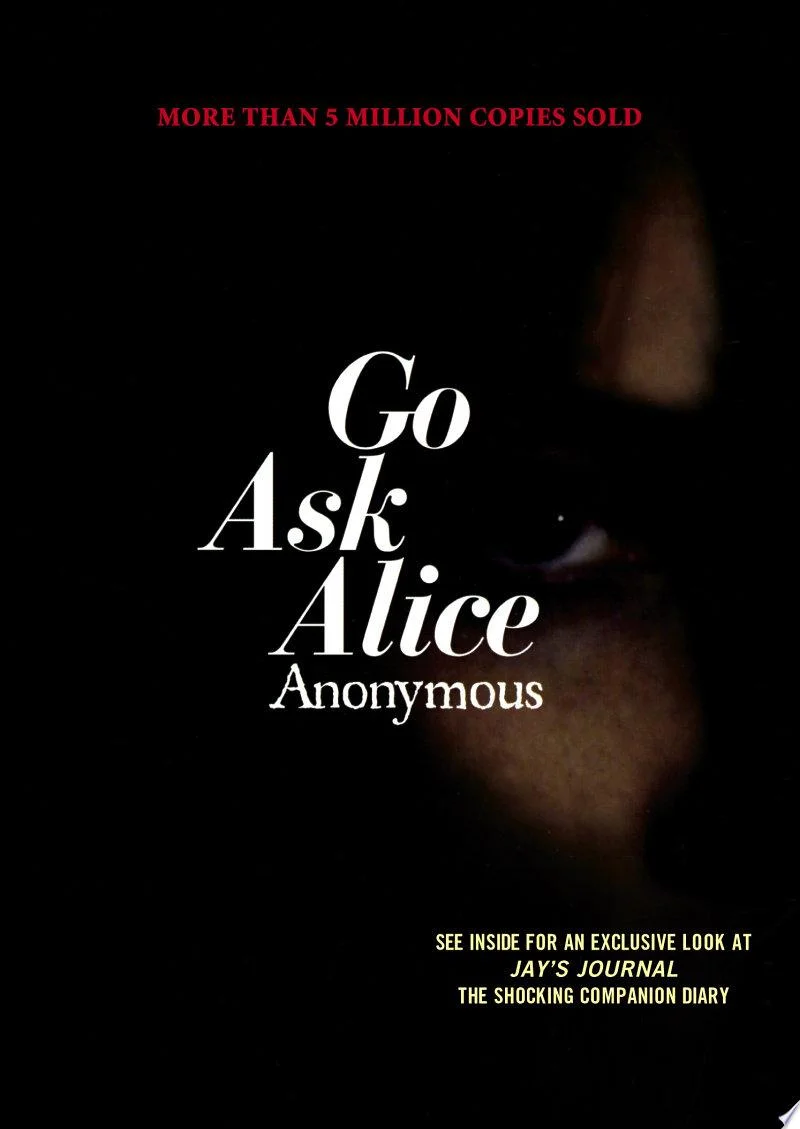
Go Ask Alice
- Publication Date:
- January 1st, 2006
- Publisher:
- Simon and Schuster
- ISBN-13:
- 9781416914631
- ISBN-10:
- 1416914633
- Pages:
- 240
Why Go Ask Alice Has Been Challenged
Objections to the book center overwhelmingly on its frank treatment of drug use, which some readers and institutions have viewed as providing a detailed roadmap of substance experimentation rather than a pure deterrent. See more ↓
Challenged or banned in 5 states across 21 school districts.
Overview
Go Ask Alice is presented as the found diary of an anonymous teenage girl, tracing her transformation from an ordinary, insecure adolescent into someone consumed by addiction. The entries begin with the everyday preoccupations of high school life before pivoting sharply after she is unknowingly given LSD at a party, an experience that opens the door to a widening cycle of drug use.
What follows is a chronicle of relapse and fragile recovery, as the diarist cycles through periods of sobriety, running away from home, and returning to the drugs that both comfort and destroy her. The entries grow more erratic and despairing as her circumstances deteriorate, ending abruptly weeks before her death, with a brief editorial note closing the account.
Structured as a first-person confessional rather than a conventional narrative, the book relies on the diary format to create a sense of unmediated intimacy, drawing readers into the diarist's private thinking as her judgment and self-control erode.
Context and Reception
Published in 1971 and credited to Beatrice Sparks, Go Ask Alice arrived amid a wave of public anxiety about teenage drug culture and was marketed as the authentic diary of a real girl. That claim of authenticity shaped its reception for decades, lending the book a documentary weight that later scrutiny complicated considerably, as researchers and journalists raised significant doubts about how much of the text was actually written by an actual teenager versus assembled or invented by Sparks herself.
Regardless of its contested origins, the book became a fixture of adolescent reading lists and cautionary curricula, often assigned or recommended specifically because of its purported real-world basis. Its lasting influence lies less in its literary technique than in its role as an early, widely circulated attempt to render addiction from the inside, in a voice ostensibly indistinguishable from the reader's own peers.
Why Go Ask Alice Has Been Challenged
Objections to the book center overwhelmingly on its frank treatment of drug use, which some readers and institutions have viewed as providing a detailed roadmap of substance experimentation rather than a pure deterrent. Descriptions of the diarist's escalating drug experiences, along with related depictions of sexual activity, running away, and family breakdown, have been cited as inappropriate for the younger end of its readership.
Some challenges have also focused on the book's despairing tone and its ending, with concerns that its portrayal of addiction and death could be distressing or, in the view of some critics, insufficiently redemptive for an audience of young readers. Others have pointed to the ambiguity surrounding its authorship and factual claims as a separate source of unease, arguing that presenting the text as a genuine diary misrepresents its nature to students. Within the catalog tracked here, these concerns have translated into challenges recorded across 5 states and 21 districts.
Where to Buy


Affiliate links may generate a small commission at no extra cost to you, which helps support this site.
Banned in Schools
Banned or challenged in 5 states across 21 school districts.
Florida 7 districts
- Charlotte County Public Schools Banned
- Duval County Public Schools Banned pending investigation
- Hillsborough County Public Schools Banned Pending Investigation
- Lake County Schools Banned pending investigation
- Okaloosa County School District Banned pending investigation
- Seminole County Public Schools Banned
- Union County School District Banned
Iowa 8 districts
- Clear Lake Community School District Banned
- Indianola Community School District Banned
- Knoxville Community School District Banned
- Lake Mills Community School District Banned
- Ridge View Community School District Banned
- Shenandoah Community School District Banned
- Spirit Lake Community School District Banned
- West Burlington Independent School District Banned
Missouri 1 district
- Cameron R-1 School District Banned by restriction
Tennessee 4 districts
- Knox County Schools Banned
- Monroe County Schools Banned
- Rutherford County Schools Banned
- Wilson County Schools Banned