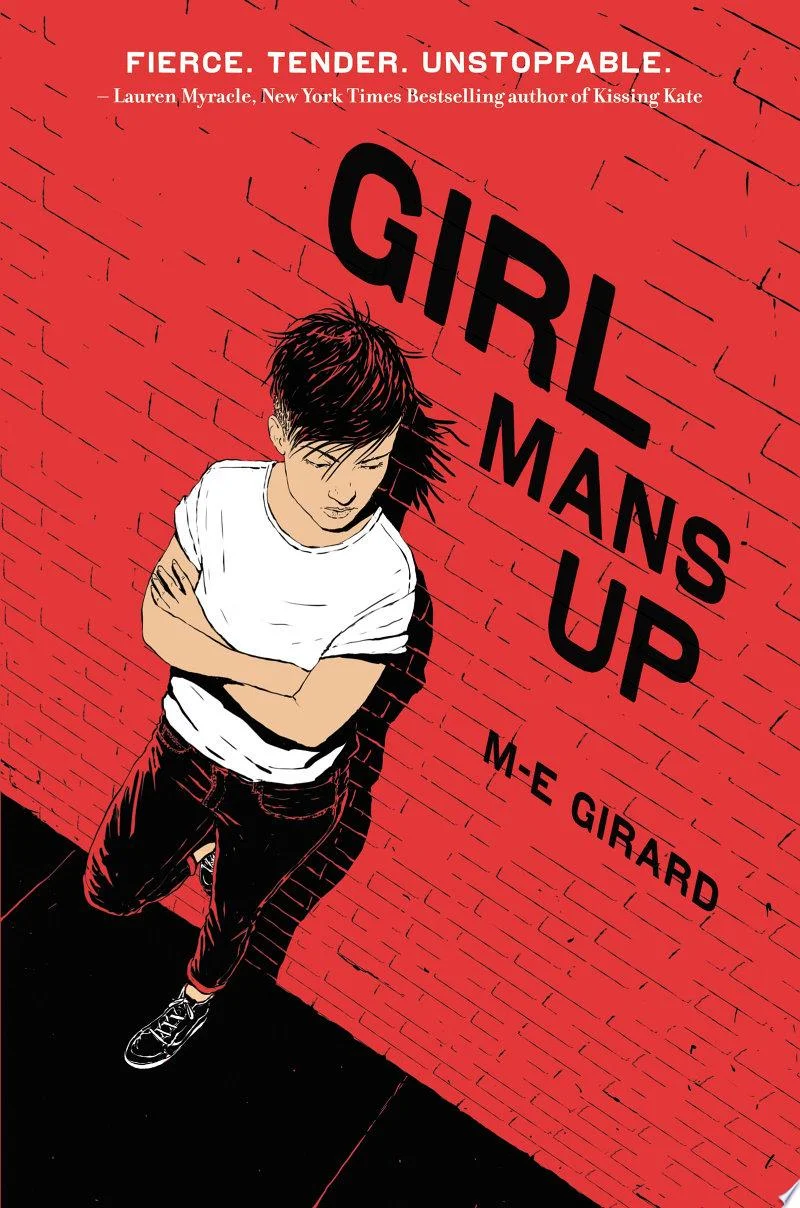
Girl Mans Up
by M-E Girard
- Publication Date:
- September 6th, 2016
- Publisher:
- HarperCollins
- ISBN-13:
- 9780062404190
- ISBN-10:
- 0062404199
- Pages:
- 255
Why Girl Mans Up Has Been Challenged
Critics of this novel have mainly taken issue with handing teenagers a story that treats a girl's masculine self-presentation and same-sex attraction as unremarkable rather than as something to be resolved or explained. See more ↓
Challenged or banned in 4 states across 8 school districts.
Overview
Girl Mans Up centers on Pen, a high schooler caught between the life she's expected to lead and the one that actually fits her. Her clothes, her posture, her ease among the boys she games with — none of it reads as "girl enough" to her traditional Portuguese immigrant parents or to the wider world around her, and she's constantly pressed to adjust herself into something more recognizable.
Much of the novel's tension comes from Pen's friendship with Colby, a boy who treats her more like property than a peer, expecting her unquestioning backup in exchange for his approval. As Pen begins to recognize how one-sided that arrangement has always been, she also starts to acknowledge feelings for other girls that she's been taught to suppress or hide.
The story follows Pen's slow refusal to keep translating herself for other people's comfort. Earning real respect, she comes to see, means setting her own terms rather than inheriting someone else's definitions of what a daughter, a friend, or a girl is supposed to look like.
Identity on Her Own Terms
Girard's novel sits within a wave of mid-2010s YA that pushed past coming-out narratives toward something subtler: stories about gender expression and self-definition that don't hinge on a single dramatic revelation. Pen isn't trying to become someone else; she's trying to stop being asked to perform a version of girlhood that was never hers to begin with. The book drew attention on release for giving that experience to a masculine-presenting female protagonist without converting her into a symbol or a lesson, and critics praised its unforced, conversational voice.
The novel also doubles as a quiet study of loyalty and its limits — how Pen's friendship with Colby, and her relationship with her parents, both trade on the assumption that love requires compliance. Watching her untangle affection from obligation gives the book a throughline beyond identity alone, one rooted in ordinary adolescent friction: family expectation, peer pressure, and the particular exhaustion of being misread by the people closest to you.
Why Girl Mans Up Has Been Challenged
Much of the friction around this title comes down to where it belongs on a shelf — whether a novel built around a teenage girl's gender nonconformity and attraction to other girls is suited to younger readers or school libraries at all. Reviewers who object to the book tend to point to its frank discussion of sexuality and gender identity, arguing that the material is too mature or too ideologically charged for adolescent audiences. Some objections also single out the book's casual depiction of teen drinking, sexual content, and coarse language as inappropriate for a school setting. Underlying many of these complaints is unease with the book's central premise: that a girl can look and act in ways coded as masculine and still simply be a girl, without that needing correction. In this catalog, the title has drawn a recorded 4 state and 8 district challenges.
Where to Buy


Affiliate links may generate a small commission at no extra cost to you, which helps support this site.
Banned in Schools
Banned or challenged in 4 states across 8 school districts.
Florida 5 districts
- Clay County School District Banned
- Escambia County Public Schools Banned pending investigation
- Hillsborough County Public Schools Banned Pending Investigation
- Union County School District Banned
- Volusia County Schools Banned Pending Investigation
Iowa 1 district
Nation 1 district
Texas 1 district
- Katy Independent School District Banned by Restriction