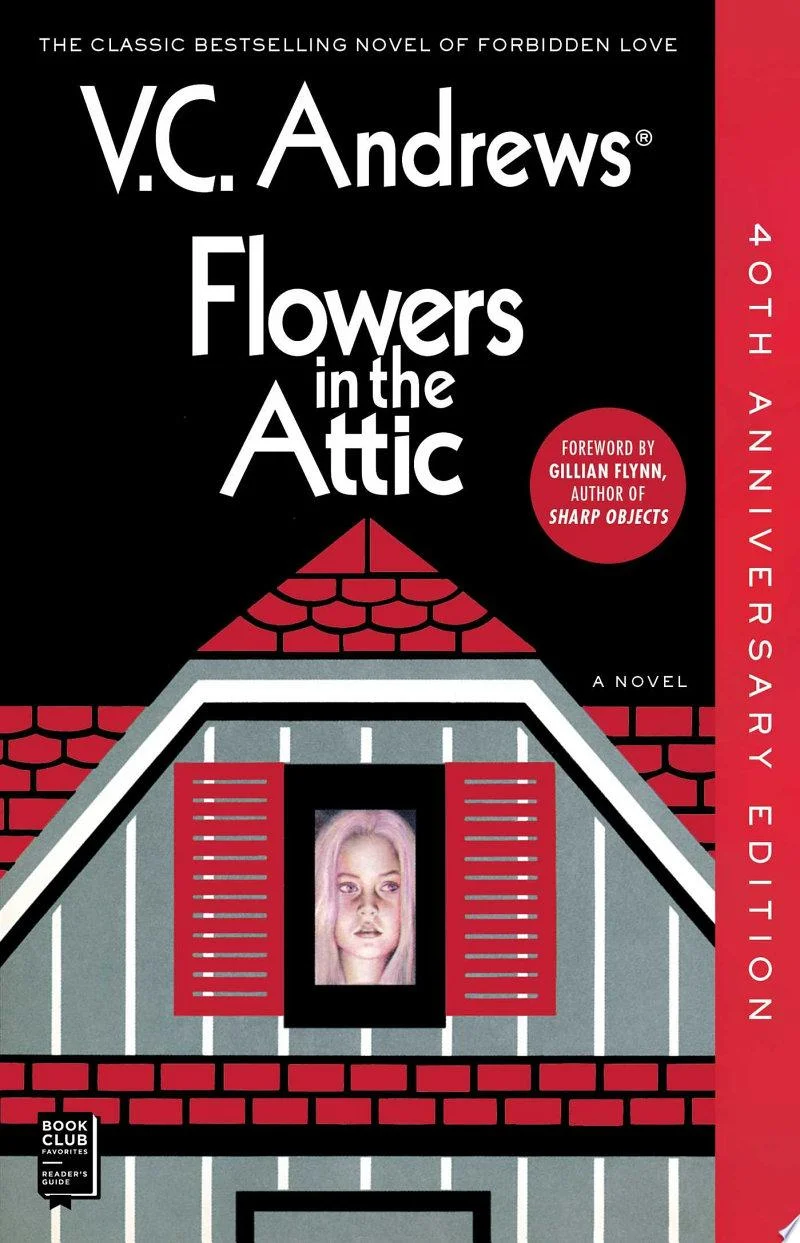
Flowers In The Attic
by V.C. Andrews
- Publication Date:
- February 8th, 2011
- Publisher:
- Simon and Schuster
- ISBN-13:
- 9781451636949
- ISBN-10:
- 1451636946
- Pages:
- 403
Why Flowers In The Attic Has Been Challenged
Critics of this novel have most often pointed to its frank depiction of sexuality between siblings as grounds for keeping it away from younger readers. See more ↓
Challenged or banned in 2 states across 7 school districts.
Overview
V.C. Andrews's 1979 debut novel opens with a family undone by sudden loss. When their father dies, a mother and her four children are left without the means to sustain the life they once had, and she turns to a path back toward her wealthy, estranged parents for help.
That path comes with a condition: the children cannot be seen. They are moved into the attic of their grandmother's sprawling estate, told the arrangement is temporary, and left to construct a private world among themselves while their mother works to reclaim her place in the family fortune below.
As weeks stretch into years, the promised brevity of their exile gives way to prolonged isolation. The novel follows how the siblings adapt, clash, and lean on one another as the adults meant to protect them grow increasingly absent and unreliable.
A Gothic Family Saga
Flowers in the Attic launched what became the Dollanganger series, spanning Petals in the Wind, If There Be Thorns, Seeds of Yesterday, and later additions including Garden of Shadows, Beneath the Attic, and Out of the Attic. Its success established Andrews as a defining voice in gothic melodrama, a genre she helped popularize for a generation of readers drawn to stories of inherited secrets, decaying estates, and families bound by obligation rather than affection.
The book is frequently discussed less for plot mechanics than for the atmosphere it sustains: a sense of confinement that mirrors the children's loss of agency, and a portrait of a household where money and reputation outweigh the welfare of its youngest members. Scholars and longtime readers alike have noted how the novel's reception shifted over the decades from a publishing phenomenon marketed to adult readers into something of a rite-of-passage text passed among teenagers, which has shaped much of the later debate over its intended audience.
Why Flowers in the Attic Has Been Challenged
Much of the dispute over this book centers on where, and for whom, it belongs on a shelf. Though often shelved or recommended alongside young adult fiction, its content has led some parents and educators to argue it is better suited to older or adult readers, if included in a library collection at all.
The substance of those objections tends to fall into a few recurring categories: the portrayal of sexual contact between the siblings as their isolation deepens, scenes of physical abuse and neglect inflicted on the children by the adults responsible for them, and a broader concern that the novel treats trauma and family dysfunction in ways some readers find exploitative rather than illuminating. Others have objected to the book's unflinching treatment of cruelty and manipulation within a family unit, arguing the material is too intense for younger or more vulnerable readers. Within the scope of this catalog, those concerns have translated into challenges recorded in 2 states and 7 districts.
Where to Buy




Affiliate links may generate a small commission at no extra cost to you, which helps support this site.
About V.C. Andrews
V. C. Andrews (1923-1986) was an American novelist best known for the gothic family saga Flowers in the Attic. After her death, ghostwriter Andrew Neiderman continued publishing under her name. This catalog lists six titles with 19 recorded bans across Florida, Georgia, and Tennessee.
Also by V.C. Andrews
Banned in Schools
Banned or challenged in 2 states across 7 school districts.
Florida 6 districts
- Bay District Schools Banned
- Collier County Public Schools Banned
- Escambia County Public Schools Banned pending investigation
- Indian River County Schools Banned
- Lee County Schools Banned by restriction
- Seminole County Public Schools Banned
Georgia 1 district
- Cobb County School District Banned pending investigation