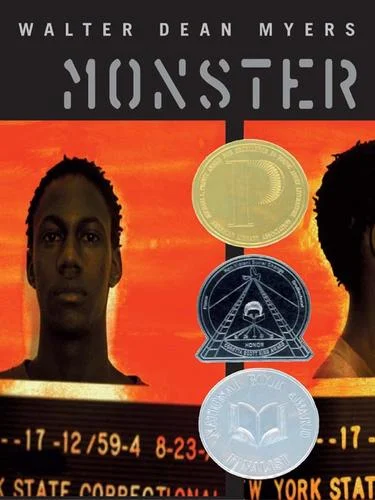
Monster
- Publication Date:
- January 1st, 2008
- Publisher:
- HarperCollins
- ISBN-13:
- 9780061782886
- ISBN-10:
- 0061782882
Why Monster Has Been Challenged
Readers unsettled by the book tend to object less to its structure than to what fills it: a frank account of violent crime and legal jeopardy that refuses to tell young audiences definitively whether its narrator deserves their sympathy. See more ↓
Challenged or banned in 2 states across 3 school districts.
Overview
Steve Harmon is sixteen and sitting in a courtroom, charged as an accomplice to a murder he insists he had no real part in. To survive the waiting, the watching, and the fear of what a jury might decide about him, he starts writing the whole ordeal as a movie: scene headings, camera directions, dialogue cut between the courtroom and his cell.
The screenplay format becomes a way of putting distance between Steve and the version of himself the prosecution describes. Interspersed with his own handwritten journal entries, it lets the reader watch him audition for his own innocence while also turning the camera on the other people in the story — lawyers, witnesses, fellow defendants — each one certain of a different truth.
What emerges is less a courtroom drama with a tidy verdict and more a study of a young person trying to narrate his way back to being seen as human, in a system that has already started filming him as something else.
A Trial Told in Two Forms
Myers structures the novel around a tension between forms: the screenplay, with its clinical stage directions and dispassionate framing, and the diary, raw and unfiltered, breaking in whenever the performance of self-defense becomes too much to sustain. That formal choice does real work. It mirrors how a defendant in the American justice system is asked to become a character in someone else's script, reduced to a role — accomplice, suspect, kid from the neighborhood — before anyone asks who he actually is.
The book arrived at a moment when young-adult fiction was still rarely willing to sit inside a Black teenager's interior life under this kind of pressure, and it helped open space for the wave of YA that followed to treat incarceration, policing, and adolescence as subjects worthy of serious literary form rather than cautionary melodrama. Myers, who spent much of his career writing about young people in Harlem navigating violence, poverty, and institutions not built with them in mind, used this novel to ask what happens to the idea of innocence once a person is formally accused — how quickly doubt about guilt curdles into doubt about worth.
Why Monster Has Been Challenged
The novel is frequently cited in discussions of innovative YA craft and has long been a staple of classroom units on narrative perspective and the justice system, yet that same critical standing has not shielded it from objection — it has drawn 2 state-level and 3 district-level challenges tracked in this catalog. The core of the pushback is content, not form: the story's unflinching look at a murder, a robbery, and the mechanics of a criminal trial, rendered in language some reviewers have found too coarse and too graphic for the age group most likely to encounter the book in school.
Other objections center on how the novel withholds certainty about Steve's guilt, which some adults reading on behalf of younger students have argued leaves impressionable readers without a clear moral anchor. Still others have raised concern about exposing students to a sympathetic, humanized portrait of someone accused of a violent crime, worried that the book asks readers to identify too closely with a character whose innocence is never fully confirmed or denied.
Where to Buy



Affiliate links may generate a small commission at no extra cost to you, which helps support this site.
Also by Walter Dean Myers
Banned in Schools
Banned or challenged in 2 states across 3 school districts.
Florida 2 districts
- Clay County School District Banned pending investigation
- Collier County Public Schools Banned