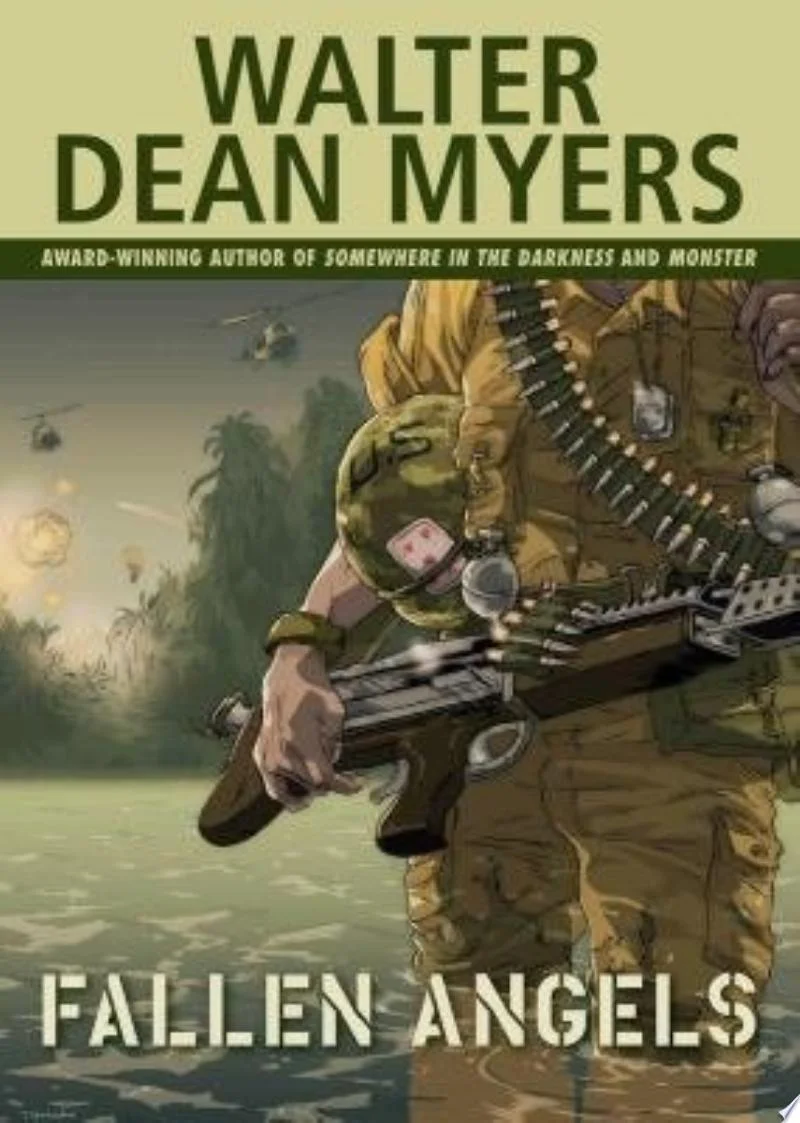
Fallen Angels
- Publication Date:
- January 1st, 1988
- Publisher:
- Scholastic Inc.
- ISBN-13:
- 9780590409438
- ISBN-10:
- 0590409433
- Pages:
- 322
Why Fallen Angels Has Been Challenged
Critics have taken issue less with the book's message about war than with putting its blunt language and combat violence in front of readers still in their early teens. See more ↓
Challenged or banned in 1 state across 1 school district.
Overview
Walter Dean Myers follows Richie Perry, newly graduated from a Harlem high school, as he signs up for the Army in the summer of 1967 with vague ideas about paying for college and escaping a stalled life at home. Within months he is in Vietnam, assigned to a unit where the gap between what he expected and what he encounters widens by the day.
The novel tracks Richie's year of active duty largely through his own uncertain, often frightened perspective. Rather than building toward a single climactic battle, it accumulates the smaller, disorienting experiences of a soldier who is still a teenager: boredom punctuated by terror, camaraderie strained by loss, and a growing awareness that the war offers none of the clarity he was promised.
Myers keeps the focus tight on Richie and the small group of soldiers around him, using their shifting relationships to register how the year changes each of them, Richie included.
A Soldier's Coming of Age
Myers, who served in the Army himself as a young man, wrote the novel in part to give young readers a war story told from inside the experience of an ordinary enlistee rather than from the vantage of strategy or politics. Richie's age and background place him squarely in the demographic most likely to be reading the book, and the narrative treats his youth not as a device but as the central fact shaping everything he sees.
The book sits within a body of young adult literature that emerged in the decades after the Vietnam War, examining the conflict's effect on the soldiers sent to fight it rather than on the historical or diplomatic record. Myers, already known for fiction that took seriously the lives of Black teenagers in urban settings, extends that attention here to a character whose enlistment is shaped as much by economic and social circumstance as by patriotism or ambition. The result reads less as a war adventure than as an extended meditation on how quickly a young person's certainties can dissolve under sustained danger.
Why Fallen Angels Has Been Challenged
Much of the disagreement over this novel centers on where it belongs on a shelf: whether a book aimed at teenage readers should carry the frank language and violent content that Myers uses to render combat and its aftermath. Objectors have pointed to the novel's profanity, much of it drawn from the speech patterns of soldiers under stress, as unsuitable for the middle and high school audiences most likely to encounter it in a classroom or library collection. Its depictions of death and injury in combat have drawn similar objections, with some arguing that the book's realism exceeds what is appropriate for younger readers even when the setting is historical and the violence is not gratuitous.
Other objections have focused on the novel's unsentimental view of the war itself, including its willingness to portray military life and enlistment as morally ambiguous rather than heroic. This tracked count reflects challenges in 1 state and 1 district within the catalog, arising from the tension between the book's realism and expectations about what students should read at a given age.
Where to Buy




Affiliate links may generate a small commission at no extra cost to you, which helps support this site.
Also by Walter Dean Myers
Banned in Schools
Banned or challenged in 1 state across 1 school district.
Florida 1 district
- Escambia County Public Schools Banned pending investigation