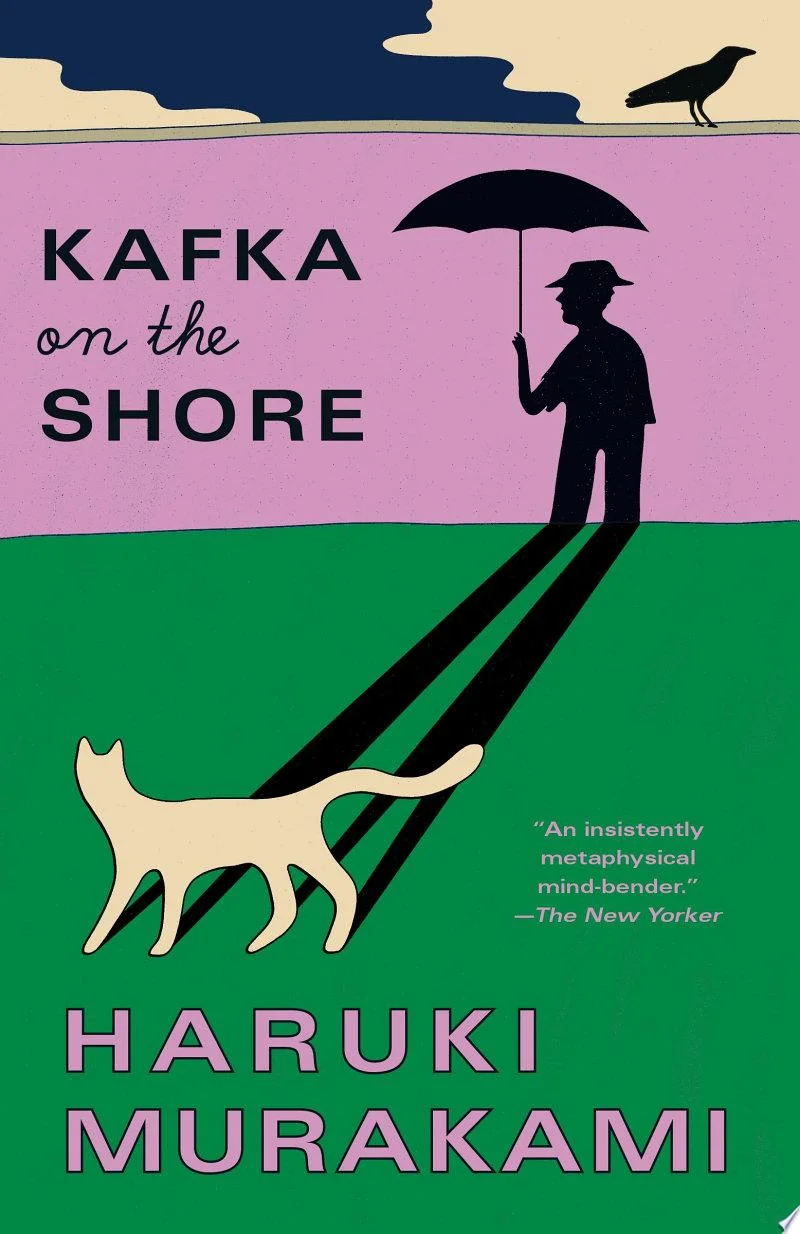
Kafka on the Shore
- Publication Date:
- January 18th, 2005
- Publisher:
- Vintage
- ISBN-13:
- 9781400044818
- ISBN-10:
- 1400044812
- Pages:
- 450
Why Kafka on the Shore Has Been Challenged
Critics who have sought to restrict this novel point mainly to its sexual content and violence, arguing those elements outweigh its literary ambitions for younger readers. See more ↓
Challenged or banned in 1 state across 5 school districts.
Overview
Haruki Murakami's novel follows two figures whose stories unfold in alternating chapters until they begin to bend toward each other. Kafka Tamura, fifteen years old, leaves home to escape a father's prophecy and a past he barely understands, landing in a quiet town where a private library becomes his refuge. Across town, and seemingly across a different order of reality, an elderly man named Nakata, who lost much of his memory and ordinary cognition in a childhood accident but gained the ability to talk with cats, sets out on a journey of his own, pulled by instincts he cannot explain.
Their paths never quite meet in a conventional sense, yet the novel treats this near-convergence as its true engine. Murakami lets the mundane and the uncanny occupy the same sentence without comment: a missing cat leads to a sinister encounter, a remote mountain town holds a passage to somewhere else, and characters slip loose from the rules that would normally govern cause and effect. The tone stays calm even as the events grow strange, which is part of what gives the book its unsettled, dreamlike pull.
Underneath the surface oddities, the novel is concerned with more grounded matters: adolescence, grief, inherited trauma, and the pursuit of connection and meaning. Kafka's search for his estranged mother and sister threads through the fantastical elements, grounding the book's symbolism in recognizable longing.
A Murakami Signature
Kafka on the Shore sits comfortably alongside the author's other major works in its fusion of plainspoken narration and surreal incident. Murakami draws on a wide range of reference points, from classical Japanese storytelling and Shinto ideas about spirits and boundaries to Western music, literature, and philosophy, folding them into a narrative that resists tidy categorization as fantasy, coming-of-age fiction, or literary mystery. The book's structure, with its paired protagonists and delayed convergence, invites readers to hold two registers of reality at once rather than resolve them into a single explanation.
Critics have often noted that the novel rewards readers willing to accept ambiguity; Murakami is less interested in explaining his symbolism than in letting it accumulate atmosphere and emotional weight. The recurring motifs, prophecy, metamorphosis, doubled identity, the permeability between the living and the dead, tie the book to a long tradition of myth and fable even as it remains distinctly contemporary in its loneliness and restlessness. Since its English translation, the novel has become one of Murakami's most widely read and taught works, frequently cited as an entry point into his broader body of fiction.
Why Kafka on the Shore Has Been Challenged
Most objections to the novel point to its suitability for high-school-aged readers, arguing that a teenage protagonist does not make the book appropriate for teenage audiences. Critics raising these concerns have singled out its frank treatment of sexuality, including incestuous undertones tied to the father's prophecy and scenes depicting sexual encounters, as well as moments of graphic violence that some find jarring against the book's otherwise meditative tone. The novel's surreal content, spirits acting independently of bodies, animals communicating with humans, and events that defy realistic explanation, has also drawn concern from those who feel such material is confusing or inappropriate for younger students, even though these elements function as part of the book's literary structure rather than gratuitous embellishment. In total, the book has been the subject of 1 state-level and 5 district-level challenges recorded in this catalog, reflecting a narrower but persistent set of objections centered on content rather than broader calls for removal.
Where to Buy




Affiliate links may generate a small commission at no extra cost to you, which helps support this site.
Also by Haruki Murakami


Banned in Schools
Banned or challenged in 1 state across 5 school districts.
Florida 5 districts
- Escambia County Public Schools Banned pending investigation
- Hillsborough County Public Schools Banned Pending Investigation
- Orange County Public Schools Banned
- Santa Rosa County Schools Banned
- Union County School District Banned