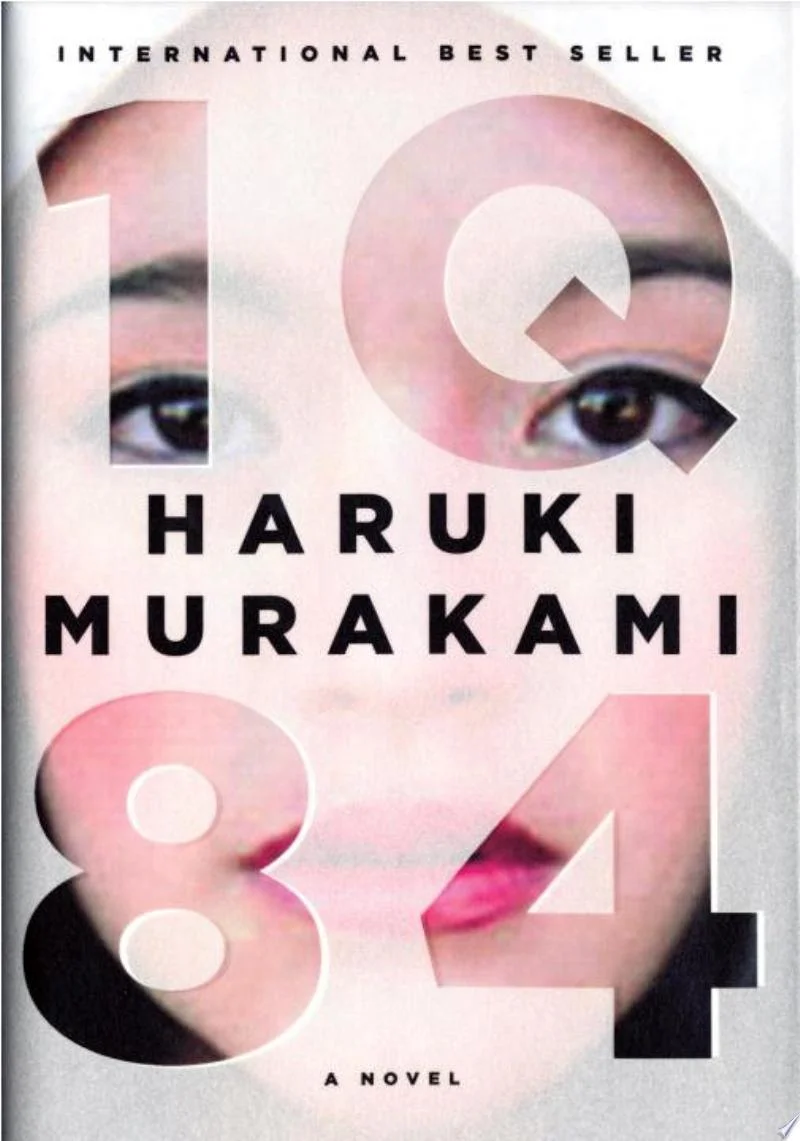
1Q84
- Publication Date:
- October 25th, 2011
- Publisher:
- Bond Street Books
- ISBN-13:
- 9780385669443
- ISBN-10:
- 0385669445
- Pages:
- 1342
Why 1Q84 Has Been Challenged
Critics of the novel's placement have taken issue less with its ideas than with how graphically it renders sexual abuse and coercion within its cult storyline. See more ↓
Challenged or banned in 2 states across 2 school districts.
Overview
Set in a version of 1984 Tokyo that gradually reveals itself as slightly, unsettlingly off from the one readers know, the novel follows two people whose paths run parallel for most of the book. Aomame, stalled in traffic on an elevated expressway, accepts a stranger's odd suggestion for slipping away from the gridlock — a small choice that seems to nudge her into a world subtly rearranged from the one she left. She continues carrying out clandestine assignments even as the ground beneath her perception shifts, and a job connected to a secretive religious leader draws her deeper into danger.
Tengo, meanwhile, lives an unremarkable life while quietly hoping to write fiction of his own. He is pulled into a scheme involving a literary competition and a manuscript that is not entirely what it claims to be, and the consequences ripple outward in ways he can't fully anticipate.
Across alternating chapters, the two storylines edge closer together, driven by coincidence, memory, and a shared sense that reality has become negotiable. The novel builds toward the question of whether two people who have loved each other only in the abstract can actually find one another amid a world that no longer holds still.
A Murakami Novel in Conversation with Orwell
The title itself signals the book's project: a reworking of the numerals in "1984," and with them, an engagement with the surveillance and control that animate Orwell's original. Where Orwell imagined a state that dictates truth through force, this novel is more interested in truth as something that erodes quietly — through cults, private compulsions, and the small negotiations people make with reality in order to keep living in it. The result is less a dystopia than a meditation on how easily the ordinary world can develop a second, parallel version of itself, one governed by different rules that its inhabitants barely notice they've started obeying.
The novel arrived as a major event in Murakami's career, extending the blend of realist detail and quiet surrealism that runs through his earlier work into a much larger canvas. Themes familiar from his other fiction recur here: solitary characters, an ambient sense of dislocation, music and everyday ritual used as anchors against forces that resist explanation. Structurally, the book is patient to the point of demanding real commitment from readers, withholding resolution and clarity in favor of accumulating atmosphere and coincidence, which has made it both a defining achievement and a point of debate among those assessing Murakami's body of work.
Why 1Q84 Has Been Challenged
Aomame's occupation and the sequence of events connected to the religious group at the center of the plot bring the novel into territory that has repeatedly drawn objection: descriptions of sexual violence, coercive control within a cult setting, and sexual content involving characters whose age or circumstances complicate consent. Reviewers of the book for school and library collections have pointed to specific passages depicting abuse and exploitation as too explicit or too disturbing for the shelves where the novel has been placed, particularly in settings serving younger readers. The cult storyline's unflinching treatment of manipulation and violence has been read by some challengers less as social commentary than as material simply too graphic to justify its presence in accessible collections. In the catalog tracked here, 1Q84 has been the subject of formal challenges in 2 states and 2 districts, reflecting a narrower but persistent pattern of concern focused on its content rather than its literary ambitions.
Where to Buy




Affiliate links may generate a small commission at no extra cost to you, which helps support this site.
Also by Haruki Murakami

Banned in Schools
Banned or challenged in 2 states across 2 school districts.
Florida 1 district
- Escambia County Public Schools Banned pending investigation
Texas 1 district
- Fort Bend Independent School District Banned by Restriction