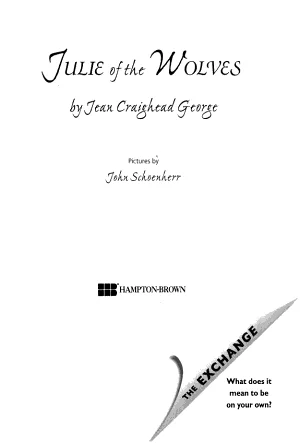
Julie of the Wolves
- Publication Date:
- January 1st, 1985
- ISBN-13:
- 9780736228190
- ISBN-10:
- 0736228195
- Pages:
- 212
Why Julie of the Wolves Has Been Challenged
Critics of this novel have focused less on its wilderness survival story than on a disturbing moment of sexual violence within a child's arranged marriage, which some argue is too graphic for the young readers who commonly study the book. See more ↓
Challenged or banned in 2 states across 4 school districts.
Overview
Jean Craighead George's novel follows a young Iñupiat girl who flees an arranged marriage and sets out across the Alaskan tundra, only to become disoriented and stranded far from any settlement. Facing starvation, she turns to an unlikely source of help: a nearby wolf pack, whose body language and social signals she painstakingly studies and imitates until the animals accept her as one of their own.
What follows is less a conventional survival tale than a close observation of animal behavior and interdependence. The girl learns to read the pack's hierarchy, communicate through posture and sound, and rely on the wolves for food and protection, even as she begins to understand the delicate balance of life in the wilderness.
As rescue and the possibility of return edge closer, she is forced to weigh two identities and two families against each other: the wild, instinctive kinship she has built with the wolves and the human community and heritage waiting for her beyond the tundra.
A Coming-of-Age Story Rooted in the Natural World
George, a naturalist as much as a novelist, uses the wilderness setting to explore questions that extend well beyond survival mechanics. The protagonist's journey is also a meditation on identity at a crossroads between cultures, as she navigates the pull of traditional Iñupiat life, the encroaching influence of the wider world, and her own sense of self once she has lived, however briefly, outside human society altogether.
The novel's attentiveness to wolf ecology reflects a broader current in George's body of work, which frequently places young protagonists in direct, unmediated contact with animals and landscapes. Rather than romanticizing nature, the book presents it as something to be studied, respected, and reckoned with, a stance that has made the novel a frequent fixture in classrooms exploring ecology, Indigenous life, or stories of resilience. Its recognition within children's literature circles after publication helped cement its place as a staple of middle-grade reading lists for decades.
Why Julie of the Wolves Has Been Challenged
A brief scene involving the forced consummation of the protagonist's arranged marriage has been the primary flashpoint for objectors, who argue that the material is too mature or disturbing for the younger readers who typically encounter the book in school settings. Critics raise similar concerns about an incident of sexual violence referenced later in the story, contending that its presence in a novel otherwise aimed at a middle-grade audience is jarring or inappropriate without additional context or guidance.
Some challenges have also centered on the book's unflinching treatment of a marriage arranged for a child, with objectors uneasy about exposing young readers to the practice even within its specific cultural and narrative framing. Taken together, the complaints reflect a broader tension familiar to many challenged works: a story using difficult, real-world circumstances to illuminate its protagonist's resilience runs up against discomfort over whether such content belongs in the hands of the age group most likely to be assigned it. In this catalog, the novel has drawn recorded challenges in 2 states and 4 districts.
Where to Buy




Affiliate links may generate a small commission at no extra cost to you, which helps support this site.
Banned in Schools
Banned or challenged in 2 states across 4 school districts.
Florida 3 districts
- Clay County School District Banned by restriction
- Indian River County Schools Banned
- Lee County Schools Banned by restriction