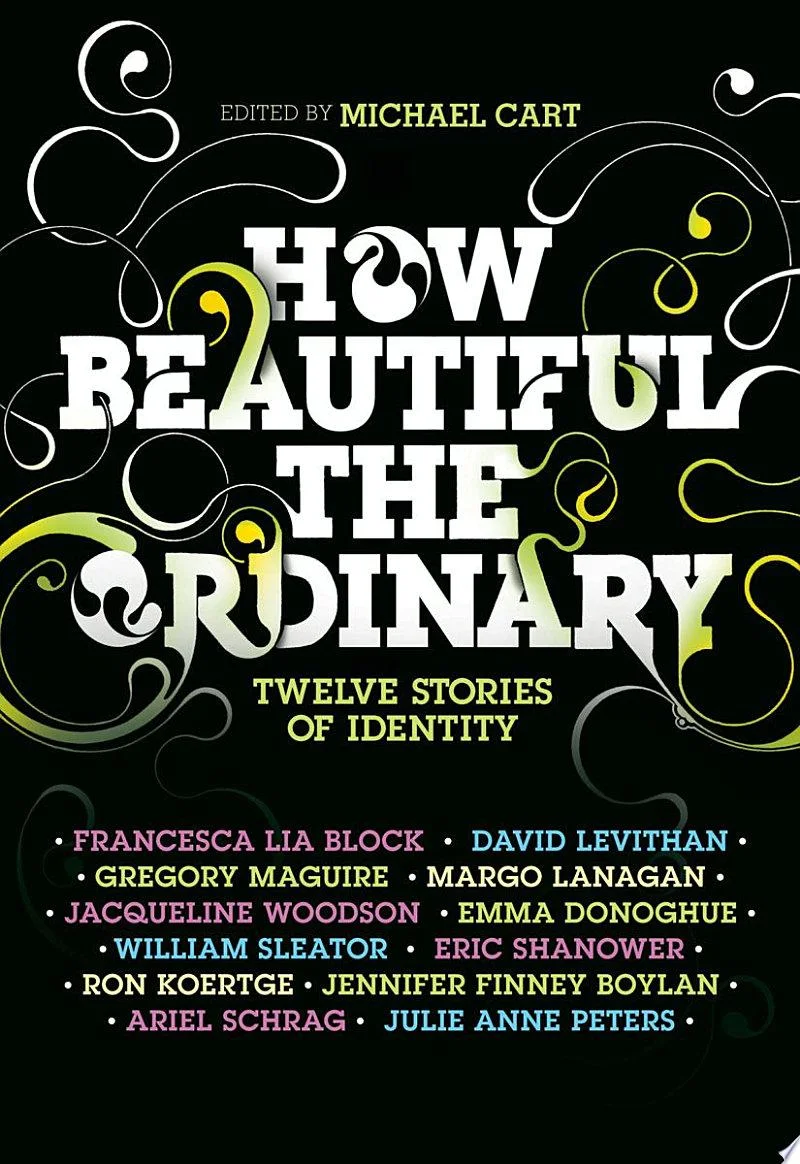
How Beautiful the Ordinary
by Michael Cart
- Publication Date:
- October 6th, 2009
- Publisher:
- Harper Collins
- ISBN-13:
- 9780061949654
- ISBN-10:
- 0061949655
- Pages:
- 374
Why How Beautiful the Ordinary Has Been Challenged
Most objections to this anthology center on its unguarded treatment of teenage sexuality and gender nonconformity rather than any single story's plot. See more ↓
Challenged or banned in 7 states across 10 school districts.
Overview
Edited by Michael Cart, this collection brings together short fiction, unconventional narrative forms, and short comics-style pieces centered on queer and questioning teenagers. The pieces move between registers—wistful, urgent, funny, mournful—but share a focus on the private moment when a young person's sense of self collides with the expectations placed on them.
Several entries turn on small acts of defiance: a girl borrowing a sibling's clothing, a boy declining to wear what he's told to wear. Others follow the aftermath of love and violence, or revisit a formative connection years later with the clarifying distance of adulthood. A closing piece takes the form of a letter from an estranged mother to the daughter she has not seen in over a decade, folding a parent's regret into a book largely told from a teenager's point of view.
Because the collection is assembled from many distinct voices and formats rather than a single continuous story, it reads less like a novel than like a set of overlapping snapshots—each one brief, each one attentive to a different facet of coming of age while queer.
An Anthology Built Around a Spectrum
The book's organizing idea is breadth rather than a single narrative arc. By mixing traditional short stories with more experimental structures and illustrated fragments, the collection resists offering one template for what a queer adolescence looks like. Some contributions dwell on comedy and self-discovery; others sit with grief, estrangement, or violence directed at someone the protagonist loves.
That structural variety is also the book's argument: identity and desire do not resolve into a single tidy narrative, and an anthology format lets contradictory tones—hope beside loss, humor beside fear—sit next to each other without needing to be reconciled. The title's suggestion that queer lives are simply "ordinary" pushes against a publishing landscape where such stories have historically been treated as exceptional or othered, positioning the collection within a broader effort in young adult literature to normalize LGBTQ+ experience as one thread among many in the general coming-of-age shelf, rather than a separate, specialized category.
Why How Beautiful the Ordinary Has Been Challenged
Content involving sexual and romantic relationships between teenage characters, along with the book's sustained attention to gender identity and expression, is at the center of most complaints brought against this title. Because several stories describe physical intimacy or use gender-nonconforming characters as their central focus, critics have argued the collection is inappropriate for the age group it's marketed to, or that it introduces topics some object to seeing addressed in school settings at all.
Other objections point to individual stories involving violence connected to a character's sexuality, framing those passages as too dark or upsetting for young readers even though they appear within a larger anthology addressing a range of tones. Taken together, these concerns reflect a broader discomfort, in some communities, with queer subject matter being presented to teenagers as unremarkable rather than as something requiring caution or special framing—the very premise the collection's title asserts. Within this catalog, the book has been documented as challenged in 7 states and 10 school districts.
Where to Buy


Affiliate links may generate a small commission at no extra cost to you, which helps support this site.
Banned in Schools
Banned or challenged in 7 states across 10 school districts.
Alaska 1 district
- Matanuska-Susitna Borough School District Banned pending investigation
Florida 1 district
- Orange County Public Schools Banned pending investigation
Missouri 1 district
- Cameron R-1 School District Banned by restriction
Nation 1 district
Texas 4 districts
- Lamar Consolidated Independent School District Banned
- Nacogdoches Independent School District Banned by Restriction
- North East Independent School District Banned
- Plano Independent School District Banned
Utah 1 district
- Davis School District Banned
Wyoming 1 district
- Laramie County School District No. 1 Banned by Restriction