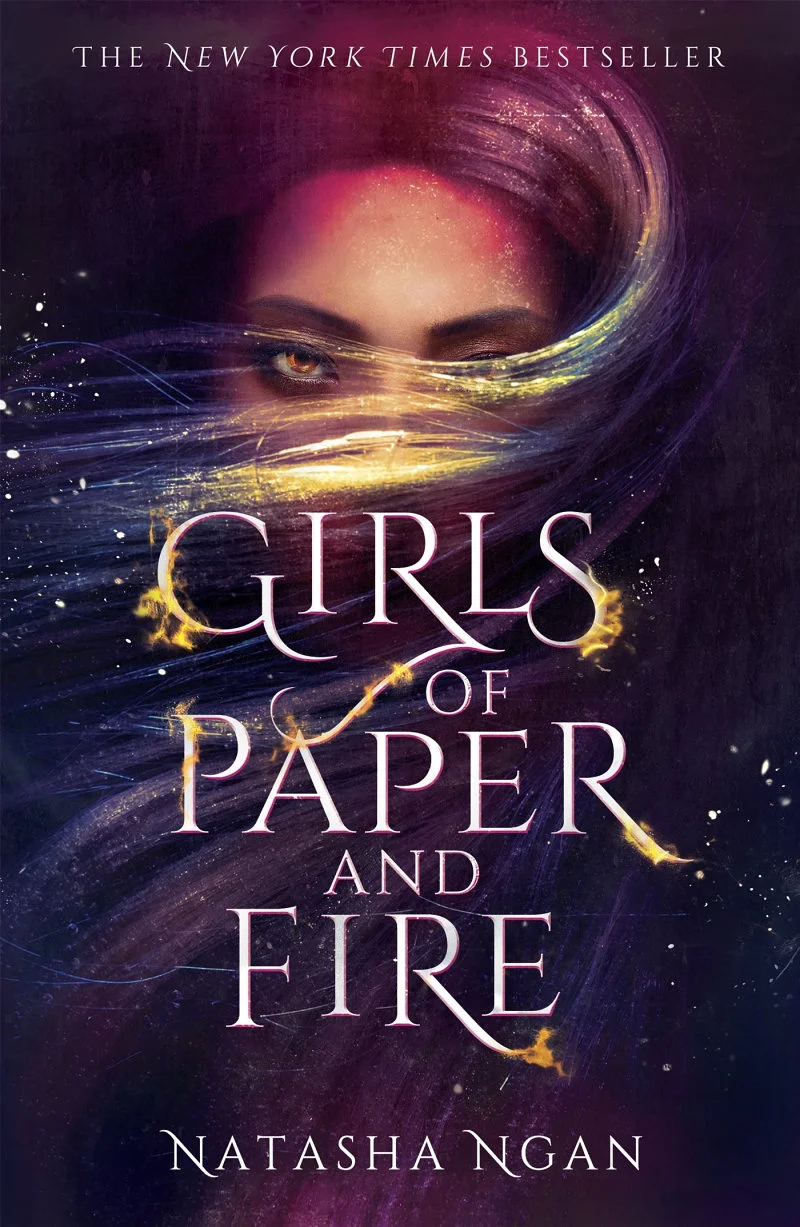
Girls of Paper and Fire
by Natasha Ngan
- Publication Date:
- November 6th, 2018
- Publisher:
- Hachette UK
- ISBN-13:
- 9781473692213
- ISBN-10:
- 1473692210
- Pages:
- 439
Why Girls of Paper and Fire Has Been Challenged
Some parents and administrators have sought to limit this title over its frank depiction of sexual violence and a same-sex relationship between its teenage protagonists. See more ↓
Challenged or banned in 4 states across 7 school districts.
Overview
Natasha Ngan's "Girls of Paper and Fire" opens a fantasy trilogy set in Ikhara, a realm split between ruling demon castes and a subjugated human population. Lei, born into the lowest and most disadvantaged human caste, has spent a decade haunted by her mother's disappearance at the hands of royal soldiers. When those same soldiers return for her, she is conscripted into service as one of the king's eight Paper Girls, an appointment framed as a singular honor but experienced as confinement.
Inside the palace, Lei and her fellow Paper Girls undergo months of grooming meant to prepare them for their roles as the king's companions. The narrative follows Lei's slow transformation from a frightened newcomer into someone willing to question the system that claimed her, a process complicated by an unanticipated romantic connection formed with another girl in her position.
That relationship becomes inseparable from the book's larger plot, as personal feeling and political resistance begin to pull in the same direction. Ngan builds toward a reckoning between Lei's private desires and the public stakes of defying a king whose power rests on controlling both her body and her silence.
Context and Reception
The novel belongs to a wave of young adult fantasy that uses invented worlds to examine real structures of caste, colonization, and gendered control, pairing worldbuilding with an unflinching look at how institutions can commodify young women's bodies. Ikhara's division between demon and human castes functions as a lens for exploring inherited inequality and the mechanisms by which hierarchies sustain themselves through ritual and spectacle.
Ngan has spoken about drawing on her own experience as a queer woman of mixed heritage in shaping Lei's arc, and the book is frequently cited within YA fantasy for centering a sapphic relationship as its emotional core rather than a subplot. Its popularity helped launch two sequels that continue Lei's story, and it is often discussed alongside other fantasy series that blend court intrigue with explicit social critique. Critics and readers have generally praised the pairing of an atmospheric setting with a narrative willing to sit with trauma rather than resolve it quickly.
Why Girls of Paper and Fire Has Been Challenged
Sexual content and depictions of abuse sit at the center of most objections to this book. The Paper Girls' role in the palace is portrayed as coercive, and the narrative includes scenes depicting sexual violence and its psychological aftermath; some readers and parents have argued this material is too explicit or disturbing for the novel's intended teen audience, regardless of its narrative purpose.
A second recurring objection concerns the central romantic relationship between Lei and another female character, which some challengers have framed as inappropriate for younger readers independent of the book's handling of consent and harm. Together, these concerns have made the title a frequent target in broader debates over which depictions of violence, trauma, and queer identity belong in school and library collections for adolescents. Within the catalog tracked here, the book has drawn 4 state-level and 7 district-level challenges.
Where to Buy




Affiliate links may generate a small commission at no extra cost to you, which helps support this site.
Also by Natasha Ngan

Banned in Schools
Banned or challenged in 4 states across 7 school districts.
Florida 4 districts
- Escambia County Public Schools Banned pending investigation
- Hillsborough County Public Schools Banned Pending Investigation
- Union County School District Banned
- Volusia County Schools Banned Pending Investigation
Oregon 1 district
- Helix School District Banned pending investigation
Tennessee 1 district
- Wilson County Schools Banned