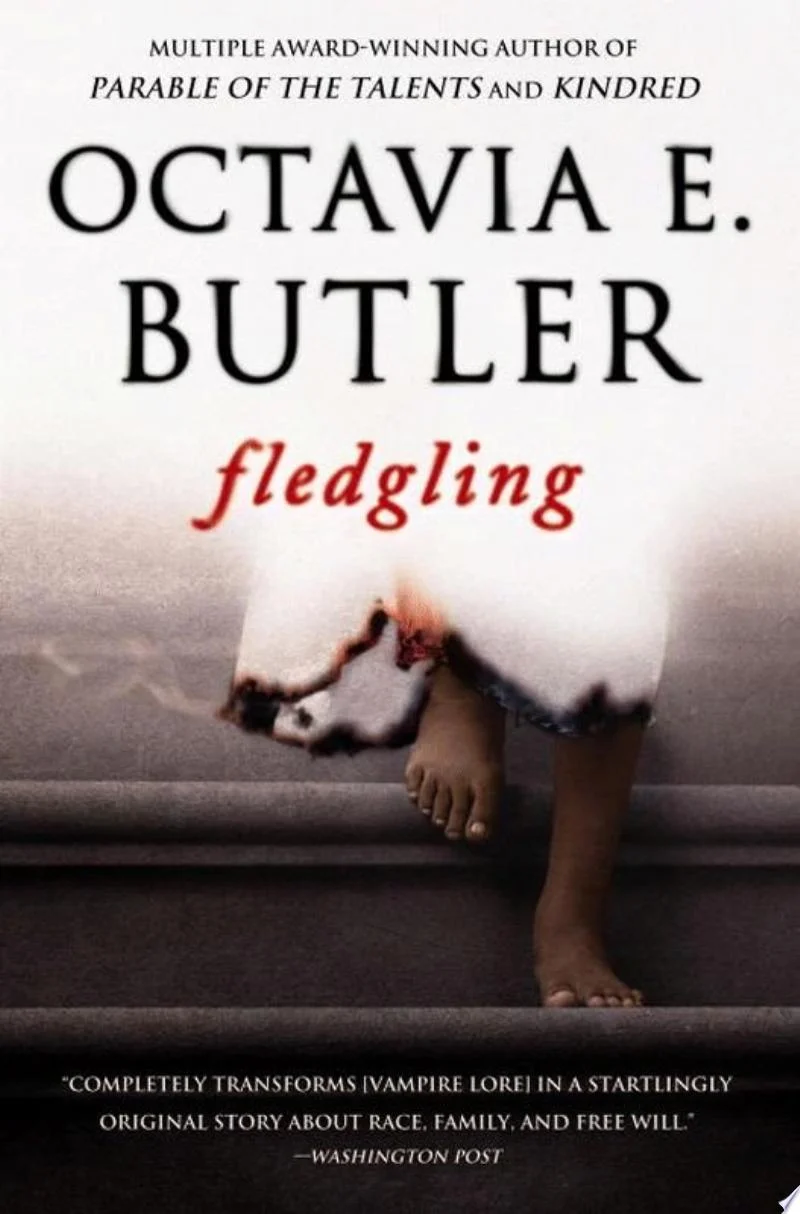
Fledgling
- Publication Date:
- January 1st, 2007
- Publisher:
- Grand Central Publishing
- ISBN-13:
- 9780759516342
- ISBN-10:
- 0759516340
- Pages:
- 235
Why Fledgling Has Been Challenged
Critics have pushed back on the novel's frank depiction of adult intimacy involving a protagonist whose body reads as adolescent, arguing the pairing is disturbing regardless of the character's true age. See more ↓
Challenged or banned in 1 state across 1 school district.
Overview
Octavia E. Butler's Fledgling opens with its narrator waking in pain, alone, and without a single memory of who she is. What she discovers about herself arrives in pieces: an appetite that isn't human, a body that heals too fast, and a growing certainty that the people around her are either protectors or threats. The answer, when it comes, reframes everything — she is Shori, a member of an ancient species that has quietly coexisted with humanity for millennia, and the product of a genetic experiment that has made her both valuable and marked for death.
As Shori rebuilds her sense of self, she also has to reconstruct a life that was violently taken from her, tracking down who destroyed her family and why. The investigation runs alongside a second, quieter story about the bonds she forms with the humans who choose to live alongside her — relationships built on mutual need, obligation, and trust that Butler examines with the same unsentimental curiosity she brought to her other work.
Published in 2005, it was Butler's first new novel in several years and would prove to be her last. It carries her signature concerns — survival, biological difference, and the uneasy architectures of power between unequal partners — into territory closer to horror and dark fantasy than the science fiction she was best known for.
Reimagining an Old Monster
Vampire fiction has long served as a vehicle for anxieties about appetite, contagion, and control, and Butler uses the form deliberately rather than decoratively. Her vampires, the Ina, are not supernatural so much as a distinct, evolved species with their own biology, social structures, and ethical codes governing how they bond with and depend on the humans who sustain them. By grounding the mythology in something closer to genetics and social contract than magic, Butler turns the vampire novel into a vehicle for her longstanding interests: symbiosis, consent within unequal relationships, and what happens when survival requires intimacy with the very thing that could destroy you.
The novel also returns to questions of racial identity that run through Butler's body of work. Shori's dark skin — the result of the genetic engineering that also extended her Ina family's tolerance for sunlight — makes her an outlier even among her own kind, and the hostility that follows her is explicitly tied to that difference. Read alongside Butler's Xenogenesis trilogy and Kindred, Fledgling continues her habit of using speculative premises to interrogate real histories of hierarchy, ownership, and who gets to claim full personhood. Critics and scholars have noted it as a notably direct late-career statement on race, made more unsettling by its genre trappings rather than softened by them.
Why Fledgling Has Been Challenged
Most objections to the novel point toward its suitability for high school readers, arguing that its content is better suited to an adult audience than to teenagers encountering it in a school library or classroom. The central concern is the novel's sexual content, particularly scenes involving Shori, who looks like a child or young teenager because of the genetic alterations that halted her physical development, despite being, chronologically, a fifty-three-year-old adult. Objectors argue that the visual disconnect between her apparent age and her actual age makes these passages inappropriate for young readers regardless of the biological explanation the text provides, and some have described the material as evoking the imagery of child exploitation even though the narrative frames Shori as an adult by every measure that matters within her species' biology.
Beyond the sexual content, some challenges have cited the book's violence and its graphic depictions of blood-feeding as unsuitable for younger students. In the catalog tracked here, Fledgling has been formally challenged in one state and one district, reflecting the broader pattern of objections to adult-themed speculative fiction being shelved or assigned in secondary schools.
Where to Buy




Affiliate links may generate a small commission at no extra cost to you, which helps support this site.
About Octavia E. Butler
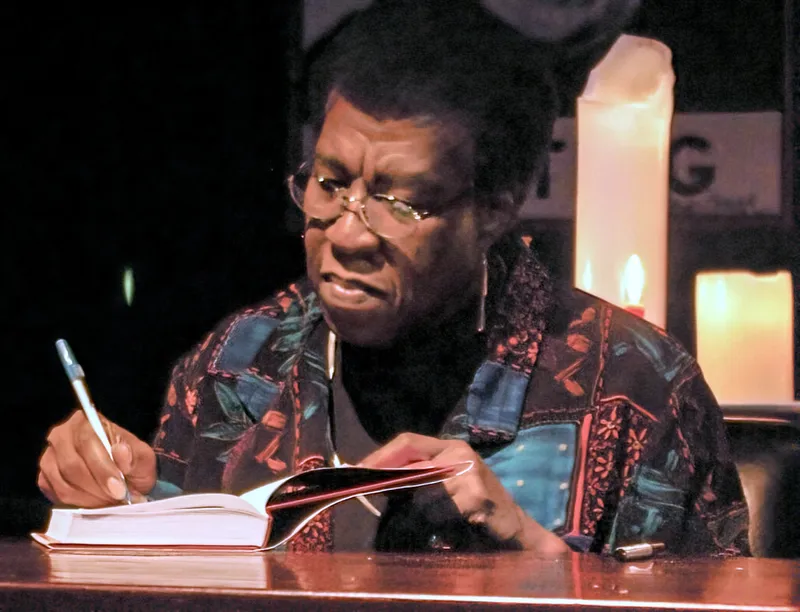
Octavia E. Butler (1947-2006) was an American science fiction writer from Pasadena, California, and the first science fiction author to receive a MacArthur Fellowship. Her works, including Kindred, Parable of the Sower and Bloodchild, explore power, race, survival and what it means to be human. She won multiple Hugo and Nebula Awards during her career.
Also by Octavia E. Butler
Banned in Schools
Banned or challenged in 1 state across 1 school district.
Texas 1 district
- Fort Bend Independent School District Banned by Restriction