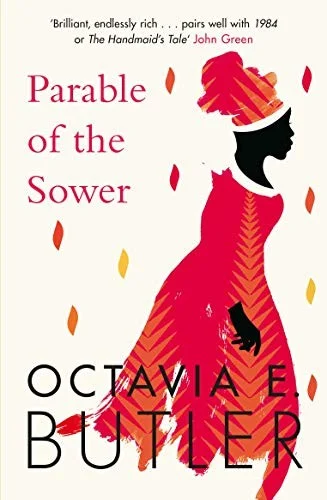
Parable of the Sower
- Publication Date:
- August 20th, 2019
- Publisher:
- Headline
- ISBN-13:
- 9781472263667
- ISBN-10:
- 1472263669
- Pages:
- 320
Why Parable of the Sower Has Been Challenged
Objections to the novel have centered on its unflinching depiction of violence, including scenes of sexual assault, murder, and the disintegration of social order, which some have argued make the book inappropriate for younger readers. See more ↓
Challenged or banned in 1 state across 1 school district.
Overview
Octavia E. Butler's Parable of the Sower opens on a near-future California where public order has all but dissolved under the weight of drought, economic collapse, and spreading violence. Lauren Olamina, a teenager living inside a walled community near Los Angeles, is one of the few residents trying to imagine a future beyond mere survival. Her father, a minister, holds the neighborhood together through faith and discipline, while Lauren quietly develops her own philosophy, one built on the idea that change is the only constant worth organizing a life around.
Lauren also carries hyperempathy, a neurological condition that forces her to feel the pain of others as though it were her own. The trait isolates her even as it sharpens her moral attention, making her acutely aware of suffering that the adults around her have learned to look past.
When the enclave is overrun and burned, Lauren loses her family and is thrust onto the road with a small band of survivors. Their trek north becomes both a search for safety and the proving ground for the belief system Lauren has been assembling, one she comes to call Earthseed, which reframes catastrophe as the raw material of a new beginning.
Themes and Context
Published in 1993, the novel belongs to a lineage of speculative fiction that uses a broken future to interrogate present-day fault lines: resource scarcity, privatization of basic services, racial and economic segregation, and the fragility of civic institutions. Butler grounds these large forces in the intimate scale of one young woman's body and belief, using Lauren's hyperempathy as a literal mechanism for exploring what it means to be responsible for others' pain in a society organized to ignore it.
The book is also notable for treating religious invention as a serious survival strategy rather than a naive one. Earthseed is not presented as false comfort but as a working theology, assembled empirically by a protagonist who rejects both her father's inherited faith and the nihilism of the collapse around her. Critics and readers have long noted how the novel's depiction of climate disaster, gated communities, and social breakdown has grown more, rather than less, resonant with time, and it is frequently read alongside Butler's other work as a meditation on power, adaptation, and the costs of clinging to systems that no longer function.
Why Parable of the Sower Has Been Challenged
Objections to the novel have centered on its unflinching depiction of violence, including scenes of sexual assault, murder, and the disintegration of social order, which some have argued make the book inappropriate for younger readers. The story's frank treatment of drug abuse and its portrayal of institutional collapse have also drawn scrutiny from those who see the material as too bleak or disturbing for a school setting. Additionally, the novel's central invention of the Earthseed belief system, a homegrown theology that supplants organized religion, has prompted some challengers to characterize the book as antagonistic toward traditional faith. In this catalog, the book has been the subject of a challenge or ban in 1 state and 1 school district.
Where to Buy




Affiliate links may generate a small commission at no extra cost to you, which helps support this site.
Also by Octavia E. Butler

Banned in Schools
Banned or challenged in 1 state across 1 school district.