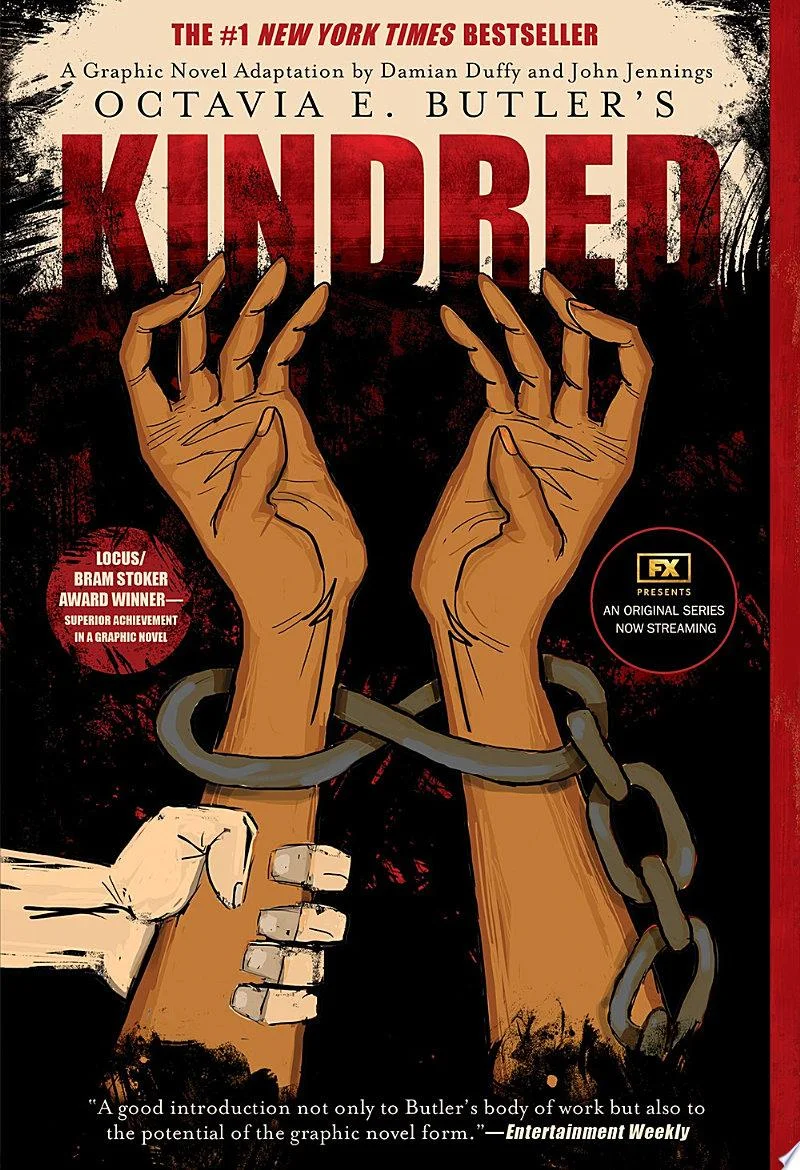
Kindred: A Graphic Novel Adaptation
- Publication Date:
- January 10th, 2017
- Publisher:
- Abrams
- ISBN-13:
- 9781613128626
- ISBN-10:
- 1613128622
- Pages:
- 264
Why Kindred: A Graphic Novel Adaptation Has Been Challenged
The book's frank visual depictions of slavery's brutality and coerced intimacy, rendered explicitly in comics form, have made it a recurring target for removal from school shelves and curricula. See more ↓
Challenged or banned in 2 states across 2 school districts.
Overview
This volume adapts Octavia E. Butler's original prose novel into comics form, translating her narrative onto the page through sequential art rather than illustrated text alone. The story follows Dana, a Black woman living in 1970s California who finds herself pulled without warning into the pre-Civil War South, thrust into the world of a plantation where her own ancestry is rooted.
Each time Dana is drawn backward in time, she is bound to Rufus, the white son of a slaveholding family and, improbably, one of her own forebears. Her survival depends on keeping him alive long enough for her family line to exist, even as she witnesses and is subjected to the brutality of the system that sustains his household. The novel moves her between centuries and identities, free in one era and enslaved in another, collapsing the distance between past and present.
The adaptation preserves the architecture of Butler's plot while giving artists room to render its violence and intimacy visually, offering readers already familiar with the prose a new point of entry, and readers new to the story an accessible one.
A Genre-Bending Reckoning with the Past
Butler wrote in the language of speculative fiction but aimed her time-travel device at a very specific and unspeculative history. The novel is frequently discussed less as fantasy escapism and more as a mechanism for forcing a contemporary protagonist, and by extension a contemporary reader, into direct, embodied contact with slavery rather than allowing it to remain an abstraction of the past.
The book occupies a distinctive place in Butler's body of work and in American letters more broadly, often cited as foundational to Afrofuturist and feminist speculative traditions even though its setting is historical rather than futuristic. Its concerns with lineage, bodily autonomy, and the way present identities are shaped by inherited trauma have kept it in circulation well beyond its original publication, and the graphic novel format extends that reach to readers who engage more readily with visual storytelling, including many encountering the story for the first time in classrooms.
Why Kindred Has Been Challenged
Critics and educators have long praised the book for its unflinching honesty and its refusal to soften the realities it depicts, qualities that are precisely what draw scrutiny from those who would rather see the material excluded from school settings. The visual medium intensifies this tension: scenes of violence, sexual coercion, and physical punishment that read as prose description in the original novel become explicit images in the adaptation, and it is this heightened visibility that has driven most objections.
Challenges have centered on the graphic depiction of slavery-era violence, including whippings and sexual assault, as well as language considered offensive or inappropriate for the age groups in which the book is taught. Some objections have framed the content as too disturbing or mature for classroom use regardless of grade level, while others have taken issue with its frank treatment of race and its implication that the legacies of slavery persist into the present. In this catalog, the title has been recorded as challenged or banned in 2 states and 2 districts, reflecting a pattern common to adaptations of historically grounded literature: the underlying story is rarely disputed, but its visual and unvarnished rendering is.
Where to Buy




Affiliate links may generate a small commission at no extra cost to you, which helps support this site.
Also by Octavia E. Butler
Banned in Schools
Banned or challenged in 2 states across 2 school districts.
Florida 1 district
- Orange County Public Schools Banned pending investigation
Tennessee 1 district
- Oak Ridge Schools Banned