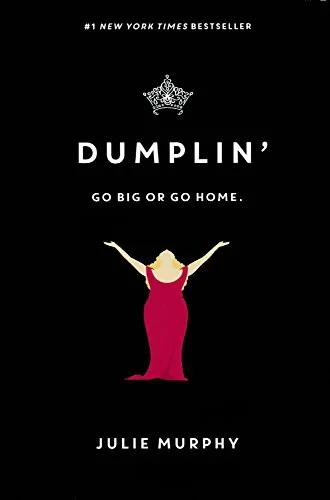
Dumplin'
by Julie Murphy
- Publication Date:
- April 4th, 2017
- Publisher:
- Turtleback
- ISBN-13:
- 9780606396479
- ISBN-10:
- 0606396470
- Pages:
- 400
Why Dumplin' Has Been Challenged
Critics of the novel have pushed back less on its message about self-acceptance than on how openly it lets a teenage narrator talk about her own body and romantic feelings. See more ↓
Challenged or banned in 4 states across 4 school districts.
Overview
Willowdean Dickson has grown up in the shadow of her mother's pageant obsession, watching from the sidelines of an event built around a kind of femininity she has never been told she can claim. When romantic interest from a co-worker complicates her sense of who she's allowed to be, Willowdean responds not by shrinking herself but by signing up for the very competition that seems designed to exclude her.
Julie Murphy builds the novel around that act of defiance, pulling in a handful of other girls who don't fit the pageant mold to compete alongside her. The story moves between romantic uncertainty, friction with old friends, and the slower work of deciding that a body doesn't need to be apologized for.
What results is less a pageant underdog story than a portrait of a teenager refusing the terms other people have set for her worth, staged in a small town where everyone is watching.
Body, Image, and Small-Town Expectation
Dumplin' sits at the intersection of two genres that don't usually overlap: the pageant novel and the body-positive coming-of-age story. Murphy uses the ritual of the beauty pageant, with its explicit scoring of appearance, as a mechanism for examining what towns like Willowdean's quietly reward and punish. The pageant isn't treated as inherently villainous; it's run by Willowdean's own mother, which keeps the conflict personal rather than abstract, rooted in a specific mother-daughter relationship rather than a broad critique of beauty culture.
The novel also resists tidying its romance into something simple. Willowdean's hesitation about a relationship with a co-worker isn't framed as a lack of self-esteem to be cured by the end of the book, but as a recognizable tangle of desire, suspicion, and self-protection. Since its publication, the book has become a touchstone in conversations about size representation in young adult fiction, and its adaptation into a feature film extended its reach well beyond its original readership.
Why Dumplin' Has Been Challenged
A parent complaint filed with one school district centered on the frankness of Willowdean's thoughts about her body and about sex, arguing that passages exploring her physical self-consciousness and her romantic relationship were too explicit for the middle-grade and early high-school readers who might encounter the book on a shelf. Other challengers have focused less on specific scenes than on the novel's casual treatment of teenage dating and physical attraction, contending that the material is more appropriate for an older audience than typical YA shelving suggests.
A second recurring thread in objections concerns language, with some reviewers flagging profanity used by Willowdean and her peers as inappropriate for school library collections. Taken together, the challenges reflect a broader discomfort with young adult fiction that treats a teenage girl's body, desire, and self-image as subjects worth depicting candidly rather than discreetly. The book has been formally challenged in 4 states and 4 school districts represented in this catalog, a record that places it among the more frequently contested body-positive titles in recent YA publishing.
Where to Buy




Affiliate links may generate a small commission at no extra cost to you, which helps support this site.
Banned in Schools
Banned or challenged in 4 states across 4 school districts.
Florida 1 district
- Escambia County Public Schools Banned pending investigation
Iowa 1 district
- Nevada Community School District Banned pending investigation
Tennessee 1 district
- Rutherford County Schools Banned by Restriction
Texas 1 district
- Nacogdoches Independent School District Banned by Restriction