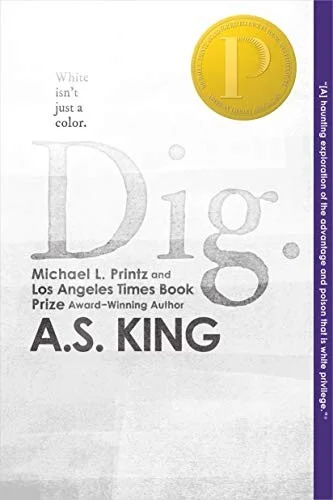
Dig
by A. S. King
- Publication Date:
- June 30th, 2020
- Publisher:
- Penguin Books
- ISBN-13:
- 9781101994931
- ISBN-10:
- 1101994932
- Pages:
- 400
Why Dig Has Been Challenged
At the heart of the dispute over this novel is its decision to render bigotry, addiction, and family dysfunction in the blunt, unsoftened language its teenage characters would actually use. See more ↓
Challenged or banned in 4 states across 4 school districts.
Overview
Dig, by A. S. King, is a work of contemporary young adult fiction that traces a handful of teenage cousins from an outwardly prosperous white family as old secrets rise to the surface. The novel moves between these young people's separate, often strange and isolating lives, gradually revealing how their disconnection from one another traces back to choices their parents and grandparents made decades earlier.
King builds the story with an unconventional, fragmented structure, letting surreal and symbolic imagery sit alongside blunt realism. Rather than resolving its mysteries through a single narrator, the novel asks readers to assemble the family's hidden history themselves, piece by piece, much as its characters must do.
The result is a novel less interested in plot mechanics than in exposing what a family would rather not look at directly: how wealth was built, who was shut out of it, and what that inheritance does to children who never asked for it.
A Family's Buried Inheritance
Much of A. S. King's work returns to the idea that adolescence is where a family's unspoken truths finally come due, and Dig fits squarely within that preoccupation. Here the inheritance in question is not only money but attitude: a long-standing, often unexamined racism that has shaped the family's choices and that its younger generation must confront, whether or not they understand its origins.
The book sits among King's more formally ambitious novels, using its fractured timeline and symbolic flourishes to mirror the way denial and privilege distort a family's sense of its own story. Critically, it has been read as a pointed examination of whiteness and class complacency, told from the inside of the family benefiting from both.
Why Dig Has Been Challenged
Dig has drawn praise from critics and educators for its unflinching honesty and its formal daring, even as that same bluntness has made it a target for removal from school shelves. The qualities reviewers single out as the book's strengths — its willingness to let characters speak and think in ugly, unguarded ways, its refusal to soften what prejudice sounds like from the inside — are the same qualities that have drawn objections.
Challenges to the novel have centered on its frank treatment of racism, including the use of racial slurs employed to expose characters' bigotry rather than endorse it, along with its depictions of drug use, sexual content, and strong language. Some objections have also focused on the book's portrayal of family dysfunction and abuse, material that some parents and community members have considered too dark or explicit for a school-age audience. The book has been challenged or restricted in 4 states and 4 districts tracked in this catalog, reflecting the broader pattern of scrutiny faced by young adult fiction that treats racism and addiction as lived realities rather than cautionary abstractions.
Where to Buy




Affiliate links may generate a small commission at no extra cost to you, which helps support this site.
About A. S. King

A. S. King (Amy Sarig King) is an award-winning American author of young adult and adult fiction whose surreal, boundary-pushing novels have earned her a Printz Award, two Printz Honors, and the 2022 Margaret A. Edwards Award for lifetime contribution to YA literature. Her novels Please Ignore Vera Dietz and Ask the Passengers are both frequently challenged for depictions of sexuality, profanity, and LGBTQ+ characters. She previously spent fifteen years writing while living and teaching literacy in Ireland before publishing her debut novel in 2009.
Also by A. S. King

Banned in Schools
Banned or challenged in 4 states across 4 school districts.
Florida 1 district
- Escambia County Public Schools Banned pending investigation
Tennessee 1 district
- Wilson County Schools Banned