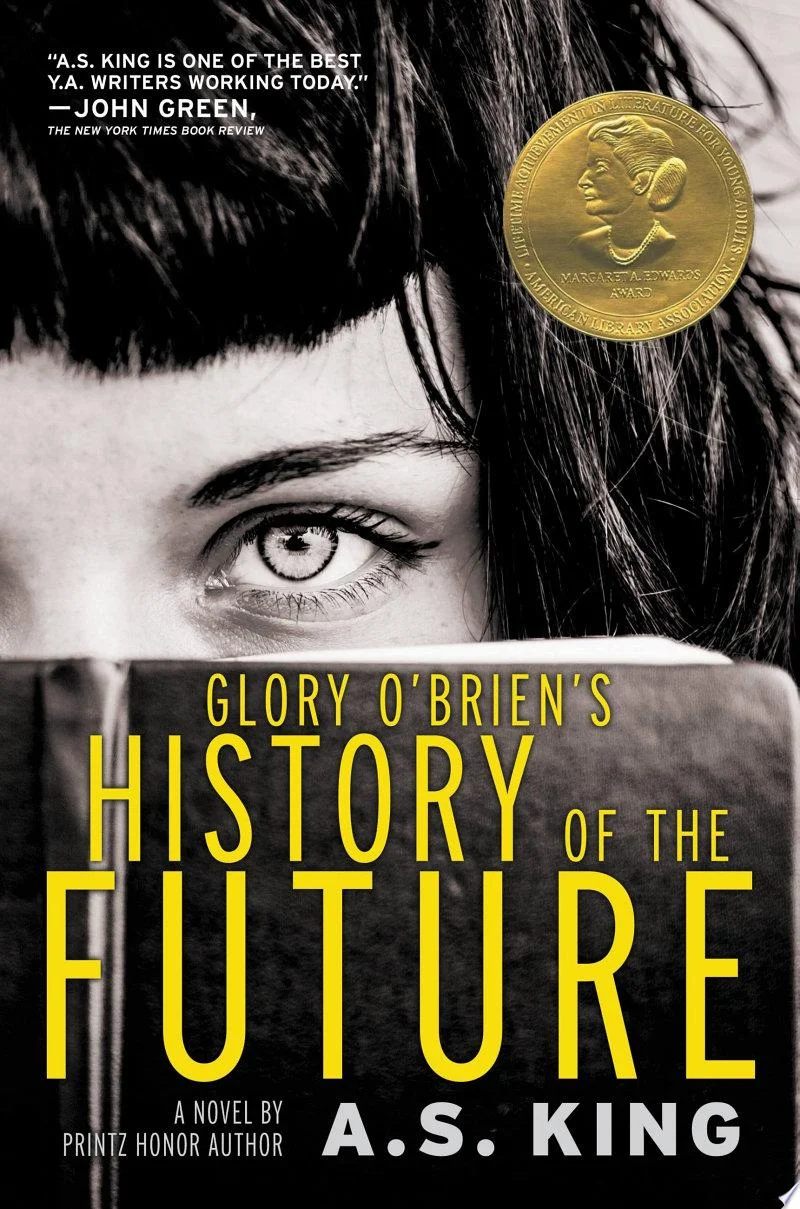
Glory O'Brien's History of the Future
by A. S. King
- Publication Date:
- October 14th, 2014
- Publisher:
- Little, Brown Books for Young Readers
- ISBN-13:
- 9780316222747
- ISBN-10:
- 0316222747
- Pages:
- 286
Why Glory O'Brien's History of the Future Has Been Challenged
Objectors have pushed back on the novel's frank sexuality and its bleak vision of a country stripped of women's rights, arguing the material is too heavy for the teen readers it targets. See more ↓
Challenged or banned in 1 state across 1 school district.
Overview
Glory O'Brien stands at the edge of adulthood with no map forward. Fresh out of high school, she watches her peers make plans while she remains fixed on the absence at the center of her life: a mother who took her own life when Glory was a small child, and the fear that the same fate is somehow waiting for her too.
That paralysis breaks open one night when Glory, almost by accident, drinks a strange concoction with her friend Ellie and finds she can suddenly perceive the full sweep of a person's existence — ancestors long dead, descendants not yet born — just by looking at them. The gift arrives without warning or instructions, and it does not stay confined to curiosity.
What Glory sees stretching ahead is a nation curdling into authoritarianism: a strongman's rise, the rollback of women's legal standing, a civil war fought along those lines, and girls disappearing into camps. Unable to shake what she's witnessed, she begins writing it all down, less in hope of saving herself than in hope that a record of the future might still be enough to keep it from happening.
A Feminist Coming-of-Age Story Told Through Prophecy
A. S. King builds the novel around a deliberate collision of genres: the quiet, interior realism of a grief-stricken teenager figuring out who she is, set against the speculative sweep of dystopian prophecy. The device of second sight lets the book move fluidly between Glory's immediate, ordinary anxieties — her mother's suicide, her friendship with Ellie, her uncertainty about the future — and a much larger historical canvas stretching backward and forward across generations.
That structure lets the story make an argument without stating it outright: that the personal and the political are inseparable, and that the rights women hold in any given era are neither permanent nor guaranteed. Glory's visions function less as literal forecasting than as a thought experiment about complacency, asking what happens when a society stops paying attention to the fragility of its own freedoms. The novel's reputation rests in part on King's willingness to let a young-adult book sit with despair and uncertainty rather than resolve them neatly, a quality that has drawn both admiration and discomfort from readers encountering it for the first time.
Why Glory O'Brien's History of the Future Has Been Challenged
Much of the friction around this novel comes down to a disagreement over what belongs on a shelf accessible to teenagers versus what ought to be reserved for older or more mature readers. Reviewers and parents who have objected to the book tend to point to its unflinching treatment of teenage sexuality, including candid depictions of sexual experience and desire, as more explicit than they consider appropriate for the intended young-adult audience.
A second strand of objection concerns the novel's political imagination. Its depiction of a future United States where women lose legal rights, dissent is crushed, and a violent civil conflict erupts has struck some challengers as ideologically charged or excessively dark material to place in front of adolescent readers, even though the book frames these events as a warning rather than an endorsement. Underlying both threads is a broader debate about how much unfiltered reality — sexual, political, or otherwise — young readers should be trusted to process, a question that has made this title, challenged in one state and one school district represented in this catalog, a recurring flashpoint in arguments over what belongs in a school library.
Where to Buy




Affiliate links may generate a small commission at no extra cost to you, which helps support this site.
About A. S. King

A. S. King (Amy Sarig King) is an award-winning American author of young adult and adult fiction whose surreal, boundary-pushing novels have earned her a Printz Award, two Printz Honors, and the 2022 Margaret A. Edwards Award for lifetime contribution to YA literature. Her novels Please Ignore Vera Dietz and Ask the Passengers are both frequently challenged for depictions of sexuality, profanity, and LGBTQ+ characters. She previously spent fifteen years writing while living and teaching literacy in Ireland before publishing her debut novel in 2009.
Also by A. S. King

Banned in Schools
Banned or challenged in 1 state across 1 school district.
Florida 1 district
- Escambia County Public Schools Banned pending investigation