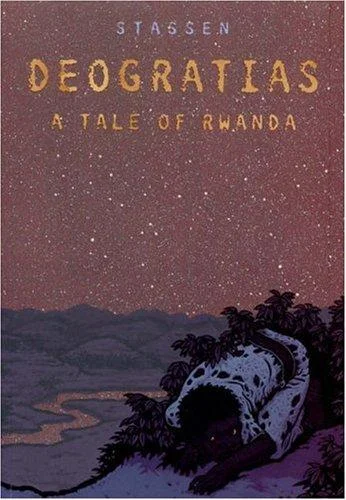
Déogratias, a tale of Rwanda
- Publication Date:
- January 1st, 2006
- Publisher:
- First Second
- ISBN-13:
- 9781596431034
- ISBN-10:
- 1596431032
- Pages:
- 79
Why Déogratias, a tale of Rwanda Has Been Challenged
Objections to this graphic novel tend to center less on the genocide it depicts than on the disturbing sexual and psychological content it uses to convey a mind destroyed by violence. See more ↓
Challenged or banned in 5 states across 10 school districts.
A Boy's Unraveling Amid Genocide
Jean-Philippe Stassen's graphic novel follows Deogratias, a Rwandan teenager whose ordinary adolescent preoccupations — friendship, mischief, a crush on a girl — are overtaken by the machinery of genocide. Deogratias is Hutu; the girl he loves, Bénigne, is Tutsi. Their story unfolds against the backdrop of 1994, when the categories assigned to them by history and propaganda become lethal.
Rather than march chronologically toward catastrophe, the book alternates between a "before," when Deogratias is simply a boy pursuing a girl he adores, and an "after," in which he wanders the same hills as a broken figure, convinced he has become a dog. Bénigne does not survive, and the narrative makes clear that Deogratias himself is implicated in her death — a fact the book approaches obliquely rather than stating outright.
Stassen keeps the genocide's worst violence largely offstage, letting its aftermath — Deogratias's madness, the silence of survivors, the altered landscape of a community — carry the weight the reader would otherwise find in direct depiction.
Memory, Complicity, and the Limits of Depiction
What distinguishes this work within genocide literature is its refusal to separate perpetrator from victim in any simple way. Deogratias is not a monster introduced to explain atrocity from a safe distance; he is a recognizable boy who becomes an instrument of violence while still believing, in some broken part of himself, that he is in love. The book asks readers to sit with that discomfort rather than resolve it.
The structure itself does interpretive work. By braiding the "before" and "after" timelines together instead of letting one follow the other, Stassen forces past innocence and present ruin to inform each other continuously, so that neither can be read in isolation. The device also lets the book gesture toward the genocide's scale without rendering it as spectacle.
The book is also pointed about context beyond Rwanda's borders, implicating foreign actors and institutions whose indifference or complicity helped set the conditions for mass killing. Recognized with the Goscinny Prize for its script, the work has been read as both a landmark in graphic-novel reportage and a meditation on how trauma reshapes an individual mind long after the violence that caused it has ended.
Why Déogratias Has Been Challenged
Critics have praised the book for the discipline of its restraint and the seriousness with which it treats an atrocity too often reduced to statistics; objectors have focused instead on what does appear on the page and how starkly it appears. Though the genocide itself is kept at a remove, the book does not spare readers scenes of sexual content, drinking, and psychological breakdown, and some have argued that imagery and language intended for mature, reflective reading are unsuited to the younger students who might encounter the book in a school library or classroom.
Much of the concern centers on tone rather than plot: a protagonist who is simultaneously victim, perpetrator, and casualty of his own mind resists the clear moral framing that some reviewers expect from material assigned to teenagers. Deogratias's delusion that he has become a dog, and the surrounding suggestion of sexual exploitation and trauma, have been cited as too disturbing or too ambiguous for an educational setting without extensive guidance. The catalog records challenges to the book in 5 states and 10 school districts, reflecting how differently communities weigh difficult historical content against concerns about graphic imagery and theme suitability for young readers.
Where to Buy




Affiliate links may generate a small commission at no extra cost to you, which helps support this site.
Banned in Schools
Banned or challenged in 5 states across 10 school districts.
Florida 3 districts
- Duval County Public Schools Banned pending investigation
- Nassau County School District Banned
- Okaloosa County School District Banned pending investigation
Tennessee 2 districts
- Roane County Community School District Banned
- Wilson County Schools Banned
Texas 3 districts
- Lamar Consolidated Independent School District Banned
- Nacogdoches Independent School District Banned by Restriction
- North East Independent School District Banned