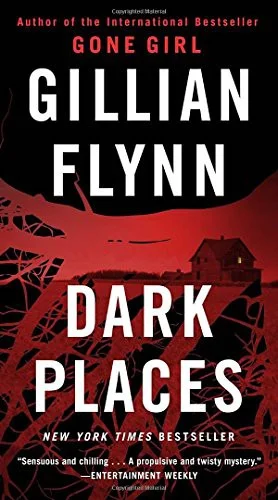
Dark Places
- Publication Date:
- May 22nd, 2018
- Publisher:
- Crown
- ISBN-13:
- 9781101902882
- ISBN-10:
- 1101902884
- Pages:
- 541
Why Dark Places Has Been Challenged
Readers have pushed back on this novel less for its mystery than for how unflinchingly it stays with the violence, poverty, and adult content surrounding its child narrator. See more ↓
Challenged or banned in 2 states across 7 school districts.
Overview
Gillian Flynn's "Dark Places" follows Libby Day, the sole surviving member of a family murdered on their Kansas farm when Libby was seven. Her brother Ben was convicted largely on the strength of her childhood testimony, and for over two decades Libby has drifted through adulthood on donations and the morbid fascination of strangers, never working, never settling, never quite living.
That stasis breaks when a true-crime club obsessed with the case tracks her down, offering money for information and insisting Ben is innocent. To collect, Libby has to do something she has spent her whole life avoiding: revisit the night of the murders and ask whether the story she has told herself, and everyone else, actually holds up.
Flynn builds the novel by cutting between Libby's present-day investigation and scenes from the day of the killings, so the reader assembles the truth alongside her, one contradiction at a time. The structure turns memory itself into the novel's central mystery.
Memory, Trauma, and the Unreliable Witness
Beneath its crime-novel mechanics, "Dark Places" is really a study of how a child's mind protects itself from a trauma too large to process, and what happens when that protection calcifies into a life. Libby isn't a detective by temperament; she's a bystander to her own history, pulled back into it by other people's need for a story to be true. Flynn uses the investigation less to deliver a tidy solution than to interrogate how certainty gets manufactured, by a scared child, by a small town eager to convict an outsider, by true-crime enthusiasts who want their theories confirmed.
The book arrived as Flynn's second novel, before the commercial breakthrough of "Gone Girl," and it carries many of the same fingerprints: a morally compromised narrator, a rural setting that feels both specific and suffocating, and an interest in how families construct narratives to survive each other. It has been read as an early showcase of Flynn's skill at withholding sympathy from her characters while still making their interiority compelling.
Why Dark Places Has Been Challenged
Critics have generally praised the novel's psychological precision and its unsentimental honesty about grief, even as some of that same unflinching quality has made it a target for challenge in school and library settings. The objections brought against the book, which has drawn 2 state and 7 district challenges in the records tracked here, center less on the mystery plot than on how explicitly it renders the violence at its core.
Because the murders are revisited repeatedly from different vantages, the novel does not let the reader look away from physical brutality, and its depiction of a family's final hours includes sustained violence against children. Challengers have also objected to the book's frank treatment of poverty, drug use, and sexual content involving teenage characters, arguing that the combination is inappropriate for younger readers regardless of the novel's literary ambitions. Defenders counter that the discomfort is the point: a story about the aftermath of violence that softened the violence itself would undercut its honesty about trauma and memory.
Where to Buy




Affiliate links may generate a small commission at no extra cost to you, which helps support this site.
Also by Gillian Flynn
Banned in Schools
Banned or challenged in 2 states across 7 school districts.
Florida 6 districts
- Clay County School District Banned
- Escambia County Public Schools Banned pending investigation
- Hillsborough County Public Schools Banned Pending Investigation
- Orange County Public Schools Banned by restriction
- Santa Rosa County Schools Banned pending investigation
- Union County School District Banned
Wisconsin 1 district
- Elkhorn Area School District Banned pending investigation