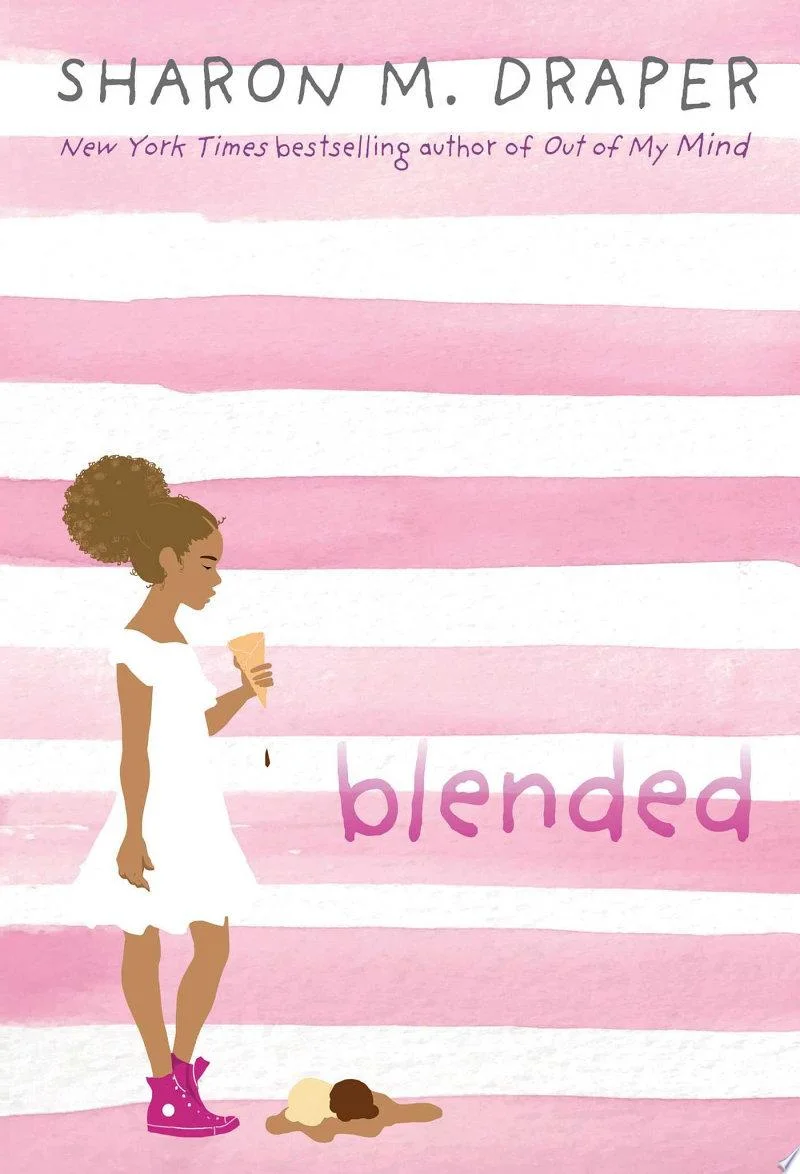
Blended
- Publication Date:
- October 30th, 2018
- Publisher:
- Simon and Schuster
- ISBN-13:
- 9781442495029
- ISBN-10:
- 1442495022
- Pages:
- 320
Why Blended Has Been Challenged
Critics of the novel have mainly pushed back on exposing young readers to a dramatized police shooting and frank talk of racial bias well before middle school, arguing the material belongs with older audiences or under adult guidance rather than on open shelves. See more ↓
Challenged or banned in 4 states across 6 school districts.
Overview
Sharon M. Draper's novel follows Isabella, an eleven-year-old who divides her life into alternating weeks: one spent as "Isabella" in her father's affluent, mostly white neighborhood with his fiancée and her son, the next as "Izzy" in her mother's modest house with her mother's fiancé. The arrangement means more than switching addresses. It means switching backpacks, nicknames, and, increasingly, the version of herself she's allowed to be in each house.
As her parents' custody arguments intensify, Isabella starts to notice how strangers react to her mixed heritage, her father Black and her mother white, with intrusive questions about what she "really" is. The novel traces how a child absorbs these comments long before she has the language to push back against them, and how a family's unresolved conflicts can make a child feel less like a person and more like a territory being divided.
The story builds toward a sudden, violent encounter between Isabella's stepbrother and the police, an event that recasts everything that came before it and forces her parents to confront what their daughter's safety actually depends on.
A Child's-Eye View of Race and Belonging
Draper, known for Out of My Mind and her long career writing for young readers, uses the mechanics of joint custody as a structural device, not just a plot point. The weekly handoffs become a way of asking what it costs a biracial child to be read differently depending on which parent she's standing next to, and whether "half and half" can ever add up to whole. The book sits alongside a body of middle-grade fiction that has moved beyond treating divorce or racial identity as single-issue subjects, choosing instead to show how they compound: a custody fight is never just about scheduling when race, class, and belonging are also being negotiated in the background.
The novel's turn toward a police shooting situates it within a wider shelf of contemporary youth literature grappling with how Black and biracial children experience encounters with law enforcement. Rather than building toward a tidy resolution of the custody dispute, the book uses that crisis to strip away the smaller frustrations of Isabella's divided life and expose the much larger stakes underneath them, reframing a story that began as a portrait of a fractured family into one about what it means to keep a child safe in a country that doesn't see her as simply a child.
Why Blended Has Been Challenged
Much of the friction around Blended centers less on whether middle-grade readers can handle its themes than on where it belongs on a shelf and how much guidance young readers need alongside it, since the novel pairs a child's perspective with material some consider heavier than typical fare for its intended age group. Critics have pointed to its unflinching depiction of a police shooting involving a young Black character as the kind of content that warrants restriction or parental oversight rather than open classroom access.
Other objections focus on the book's direct engagement with racial identity and bias, including the invasive comments Isabella fields as a biracial child, and on its candid treatment of divorce and blended-family conflict, which some reviewers have argued exposes children to adult relationship dysfunction before they're ready for it. Taken together, these concerns reflect a broader discomfort with pairing realistic depictions of racialized violence with a protagonist young enough that her readership skews toward the same age as the character herself. The book has drawn a modest but consistent pattern of challenges, with records showing objections raised in 4 states and 6 school districts.
Where to Buy




Affiliate links may generate a small commission at no extra cost to you, which helps support this site.
Also by Sharon M. Draper
Banned in Schools
Banned or challenged in 4 states across 6 school districts.
Florida 2 districts
- Martin County Schools Banned by restriction
- St. John's County School District Banned by restriction
Iowa 2 districts
- Spencer Community School District Banned pending investigation
- Spirit Lake Community School District Banned
North Carolina 1 district
- New Hanover County Schools Banned by Restriction
Wisconsin 1 district
- Elkhorn Area School District Banned pending investigation