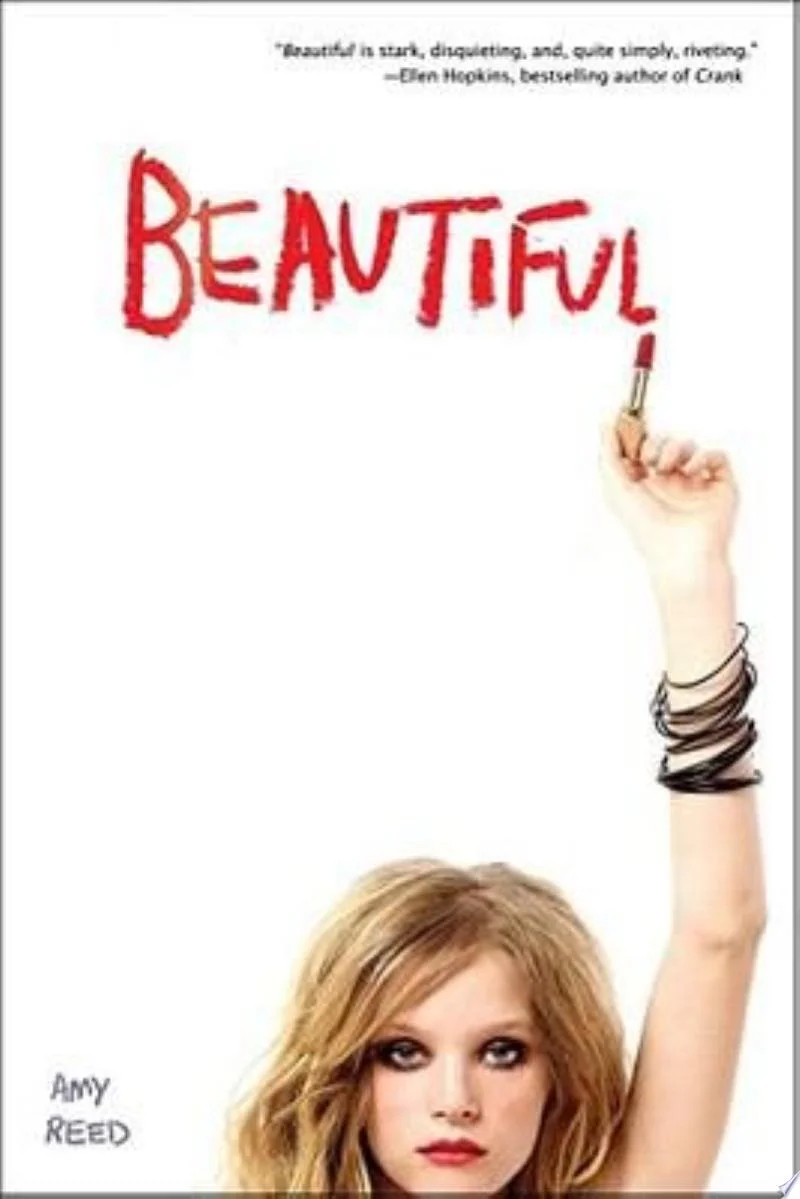
Beautiful
by Amy Reed
- Publication Date:
- October 5th, 2010
- Publisher:
- Simon and Schuster
- ISBN-13:
- 9781416978312
- ISBN-10:
- 1416978313
- Pages:
- 258
Why Beautiful Has Been Challenged
Objections to Beautiful center on its unflinching treatment of subjects considered inappropriate for the young age of its protagonist and, by extension, much of its readership. See more ↓
Challenged or banned in 4 states across 20 school districts.
Overview
Amy Reed's Beautiful follows Cassie, a middle schooler relocating to Seattle carrying the weight of an unspecified but clearly serious history. The move is meant to function as a reset, a chance to leave whatever happened before behind her. Instead, the unfamiliar school becomes fertile ground for a new kind of trouble.
Cassie falls in with an older, harder-edged crowd, and the novel tracks her descent into experiences well beyond what most thirteen-year-olds encounter: casual drug use, sexual exploitation, and exposure to violence that escalates as the story progresses. Reed frames this less as a cautionary tale of bad choices and more as a portrait of how quickly a vulnerable kid can be pulled under.
Running alongside Cassie's unraveling is her parents' near-total blindness to it. Their inattention isn't cartoonish neglect so much as the ordinary distraction of adults who assume their child is fine because she hasn't said otherwise—a gap between what's happening and what's noticed that drives much of the book's tension.
Context and Themes
Beautiful sits within a body of young adult fiction—often associated with authors like Reed—that declines to soften adolescence into something tidy. The novel is less interested in plot mechanics than in atmosphere: the disorientation of being thirteen and suddenly unsupervised in ways that feel like freedom until they don't.
A recurring undercurrent is the unreliability of surfaces. Cassie's new friends read as glamorous and confident before their circumstances reveal themselves as coping mechanisms of their own; her parents read as present while remaining functionally absent. The title itself works ironically, gesturing at how appearance and desirability can mask harm, both self-inflicted and imposed by others.
The book also examines how trauma compounds. Cassie's unresolved past isn't cured by geography, and the novel resists suggesting that a new school or new friends can substitute for the reckoning she's avoiding. That refusal to offer easy resolution is characteristic of the grittier strain of YA literature it belongs to, and it's part of what has kept the book in circulation as a discussion piece about how fiction should—or shouldn't—depict struggling teenagers.
Why Beautiful Has Been Challenged
Objections to Beautiful center on its unflinching treatment of subjects considered inappropriate for the young age of its protagonist and, by extension, much of its readership. The novel's depictions of drug use, sexual content involving a minor character, and scenes of violence have drawn the most sustained criticism, with challengers arguing that the material is too explicit or too dark for middle-grade and early high-school readers regardless of any cautionary intent.
A related line of objection concerns the book's portrayal of parental absence: some challengers have argued that a narrative in which adults fail so completely to intervene risks normalizing that neglect rather than critiquing it. Others have taken issue with the book's refusal to moralize outright, worrying that younger readers may not have the context to process Cassie's choices as warnings rather than templates.
These concerns have translated into a substantial challenge record: this catalog tracks 4 states and 20 districts in which Beautiful has faced formal objection or removal efforts, reflecting how consistently its subject matter has triggered scrutiny across school and library systems.
Where to Buy




Affiliate links may generate a small commission at no extra cost to you, which helps support this site.
About Amy Reed
Amy Reed is an American author of young adult fiction whose novels explore trauma, addiction, sexual violence, and survival with honesty and empathy. She is best known for The Nowhere Girls (2017), a novel about rape culture that has been challenged in multiple school districts, and her debut Beautiful (2009).
Also by Amy Reed
Banned in Schools
Banned or challenged in 4 states across 20 school districts.
Florida 14 districts
- Broward County Public Schools Banned
- Citrus County School District Banned
- Collier County Public Schools Banned
- Duval County Public Schools Banned pending investigation
- Escambia County Public Schools Banned
- Hernando County Schools Banned
- Hillsborough County Public Schools Banned
- Orange County Public Schools Banned
- Pinellas County Schools Banned
- Santa Rosa County Schools Banned
- School District of Osceola County Banned
- School District of Palm Beach County Banned
- Seminole County Public Schools Banned
- Union County School District Banned
Iowa 3 districts
- Ankeny Community School District Banned
- Cedar Falls Community School District Banned pending investigation
- Council Bluffs Community School District Banned pending investigation
Tennessee 2 districts
- Knox County Schools Banned
- Rutherford County Schools Banned
Wyoming 1 district
- Laramie County School District No. 1 Banned by Restriction