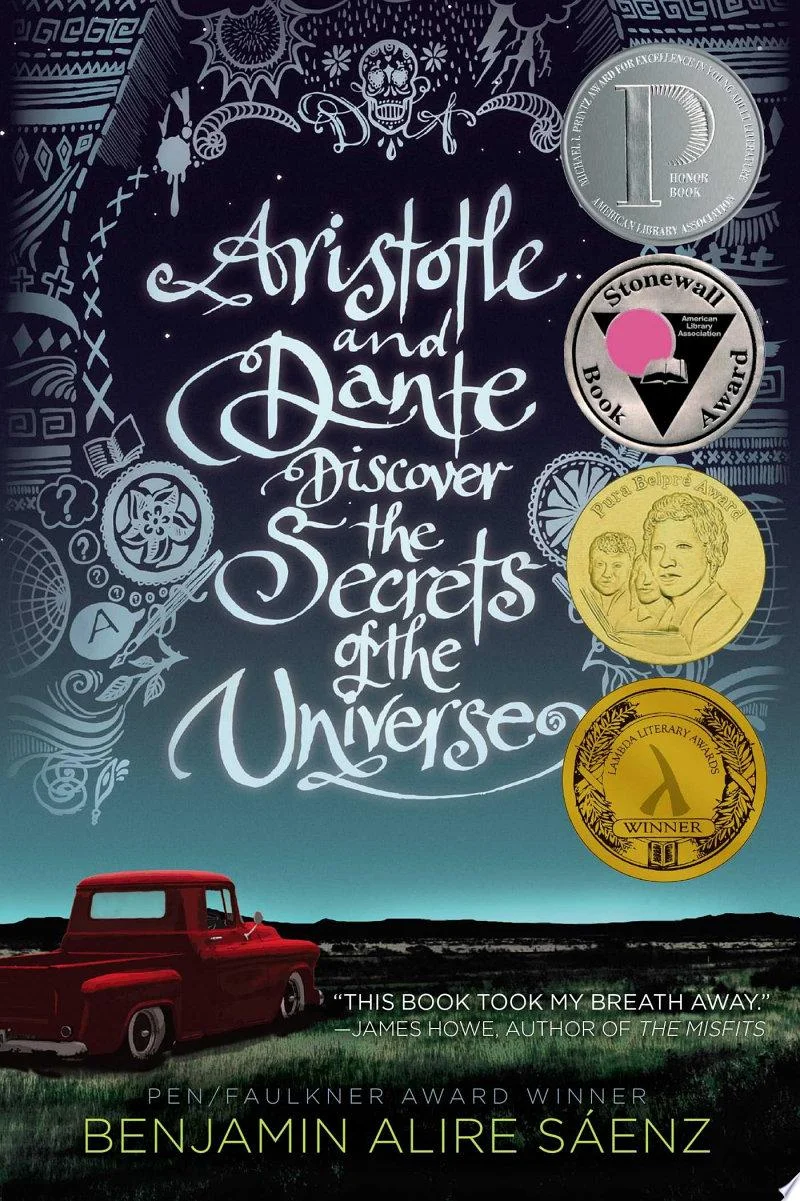
Aristotle and Dante Discover the Secrets of the Universe
- Publication Date:
- February 21st, 2012
- Publisher:
- Simon and Schuster
- ISBN-13:
- 9781442408944
- ISBN-10:
- 1442408944
- Pages:
- 384
Why Aristotle and Dante Discover the Secrets of the Universe Has Been Challenged
At the heart of the pushback against this novel is discomfort with placing a tender same-sex love story in front of young teenagers without adult oversight. See more ↓
Challenged or banned in 4 states across 9 school districts.
Overview
Benjamin Alire Sáenz's novel follows Aristotle, a guarded teenager carrying the weight of a brother's imprisonment and a family that rarely speaks of it, and Dante, a curious, articulate boy who seems to move through the world without Ari's defenses. Their meeting at a public pool sets off a friendship neither expects, one that slowly reshapes how each of them understands solitude, masculinity, and belonging.
Told through Ari's internal, often halting narration, the story unfolds less through plot incident than through accumulation: summer afternoons, long conversations, an accident that changes the emotional stakes between the two boys, and the gradual erosion of Ari's instinct to keep people at arm's length. Dante's openness, about his feelings and eventually about his own sexuality, becomes the counterweight to Ari's caution.
What emerges is a coming-of-age narrative less interested in dramatic turns than in interior change, tracking how a friendship can become the mechanism by which a young person finally names what he has been avoiding about himself.
A Quiet Entry in the Coming-of-Age Canon
Sáenz's novel arrived as part of a broader shift in young adult literature toward stories centering Latino families and queer adolescence without treating either as a novelty or a lesson. Ari and Dante are drawn with attention to their households, their parents' own unspoken histories, and the particular textures of growing up in the borderlands of El Paso, giving the book a specificity that resists easy universalizing even as its themes of loneliness and self-discovery are broadly recognizable.
The novel's restraint is part of its identity: it withholds easy catharsis, lets silences between characters do real work, and resists resolving Ari's confusion faster than a teenager plausibly would. That patience has made it a touchstone for readers looking for depictions of male vulnerability and same-sex attraction that aren't organized around trauma or tragedy, and it has kept the book in steady circulation in classrooms and libraries long after its initial publication, including through a screen adaptation that introduced it to new readers.
Why Aristotle and Dante Discover the Secrets of the Universe Has Been Challenged
Most challenges to the novel cite its appropriateness for middle school and early high school readers, arguing that the emotional and romantic material between its teenage protagonists is better suited to older audiences. Critics who raise this concern typically point to the book's frank treatment of a same-sex relationship as the central objection, arguing that its depiction of two boys falling in love, however understated, is not something they want placed in front of younger students without parental knowledge or consent.
A related line of objection focuses on brief scenes involving sexual content and underage drinking, which some challengers describe as inappropriate regardless of the surrounding context or the maturity of the narration. Others have framed their objections in broader terms, characterizing the novel as promoting a viewpoint on sexual orientation that conflicts with their own values and arguing it should not be presented to students as an unremarkable part of adolescence. In this catalog, the book has been the subject of challenges in 4 states and 9 districts, with objections concentrated on these questions of age-appropriateness and the depiction of queer identity rather than on the book's craft or literary merit.
Where to Buy




Affiliate links may generate a small commission at no extra cost to you, which helps support this site.
Also by Benjamin Alire Sáenz
Banned in Schools
Banned or challenged in 4 states across 9 school districts.
Florida 3 districts
- Citrus County School District Banned by Restriction
- Collier County Public Schools Banned by restriction
- Escambia County Public Schools Banned by restriction
Iowa 3 districts
- Clear Lake Community School District Banned
- Melcher-Dallas Community School District Banned pending investigation
- Nevada Community School District Banned pending investigation
Tennessee 2 districts
- Monroe County Schools Banned
- Rutherford County Schools Banned
Texas 1 district
- Nacogdoches Independent School District Banned by Restriction