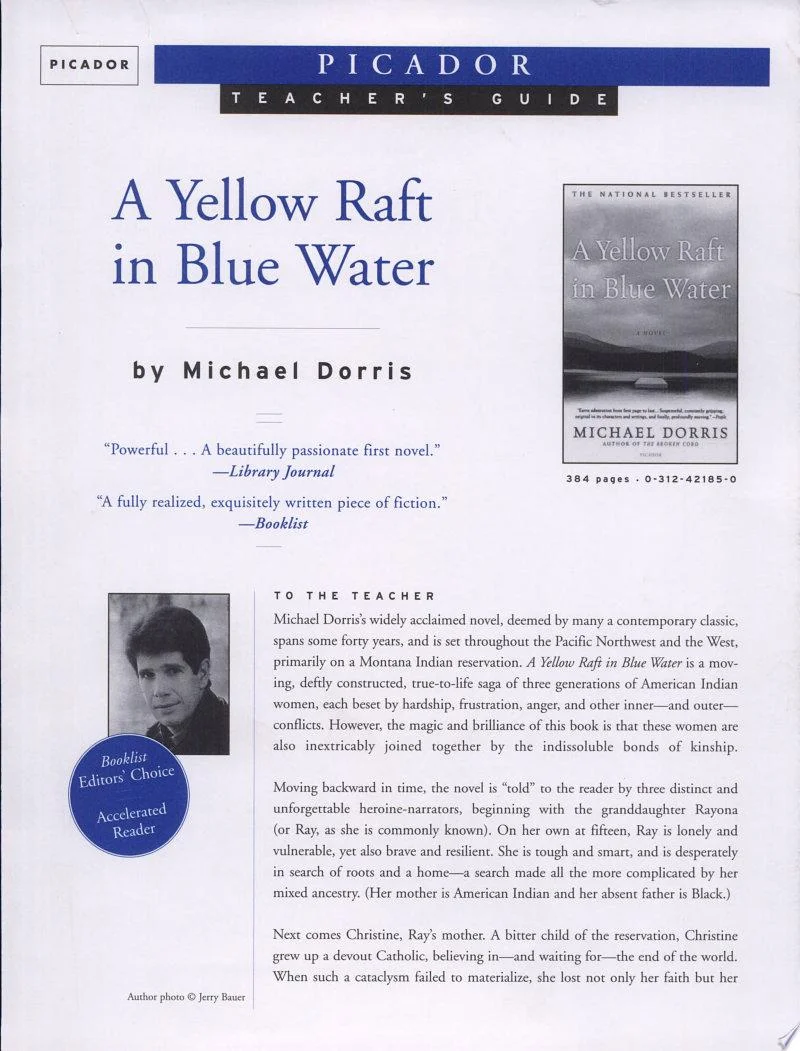
A Yellow Raft in Blue Water
- Publication Date:
- October 1st, 2003
- Publisher:
- Macmillan
- ISBN-13:
- 9780312422714
- ISBN-10:
- 0312422717
- Pages:
- 8
Why A Yellow Raft in Blue Water Has Been Challenged
Critics of this novel have generally taken issue with how openly it lets young readers sit alongside adult characters' sexual histories and struggles with addiction. See more ↓
Challenged or banned in 2 states across 5 school districts.
Overview
Michael Dorris structures this novel as an unwinding rather than an unfolding. It opens with Rayona, a teenage girl navigating her mixed heritage and a fractured home, then hands the narrative back to her mother, Christine, and finally to her grandmother, Ida. Each woman tells her own section, and each telling recasts what came before it.
The reverse chronology means readers meet consequences before causes: a strained relationship, a hidden decision, a family secret, all seen first through the eyes of the person who inherited them, then through the eyes of the person who made them. By the time Ida's section closes the book, incidents that seemed inexplicable in Rayona's opening pages have acquired roots stretching back decades.
The novel is, at its core, about inheritance — not of property, but of silence, resilience, and the stories families choose not to tell. Its setting in and around a Montana reservation grounds this personal history in a specific American Indian community and its relationship to the wider world.
A Family Told in Reverse
Dorris's structural choice does more than create suspense; it argues something about how understanding actually happens within families. Children rarely learn their parents' full histories until much later, if ever, and grandparents carry reasons for their choices that outlive easy explanation. By moving backward, the novel lets readers experience that gradual, retroactive understanding themselves, arriving at empathy for characters only after first judging them through someone else's incomplete account.
The book also sits within a broader body of literature attentive to Native American women's interior lives, treating cultural identity, poverty, and displacement not as backdrop but as lived texture shaping each woman's choices. Its reputation rests less on plot mechanics than on voice: three narrators who sound distinctly of their generations, their genders' expectations, and their particular wounds.
Why A Yellow Raft in Blue Water Has Been Challenged
Much of the scrutiny directed at this novel traces back to Christine's and Ida's sections, where the adult narrators recount sexual experiences, pregnancies, and relationships with a candor that some readers consider inappropriate for younger audiences. The novel also depicts alcoholism and its corrosive effect on parenting, along with domestic instability and absent or unreliable father figures, portrayed without softening for a young-adult readership.
Objectors have additionally pointed to language and behavior among teenage characters that they view as normalizing risk-taking, while others have raised concerns about how the book handles family trauma more broadly, arguing that its unflinching tone is too mature for school shelves. Taken together, these concerns have led to the book being challenged or restricted in 2 states and 5 districts tracked in this catalog, with objections centering less on any single scene than on the novel's overall willingness to render difficult adult realities through a teenager's proximity to them.
Where to Buy




Affiliate links may generate a small commission at no extra cost to you, which helps support this site.
Banned in Schools
Banned or challenged in 2 states across 5 school districts.
Florida 4 districts
- Clay County School District Banned
- Hillsborough County Public Schools Banned Pending Investigation
- Santa Rosa County Schools Banned pending investigation
- Union County School District Banned