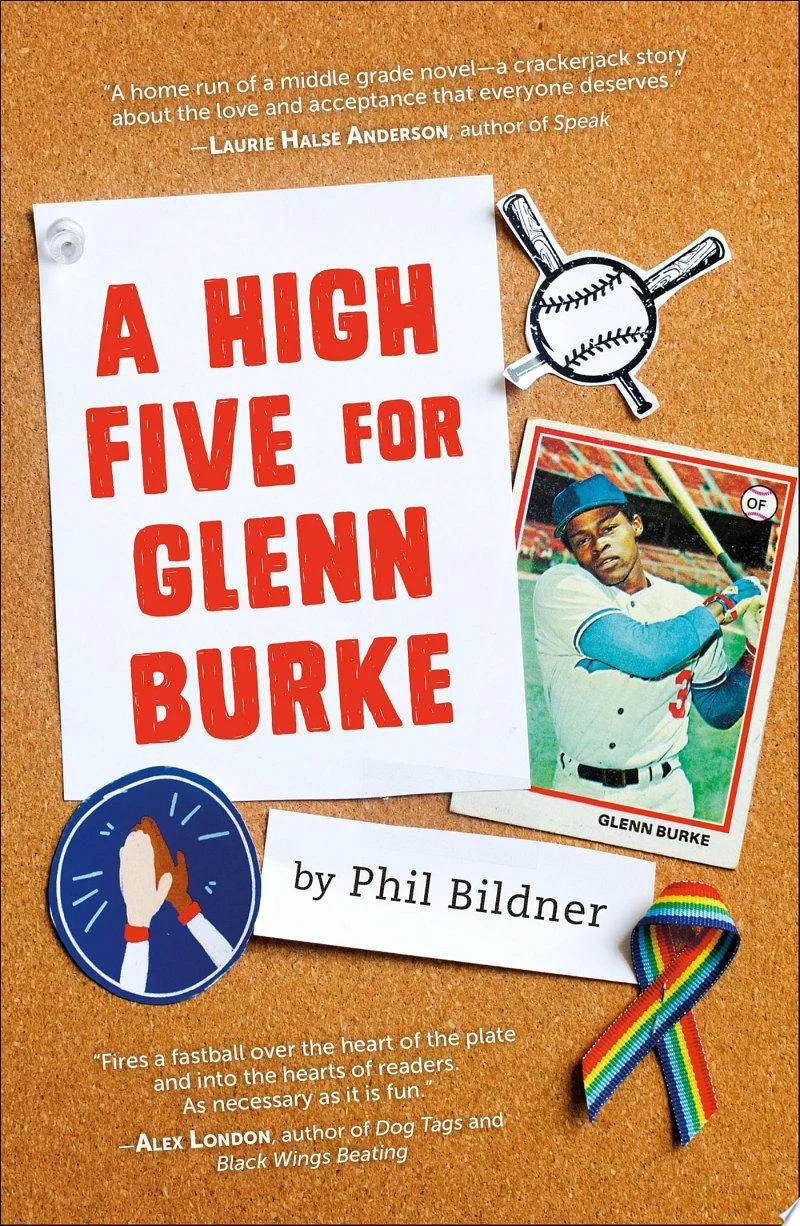
A High Five for Glenn Burke
by Phil Bildner
- Publication Date:
- February 25th, 2020
- Publisher:
- Macmillan + ORM
- ISBN-13:
- 9780374312749
- ISBN-10:
- 0374312745
- Pages:
- 201
Why A High Five for Glenn Burke Has Been Challenged
A sixth grader's quiet, halting process of coming out to the people closest to him has drawn scrutiny from those who object to any acknowledgment of sexual orientation in books written for young readers. See more ↓
Challenged or banned in 3 states across 3 school districts.
Overview
Phil Bildner's novel follows Silas Wade, a sixth grader whose class assignment on a forgotten piece of baseball history becomes the occasion for his own reckoning with identity. Researching Glenn Burke, the Major League outfielder credited with inventing the high five, Silas learns that Burke was also the first professional ballplayer to come out publicly as gay. The discovery gives Silas a language and a mirror for a truth he has been sitting with privately.
What starts as a school project becomes a slow, uneven process of disclosure. Silas confides in his best friend Zoey first, testing the ground before he can imagine telling anyone else. His baseball teammates remain the harder audience, and the pressure of that silence builds until a moment of cover-up brings real consequences into his friendships and his standing on the team.
Bildner threads Burke's real biography through Silas's fictional one, letting the historical figure's courage and isolation illuminate the more ordinary, contemporary anxieties of a kid worried about being accepted by his peers.
A Sports Story Rooted in Overlooked History
The novel sits at an intersection of two genres not often paired: the middle-grade sports book and the coming-out narrative. By anchoring Silas's story to Glenn Burke, an athlete whose contributions to baseball culture are widely known even as his personal history has been largely erased from the sport's popular memory, Bildner uses fiction to restore a piece of history that team locker rooms and broadcast booths rarely mention. The book's interest is less in dramatic revelation than in the ordinary mechanics of a young person deciding, in stages, who gets to know something true about him and when.
That structure — research assignment as accidental self-discovery — lets the book explore visibility without asking its protagonist to make a single grand declaration. Instead, the tension plays out across small relationships: a best friend, a team, a family, each requiring its own calculation of trust. The novel has been recognized by youth literature honors focused on LGBTQ+ representation and by public library best-of lists, suggesting it has found an audience among readers and librarians looking for sports fiction that doesn't assume its readers are straight by default.
Why A High Five for Glenn Burke Has Been Challenged
Reviewers and award committees have praised the novel for its gentle, age-appropriate handling of a young character's emerging sense of self, but that same subject matter has made it a target for removal from schools and libraries. The book has drawn 3 challenges across the states and districts tracked in this catalog, objections that center almost entirely on the presence of a gay protagonist and the discussion of sexual orientation in material aimed at middle-grade readers.
Much of the pushback reflects a broader discomfort with LGBTQ+ themes appearing in books shelved for children, regardless of how the material is handled on the page. Critics of the book have argued that any acknowledgment of a character's sexual orientation is inherently inappropriate for the age group, treating the mere fact of representation as adult content rather than engaging with the story's actual handling of friendship, disclosure, and belonging. The challenges echo a pattern seen across many titles featuring LGBTQ+ characters in youth literature, where the objection is less to explicit content than to visibility itself.
Where to Buy


Affiliate links may generate a small commission at no extra cost to you, which helps support this site.
Also by Phil Bildner
Banned in Schools
Banned or challenged in 3 states across 3 school districts.
Iowa 1 district
- Norwalk Community School District Banned pending investigation
Kentucky 1 district
- Boyle County Schools Banned
Texas 1 district
- Katy Independent School District Banned by Restriction