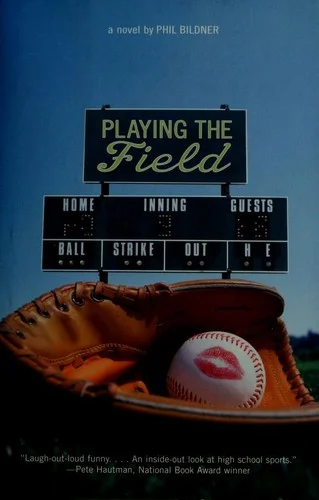
Playing the field
by Phil Bildner
- Publication Date:
- January 1st, 2006
- Publisher:
- Simon & Schuster Books for Young Readers
- ISBN-13:
- 9781416902843
- ISBN-10:
- 1416902848
- Pages:
- 192
Why Playing the field Has Been Challenged
A teenager's invented cover story has been enough, on its own, to draw scrutiny from those who object to LGBTQ themes appearing in books shelved for teen readers. See more ↓
Challenged or banned in 1 state across 1 school district.
Overview
Darcy Miller has spent her whole life on the diamond, and by her senior year she's good enough to hold down a starting spot on her high school's boys' baseball team — there being no girls' team to speak of. When teammates and rivals start asking why a girl would rather play with the boys than date them, Darcy panics and lets a rumor take root: she lets people believe she's gay, reasoning it will explain away the questions and let her keep playing without further scrutiny.
The plan works for exactly as long as plans like that ever do. Once the label sticks, Darcy finds herself on the receiving end of exclusion and hostility she never had to reckon with before, aimed at an identity that isn't even hers. Bildner uses the baseball season as a structure for watching that pressure build, inning by inning, as Darcy's easy fix turns into something much harder to walk back.
What starts as a story about earning a place on a team becomes one about the cost of borrowing an identity to survive in it — and about what Darcy owes, eventually, to the people who believed her.
Beyond the Diamond
Sports fiction for teens tends to measure its stakes in wins and losses; this novel is more interested in the social scaffolding that decides who gets to compete in the first place. Darcy's problem was never her batting average — it was that the sport had no category for a girl who simply wanted to play it well. The lie she tells is less about sexuality itself than about needing *some* explanation, any explanation, that would let the adults and teammates around her stop asking questions.
That premise puts the book in conversation with a long line of stories about passing — pretending to be something you're not in order to gain access to a space that wasn't built for you — but it complicates the usual arc by having Darcy borrow an identity that carries its own real risks for people who actually hold it. The novel doesn't let her deception be cost-free: it has to reckon with what it means to wear a label as camouflage while others wear it as an unshakable fact of who they are. Read alongside Bildner's broader body of middle-grade and YA sports fiction, it marks a turn toward using the ballfield to examine who a community decides to make room for, rather than simply who wins the game.
Why Playing the Field Has Been Challenged
Reviewers have generally credited the novel with handling a difficult premise honestly, treating both the pressures of competitive youth sports and the consequences of Darcy's choice without flattening either into an easy lesson. That same premise, though, is precisely what has drawn objection: a plot built around a teenage girl claiming a lesbian identity, even as a ruse, is enough for some challengers to categorize the book as promoting or normalizing content about sexual orientation that they consider inappropriate for a school library's teen readers. Others have objected less to the topic itself than to its placement — arguing that a coming-of-age story turning on questions of sexuality and social acceptance belongs, if anywhere, behind a parental permission slip rather than on an open shelf. The book's record in this catalog reflects a single instance of that objection reaching a formal record: it has been challenged in 1 state and 1 district. In nearly every case, the underlying complaint centers on the presence of LGBTQ subject matter in a book aimed at adolescent readers, rather than on any specific scene or passage.
Where to Buy




Affiliate links may generate a small commission at no extra cost to you, which helps support this site.
Also by Phil Bildner

Banned in Schools
Banned or challenged in 1 state across 1 school district.
Tennessee 1 district
- Monroe County Schools Banned