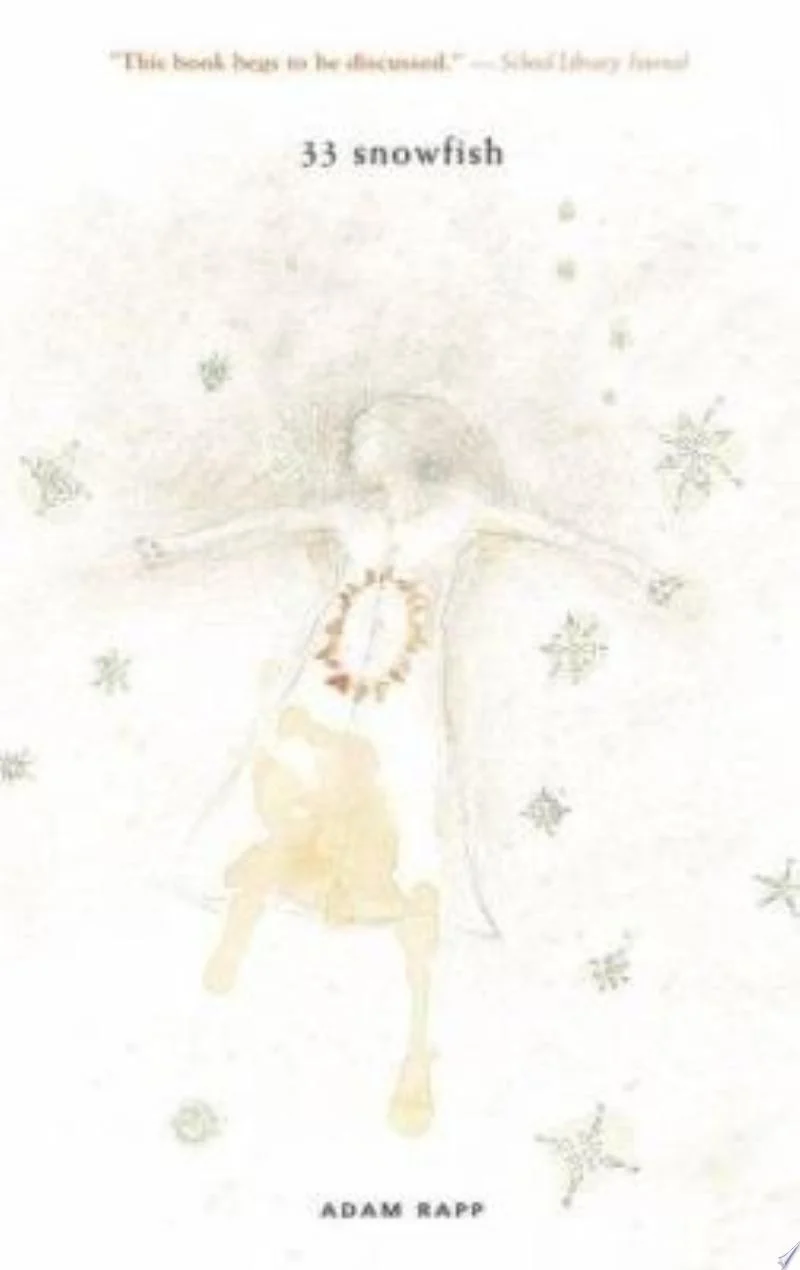
33 Snowfish
by Adam Rapp
- Publication Date:
- January 1st, 2006
- Publisher:
- Candlewick Press
- ISBN-13:
- 9780763629175
- ISBN-10:
- 0763629170
- Pages:
- 193
Why 33 Snowfish Has Been Challenged
Critics have pushed back against a novel that immerses teenage readers in addiction, exploitation, and violence without the buffer of a comfortable moral resolution. See more ↓
Challenged or banned in 3 states across 8 school districts.
Overview
Adam Rapp's 33 Snowfish follows Custis, a boy with no home and no safety net, as he falls in with a small, damaged makeshift family: Curl, a fifteen-year-old caught in addiction and sex work; her boyfriend Boobie, who has just committed a horrific act of violence against his own parents; and an infant swept along with them. As the group flees across a wintry, indifferent landscape, the narrative moves through squalor and danger toward something more fragile — the possibility that Custis might still choose a different path.
Rapp renders this world without sentimentality, letting the bleakness of his characters' circumstances speak for itself rather than softening it for the reader. The novel was recognized as an ALA Best Book for Young Adults, an acknowledgment of its unflinching engagement with the lives of adolescents that mainstream fiction often looks away from.
At its core, the book is less a plot-driven thriller than a character study of survival — what it costs, what it demands, and what, if anything, remains of hope when childhood has already been stripped away.
Context and Themes
Rapp has built a body of work around teenagers living at the edges of American life — runaways, addicts, the abused and the abandoned — and 33 Snowfish sits squarely within that project. Rather than moralizing about how these young people ended up where they are, the novel stays close to their interior experience, refusing easy judgment or tidy redemption arcs.
The book belongs to a lineage of young adult fiction that emerged in the late twentieth and early twenty-first centuries determined to depict adolescence honestly, including its most disturbing corners, on the premise that teenage readers are better served by unvarnished truth than by protective omission. Its reception has been divided along exactly that line: some critics and educators praise it as a vital, compassionate window into lives rarely given literary attention, while others question whether its subject matter belongs in the hands of the teenage audience it was ostensibly written for. That tension — between honoring difficult realities and shielding young readers from them — has shaped much of the conversation around the novel since its publication.
Why 33 Snowfish Has Been Challenged
The novel places its teenage characters inside circumstances that many adults would consider far outside the bounds of appropriate reading material for young people: drug addiction rendered from the inside, commercial sexual exploitation of a minor, and an act of parricide that sets the plot in motion. Rather than treating these as distant background facts, Rapp writes them as lived, immediate experience, which is precisely what has troubled some parents, educators, and school boards. Their objection is less to the existence of such content in the abstract than to its explicitness and proximity — the sense that the book asks readers to inhabit trauma rather than simply observe it from a safe narrative distance.
Language has compounded the concern, with critics pointing to the book's coarse, unfiltered vocabulary as further evidence that it is unsuited for school libraries or classrooms. Underlying many of these objections is a broader disagreement about audience: defenders argue the novel speaks honestly to teenagers who may recognize pieces of their own struggles in it, while detractors maintain that its content crosses a line appropriate literature for adolescents should not cross. That disagreement has translated into a real record of restriction, with the book challenged in 3 states and 8 districts tracked in this catalog.
Where to Buy



Affiliate links may generate a small commission at no extra cost to you, which helps support this site.
Banned in Schools
Banned or challenged in 3 states across 8 school districts.
Florida 6 districts
- Hillsborough County Public Schools Banned Pending Investigation
- Nassau County School District Banned Pending Investigation
- Santa Rosa County Schools Banned
- Seminole County Public Schools Banned
- St. John's County School District Banned pending investigation
- Union County School District Banned
Tennessee 1 district
- Monroe County Schools Banned
Wisconsin 1 district
- Elkhorn Area School District Banned pending investigation