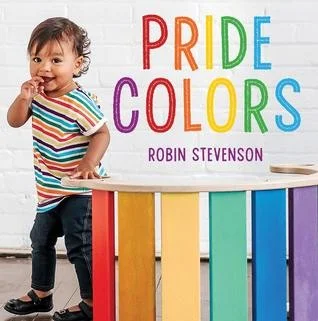
Pride Colors
- Publication Date:
- January 1st, 2019
- Publisher:
- Orca Book Publishers
- ISBN-13:
- 9781459820708
- ISBN-10:
- 1459820703
Why Pride Colors Has Been Challenged
Critics argue that a board book aimed at toddlers is the wrong vehicle for introducing any social or cultural identity, even through imagery as mild as a parade scene. See more ↓
Challenged or banned in 1 state across 1 school district.
Overview
Pride Colors belongs to the compact world of concept board books — the sturdy, oversized-lettered volumes meant to sit in small hands long before a child can read on their own. Robin Stevenson builds the book around a familiar learning device, pairing single words with bright, uncomplicated images, except that the images here are drawn from Pride parades and community celebrations rather than farm animals or fruit.
The structure keeps things simple: a color on one page, a corresponding picture on the next, each scene drawn from the visual culture of Pride events — flags, balloons, clothing, signage. There is no storyline or dialogue to speak of. The book's entire ambition is to let a toddler point, name a color, and move on, using Pride as the backdrop rather than the subject.
In that sense it reads less as an argument about identity and more as an exercise in representation by inclusion: the imagery normalizes Pride gatherings as an ordinary part of a community's visual landscape, the same way a counting book might normalize a trip to the farmers' market.
Context and Reception
Stevenson has built a career writing for children and teens about LGBTQ+ life, and Pride Colors sits at the youngest end of that catalog, part of a small but growing category of board books that extend early-concept learning into communities previously left out of it. Its closest relatives are counting or shapes books built around the same Pride-event imagery, suggesting a deliberate series logic rather than a one-off project.
The book's reception has tracked the broader debate over this format. Supporters, including many librarians building inclusive board-book collections, point to it as low-stakes representation: a toddler encountering two parents at a parade is no different, in their view, from encountering a parade at all. Critics, however, treat the same simplicity as the problem, arguing that board books are too foundational a genre to carry any social content beyond colors and shapes, regardless of how mild the imagery is.
Why Pride Colors Has Been Challenged
Because the book is pitched at infants and toddlers — the standard audience for a board book — most objections center on that very young age bracket, with challengers arguing that children too young to form their own views are being handed a book that implicitly endorses a particular set of community events and identities. Critics frame this as a question of readiness rather than content: even imagery as mild as flags and parade scenes, they argue, asks a toddler to accept a social and cultural frame before any adult has had the chance to introduce it on the family's own terms.
A second strand of objection focuses on placement rather than content, with challengers questioning why a board book built around Pride imagery belongs on open shelves in daycare or public-library toddler sections, as opposed to being available only through parental request. Some challengers also object to Pride imagery itself appearing in a children's format at all, treating the parade setting as inherently adult material regardless of how it is illustrated. The book has been challenged in one state and one district tracked in this catalog, reflecting a narrower but still active front in the broader dispute over how early, and in what format, LGBTQ+ representation belongs in children's literature.
Where to Buy




Affiliate links may generate a small commission at no extra cost to you, which helps support this site.
Banned in Schools
Banned or challenged in 1 state across 1 school district.
Florida 1 district
- Lee County Schools Banned by restriction