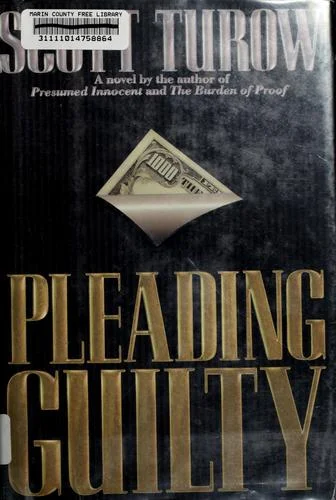
Pleading guilty
by Scott Turow
- Publication Date:
- January 1st, 1993
- Publisher:
- G.K. Hall
- ISBN-13:
- 9780816157464
- ISBN-10:
- 0816157464
- Pages:
- 495
Why Pleading guilty Has Been Challenged
Objections to Pleading Guilty have centered on its frank, often coarse language and its unvarnished depiction of adult vice—alcoholism, infidelity, and casual sexuality among its characters. See more ↓
Challenged or banned in 1 state across 1 school district.
Overview
Pleading Guilty takes readers back to Kindle County, the fictional urban landscape Scott Turow built into one of contemporary crime fiction's most recognizable settings. The story is narrated by McCormack "Mack" Malloy, a former police officer and recovering alcoholic now sliding toward the exit of his career as a partner at Gage & Griswell, a powerhouse law firm entangled in one of the city's biggest cases.
Mack is pulled into an internal investigation when a colleague, the brilliant and volatile litigator Bert Kamin, vanishes along with millions of dollars earmarked to settle a catastrophic airline disaster lawsuit. Tasked by the firm's leadership with tracking down both the missing man and the missing money, Mack is drawn from the firm's private offices into the city's seedier corners, crossing paths with old rivals, uneasy allies, and secrets that implicate the very institution he's meant to protect.
Told in Mack's wry, world-weary voice, the novel functions as both a mystery and a character study, using a missing-persons case to peel back the layers of ambition, compromise, and self-interest inside a powerful law firm.
A Turn Toward Noir Within the Kindle County Novels
Pleading Guilty marked a stylistic departure within Turow's Kindle County series, trading the courtroom procedural structure of his earlier work for a first-person voice steeped in hardboiled tradition. Mack Malloy's narration—cynical, self-deprecating, alert to his own failures—owes an evident debt to classic detective fiction even as the novel remains grounded in Turow's recurring preoccupations: the machinery of the legal profession, the porous boundary between lawful and unlawful conduct, and the moral compromises embedded in institutions meant to uphold justice.
The novel's interest in corporate and legal corruption also reflects a broader current in the literary fiction of its era, when writers increasingly used the law firm and the corporation as settings for examining ethical decay from the inside. Rather than a heroic advocate, Mack is a flawed insider whose investigation implicates the same institution paying his salary, giving the book a darker, more ambivalent take on legal fiction than the genre's traditional courtroom dramas.
Why Pleading Guilty Has Been Challenged
Objections to Pleading Guilty have centered on its frank, often coarse language and its unvarnished depiction of adult vice—alcoholism, infidelity, and casual sexuality among its characters. Mack Malloy's narration does not soften or moralize about these elements; his voice is deliberately profane and worldly, and some readers and institutions have found that candor inappropriate for certain audiences or shelving contexts. The novel's frank treatment of a protagonist's substance-abuse history and morally compromised choices has likewise drawn scrutiny from those concerned about its suitability, particularly in school settings. In the catalog tracked here, the novel has been the subject of a challenge or restriction in 1 state and 1 school district.
Where to Buy




Affiliate links may generate a small commission at no extra cost to you, which helps support this site.
Banned in Schools
Banned or challenged in 1 state across 1 school district.
Florida 1 district
- Lee County Schools Banned by restriction