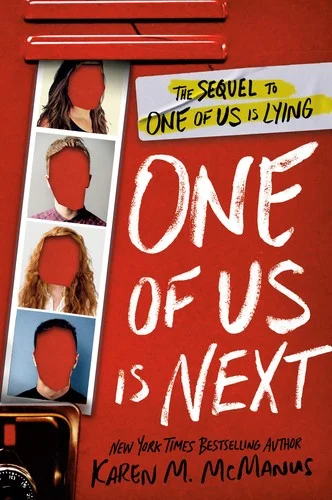
One of us is next
- Publication Date:
- January 1st, 2020
- Publisher:
- Random House Children's Books
- ISBN-13:
- 9780525707981
- ISBN-10:
- 0525707980
Why One of us is next Has Been Challenged
Some parents and community members have pushed back on a young-adult mystery whose teen characters navigate blackmail, sex, and substance use largely without adult oversight, arguing the content sits outside what belongs in a school library aimed at younger readers. See more ↓
Challenged or banned in 3 states across 3 school districts.
Overview
One of Us Is Next picks up in the same California town where Karen M. McManus's earlier bestseller left off, roughly a year after a fellow student's death exposed a web of secrets among his classmates. Bayview hasn't fully recovered, and the appetite for gossip that once fueled an anonymous app has never really gone away. When a new phone game called Truth or Dare starts circulating, it offers players an ultimatum: reveal an embarrassing or damaging truth, or complete a dare, all within a single day.
The novel follows a new set of teenage narrators as the game escalates from petty humiliation into something more dangerous, echoing the pattern of the town's earlier tragedy while charting its own course. Old names and relationships from the first book resurface, giving longtime readers a sense of continuity even as the central mystery belongs to this new group of students.
As players are forced to weigh what they're willing to admit against what they're willing to risk, the story builds toward the question of who is orchestrating the game and why Bayview seems unable to leave its culture of secrecy behind.
A Town That Can't Stop Watching Itself
McManus's sequel is less interested in solving a single crime than in examining what a community does with its appetite for scandal once it's been given a taste of it. The game format—confess or be dared, with a countdown attached—turns the town's residents into both participants and audience, implicating everyone who chooses to play along rather than opt out. That structure lets the book explore peer pressure and social surveillance as ongoing conditions of teenage life, not just a one-time crisis.
The novel also functions as a meditation on reputation: how quickly a private mistake can become public currency, and how little control anyone has over which of their secrets gets weaponized. By returning to Bayview rather than starting fresh elsewhere, McManus suggests that the mechanisms that produced one tragedy are structural rather than incidental, and that a new cast of characters can be drawn into the same trap. The book sits comfortably within the wider young-adult mystery-thriller boom of the past decade, sharing that genre's interest in unreliable narration, rotating points of view, and the moral gray areas of teenagers navigating consequences that outpace their judgment.
Why One of Us Is Next Has Been Challenged
Much of the pushback on this title centers on whether its subject matter is suited to the age group most likely to encounter it on a middle or junior-high shelf, rather than on any single scene in isolation. Because the story is told through teenage narrators whose secrets are the plot's engine, the book necessarily depicts the kinds of choices and consequences that generate those secrets in the first place, including sexual activity, underage drinking and drug use, and manipulative or coercive relationships between peers. Reviewers who object to the book tend to argue that these elements are presented too candidly, or without enough narrative consequence, for readers still in early adolescence.
Other objections focus on the book's frank language and its portrayal of blackmail and social manipulation as central plot devices, with critics questioning whether normalizing a "confess or be exposed" premise sends an unhealthy message about privacy and peer relationships. Records reviewed for this catalog show the book has drawn a combined total of six challenges across three states and three school districts, generally tied to requests to move it to an older reading level or restrict its availability rather than to remove it from circulation entirely.
Where to Buy


Affiliate links may generate a small commission at no extra cost to you, which helps support this site.
Banned in Schools
Banned or challenged in 3 states across 3 school districts.
Florida 1 district
- Escambia County Public Schools Banned pending investigation
Tennessee 1 district
- Wilson County Schools Banned