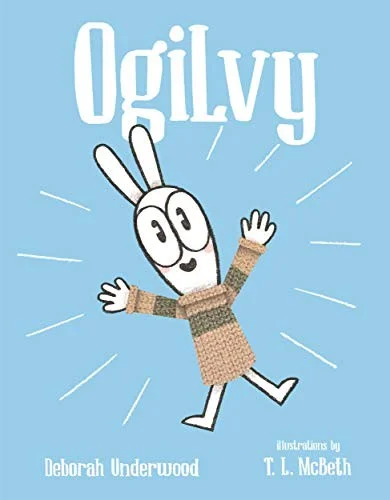
Ogilvy
- Publication Date:
- May 21st, 2019
- Publisher:
- Henry Holt and Co. (BYR)
- ISBN-13:
- 9781250151766
- ISBN-10:
- 1250151767
- Pages:
- 40
Why Ogilvy Has Been Challenged
A story that never tells readers whether its central character is a boy or a girl has struck some parents and reviewers as an inappropriate introduction to gender identity for very young children. See more ↓
Challenged or banned in 2 states across 2 school districts.
Overview
Ogilvy follows a kitten who arrives in a new town carrying a suitcase full of both dresses and overalls. The other kittens are eager to know whether Ogilvy is a girl or a boy, certain that the answer will tell them what Ogilvy can and cannot do. Ogilvy never answers the question directly, choosing instead to climb trees in a frock one day and bake cookies in trousers the next.
Deborah Underwood builds the story around simple, repeated patterns of assumption and surprise, a structure well suited to its picture-book audience. Each time a neighbor kitten predicts that Ogilvy's clothing signals a fixed set of interests or abilities, Ogilvy quietly does something that complicates the prediction, and the town's children begin to mix and match their own wardrobes and pastimes in response.
The book keeps its focus on play, curiosity, and friendship rather than on argument or lesson-making, letting the plot itself carry the point: that a kitten's favorite activities are not dictated by whether it wears a bow or a bow tie.
A Picture Book About Categories and Who Gets to Set Them
Underwood's premise sits inside a long picture-book tradition of using animal characters to examine very human social rules, letting young readers watch assumptions get tested at a safe remove before they have to think about anyone they know. The town of kittens in Ogilvy functions as a small social laboratory, where clothing operates as shorthand for a much larger set of expectations about behavior, temperament, and belonging.
What the book is ultimately interested in is not Ogilvy's identity as a fixed fact to be revealed, but the process by which a community decides what counts as normal and who is allowed to set the terms. Because the story withholds a tidy answer to the question "is Ogilvy a boy or a girl," it asks readers to sit with ambiguity rather than resolve it, a choice that distinguishes it from more conventional stories about tolerance, which typically end with the outsider's difference explained and accepted. Here, the difference is never explained at all, which is precisely what has made the book both admired and contested.
Why Ogilvy Has Been Challenged
Reviewers have praised Ogilvy for its lightness of touch and its confidence in letting very young children encounter an open question without being handed a moral, qualities that have made it a frequently recommended addition to early-childhood collections. That same openness is exactly what has drawn objections, which center on the book's refusal to identify Ogilvy's gender and on its implicit suggestion that gender itself need not determine a child's clothing, hobbies, or friendships. Critics characterize this as an introduction of gender-identity concepts to an audience too young to evaluate them, and argue that the story normalizes gender nonconformity by presenting it without caveat or contrasting viewpoint.
Because the book is aimed at preschool and early-elementary readers, much of the dispute turns on questions of age-appropriateness: whether themes of gender ambiguity belong in picture books at all, and who should decide when and how a child encounters them, parents or school libraries. In the catalog tracked here, those objections have resulted in challenges recorded in 2 states and 2 districts, reflecting a broader pattern in which picture books touching on gender identity face scrutiny disproportionate to their length and reading level.
Where to Buy




Affiliate links may generate a small commission at no extra cost to you, which helps support this site.
Banned in Schools
Banned or challenged in 2 states across 2 school districts.
Florida 1 district
- Clay County School District Banned pending investigation
Iowa 1 district
- Clear Creek-Amana Community School District Banned pending investigation