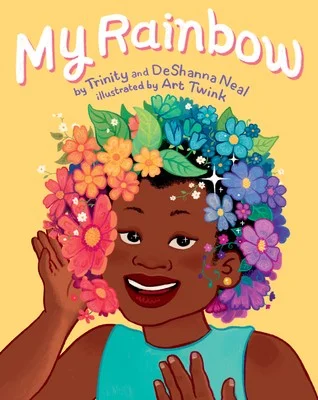
My Rainbow
- Publication Date:
- January 1st, 2020
- Publisher:
- Kokila
- ISBN-13:
- 9781984814609
- ISBN-10:
- 1984814605
- Pages:
- 32
Why My Rainbow Has Been Challenged
Much of the pushback centers on discomfort with introducing young children to a transgender character's experience at all, regardless of how the story itself handles it. See more ↓
Challenged or banned in 3 states across 4 school districts.
Overview
My Rainbow opens on an ordinary morning in the Neal household, where a young girl named Trinity is playing with her dolls and notices something missing from her own reflection: long hair like theirs. For Trinity, who is transgender, the hair is not a costume or a whim but a piece of how she wants to be seen and known.
The story follows her family's response to that need. A trip to the beauty supply store turns up nothing that fits quite right, so Trinity's mother takes matters into her own hands, gathering bundles of hair and setting out to build a wig herself. What results is less a shopping errand than a small act of craftsmanship, undertaken because a store-bought answer wasn't good enough for her daughter.
Told through the combined voices of Trinity and her mother, DeShanna Neal, and illustrated by Art Twink, the book stays close to the texture of daily family life rather than framing its events as extraordinary.
A Family's Collaboration on Identity
What distinguishes My Rainbow from many books touching on gender identity is its authorship: it is presented as a joint account from a real parent and child, giving the story the register of lived testimony rather than invented narrative. The book positions the mother not as an instructor explaining her daughter's identity to the reader, but as a collaborator solving a practical, emotional problem alongside her.
The "rainbow" of the title points to the wig's eventual many-colored design, but it also stands in for the book's broader argument — that being fully recognized by the people closest to you, hair and all, is its own kind of celebration. In the landscape of children's publishing, the book fits alongside a small but growing set of picture books centered on transgender and gender-nonconforming children, most of which are written for an audience of very young readers and their caregivers rather than for the children themselves to analyze critically.
Why My Rainbow Has Been Challenged
The scene at the center of most objections is the simplest one in the book: a mother helping her transgender daughter get the hair she asks for. Critics who have sought the book's removal from libraries and classrooms generally argue that the story normalizes or affirms a child's transgender identity at an age when, in their view, children are too young to be presented with such material, and that it does so without qualification or alternative perspective. Some challenges characterize the book as an introduction to gender-transition concepts unsuited to elementary-age readers, part of a broader wave of objections to picture books featuring transgender children or families with LGBTQ+ members.
Supporters of keeping the book available counter that it depicts nothing more explicit than a parent supporting a child's self-expression, and that its removal reflects discomfort with transgender identity itself rather than any objectionable content in the text or art. In this catalog, My Rainbow has been the subject of 7 recorded challenges across the states and districts tracked here, consistent with its frequent appearance on lists of contested titles addressing gender identity in early childhood.
Where to Buy


Affiliate links may generate a small commission at no extra cost to you, which helps support this site.
Banned in Schools
Banned or challenged in 3 states across 4 school districts.
Iowa 1 district
- Clear Creek-Amana Community School District Banned pending investigation