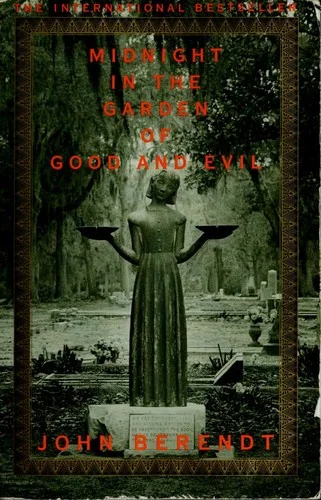
Midnight in the Garden of Good and Evil
by John Berendt
- Publication Date:
- January 1st, 1995
- Publisher:
- Vintage Books
- ISBN-13:
- 9780099521013
- ISBN-10:
- 0099521016
- Pages:
- 393
Why Midnight in the Garden of Good and Evil Has Been Challenged
Readers and reviewers have pushed back mainly on the book's unguarded portrayal of a gay central figure and its matter-of-fact treatment of drugs, hustling, and other illicit behavior among real people it names. See more ↓
Challenged or banned in 2 states across 3 school districts.
Overview
John Berendt's "Midnight in the Garden of Good and Evil" begins with a 1981 shooting inside one of Savannah, Georgia's most storied homes, and follows the resulting legal proceedings across several years and multiple trials. Rather than writing a conventional true-crime account, Berendt builds the book around the city itself, lingering on the antiques dealer at the center of the case and the wide circle of acquaintances, rivals, and onlookers who orbit him.
The narrative moves at an unhurried pace, introducing an assortment of real Savannah residents: society matrons, a hustler on the make, a recluse hoarding a lethal poison, a flamboyant drag performer, and a woman said to practice rootwork in a local cemetery. Berendt, writing in the first person as an outside observer who relocated to the city, treats these figures less as supporting characters than as co-authors of the town's identity.
What emerges is part courtroom drama, part character study, held together by Berendt's eye for telling detail and his patience in letting Savannah's contradictions speak for themselves.
A City as Character
The book's lasting appeal has less to do with whether the shooting was murder or self-defense than with its depiction of a place that resists easy categorization. Savannah, as Berendt presents it, operates by its own private logic, mannered and insular, protective of its own, and tolerant of eccentricity so long as it stays within the family. The legal case becomes a lens for examining how a tightly bound community closes around a crisis.
Berendt's hybrid approach, blending reported fact with the shaping instincts of a novelist, helped popularize a style of literary nonfiction that treats a real setting with the same attention a novelist gives an invented one. Its commercial success turned Savannah into a tourist destination and sparked ongoing debate about where journalism ends and embellishment begins, since Berendt compressed timelines and reconstructed scenes and dialogue well after the fact. That tension between documentary claim and narrative polish remains part of how the book is discussed today, decades after its release.
Why Midnight in the Garden of Good and Evil Has Been Challenged
Sexual content and the book's frank, sometimes irreverent treatment of a gay and gender-nonconforming character have driven most objections to the book, with some reviewers objecting to how drug use, hustling, and criminal activity among its real-life cast are described without editorial judgment. Because the people depicted are actual Savannah residents, critics have also raised concerns about exploitation and invasion of privacy, arguing that intimate or unflattering details about living individuals were presented for entertainment. Profanity drawn from recorded conversation and courtroom testimony has added to objections about suitability for younger or more general readers. Within this catalog, the book has been the subject of 2 statewide and 3 district-level challenges, reflecting how its subject matter has prompted reconsideration even as the book retains a wide readership and critical standing.
Where to Buy




Affiliate links may generate a small commission at no extra cost to you, which helps support this site.
Banned in Schools
Banned or challenged in 2 states across 3 school districts.
Florida 2 districts
- Clay County School District Banned
- Escambia County Public Schools Banned pending investigation