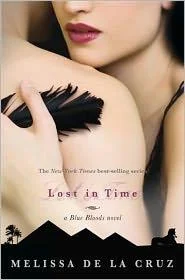
Lost in Time
- Publication Date:
- January 1st, 2011
- Publisher:
- Hyperion
- ISBN-13:
- 9781423121299
- ISBN-10:
- 1423121295
Why Lost in Time Has Been Challenged
Some reviewers have balked at how much romantic and physical tension the novel asks its teenage audience to sit with, given the perilous, high-stakes world its characters are thrown into. See more ↓
Challenged or banned in 1 state across 1 school district.
Overview
Lost in Time takes its premise from the promise of its title: a young protagonist is wrenched out of the present and set loose somewhere — or somewhen — she never chose to go. Melissa de la Cruz builds the story around that disorientation, following a teenage narrator who must make sense of a world governed by rules she does not yet understand, while the life she left behind waits, unreachable, on the other side of the gap.
As in much of de la Cruz's work, the novel pairs a fantastical premise with the more grounded concerns of a coming-of-age story: who to trust, how to hold onto a sense of self, and what it costs to fall for someone who may not belong in the same timeline at all. The time-displacement conceit becomes a vehicle for testing the protagonist's judgment and resilience under conditions no amount of ordinary teenage experience could have prepared her for.
The result is a brisk, plot-forward YA novel pitched at readers who enjoy romance threaded through speculative stakes — a pairing de la Cruz has returned to across much of her catalog.
A Familiar Voice in a New Era
De la Cruz has spent much of her career working at the intersection of history, fantasy, and romance, from the vampire mythology of her Blue Bloods series to the reimagined founding-era drama of her Alex and Eliza books. Lost in Time continues that pattern, using a speculative device — displacement across time — to put a contemporary sensibility in direct contact with a past it can neither fully master nor ignore.
That structure lets the book do double duty: it offers the pleasures of genre fiction — mystery, peril, a central romance — while also inviting reflection on how much of identity is tied to the specific moment a person happens to inhabit. Strip away the comforts of a familiar time and place, the novel suggests, and what's left is harder to pin down than most teenagers assume.
Within de la Cruz's broader body of work, the book sits comfortably alongside her other genre-blending titles: commercially accessible, romance-forward, and more interested in emotional momentum than in rigorous world-building mechanics. It has found its audience among readers who come to her fiction for that combination rather than for historical or scientific precision.
Why Lost in Time Has Been Challenged
A time-displaced romance built around a teenage protagonist inevitably raises the stakes of its central relationship — the emotional and physical pull between two people separated by circumstances neither can control tends to intensify rather than soften as the plot moves forward. It's this kind of charged, cross-era attraction, along with the peril and loss that typically accompany a young adult navigating a world not her own, that has drawn the attention of some parents and reviewing committees, who have questioned whether the romantic and dramatic content is appropriate for the book's intended readership. The novel has been challenged or restricted in 1 state and 1 school district tracked in this catalog, reflecting a narrower, more localized concern rather than a broad pattern of objection. As with many YA titles built around romance and genre thrills, the dispute centers less on any single scene than on a judgment call about how much emotional and physical intensity belongs in a book shelved for teenage readers.
Where to Buy




Affiliate links may generate a small commission at no extra cost to you, which helps support this site.
Also by Melissa de la Cruz



Banned in Schools
Banned or challenged in 1 state across 1 school district.
Florida 1 district
- Escambia County Public Schools Banned pending investigation