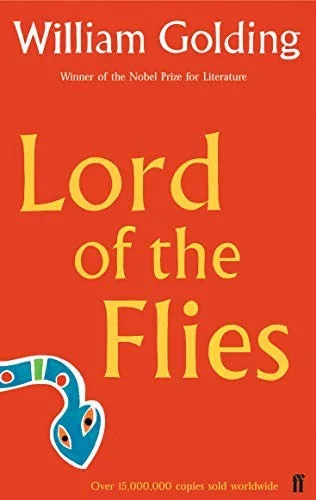
Lord of the Flies
- Publication Date:
- January 1st, 1994
- Publisher:
- Chivers
- ISBN-13:
- 9780745122397
- ISBN-10:
- 0745122280
- Pages:
- 322
Why Lord of the Flies Has Been Challenged
Critics of the novel have most often pointed to its unflinching depiction of children turning violent against one another, alongside broader unease about a story that offers so little faith in innate human decency. See more ↓
Challenged or banned in 3 states across 3 school districts.
Overview
William Golding's debut novel imagines a plane crash that leaves a group of British schoolboys alone on a remote island with no adults to answer to. What begins as an experiment in order — assemblies, a signal fire, elected leadership — steadily gives way to fear, superstition, and violence as the boys splinter into rival factions.
Golding uses the island as a closed system, stripped of the institutions and social pressures that normally keep behavior in check, to ask what remains of civilization when no one is watching. The boys' descent is charted less through a single dramatic turn than through a series of small failures: a fire left untended, a rumor about a "beast" that hardens into belief, a vote that stops mattering once fear takes hold.
The novel's central conflicts — between the group and the individual, between reasoned deliberation and instinctive reaction, between the boys' inherited sense of right and wrong and the pull toward cruelty — are dramatized through characters who each embody one pole of these tensions, giving the allegory its shape without reducing it to a simple lesson.
A Fable About Human Nature
Since its publication, Lord of the Flies has been read as a rejoinder to more optimistic castaway stories, in which resourceful children build a workable society from scratch. Golding, who served in the Royal Navy during the Second World War, was skeptical of the assumption that children — or people generally — are innately good and simply corrupted by bad institutions. His novel instead suggests that the capacity for savagery is close to the surface in everyone, requiring only the removal of familiar constraints to emerge.
That pessimism, delivered through what looks at first like a boys' adventure story, is a large part of why the book has endured in classrooms: it gives students a concrete, plot-driven way to argue about abstract questions of governance, mob psychology, and moral responsibility. It has been recognized among the notable English-language novels of the twentieth century and remains one of the more frequently assigned works of fiction in secondary schools, particularly in English-speaking countries, which has kept it both widely read and periodically controversial.
Why Lord of the Flies Has Been Challenged
Violence is the most frequently cited concern: the novel depicts the boys' escalating brutality toward one another, including two on-page deaths, in language that some parents and educators consider too graphic or disturbing for the age at which the book is commonly assigned. Objections have also centered on the novel's bleak view of human nature itself, with some challengers arguing that its portrayal of children as capable of premeditated cruelty is inappropriate or excessively grim for a school curriculum. A smaller number of challenges have focused on racial language and characterization that reflect the era in which the book was written, which some readers and administrators have found offensive by current standards. According to the records in this catalog, the novel has drawn 3 state-level challenges and 3 district-level challenges, making it one of the more consistently contested titles among widely assigned classroom novels.
Where to Buy



Affiliate links may generate a small commission at no extra cost to you, which helps support this site.
Banned in Schools
Banned or challenged in 3 states across 3 school districts.
Florida 1 district
- Escambia County Public Schools Banned pending investigation
Tennessee 1 district
- Monroe County Schools Banned
Wisconsin 1 district
- Elkhorn Area School District Banned pending investigation