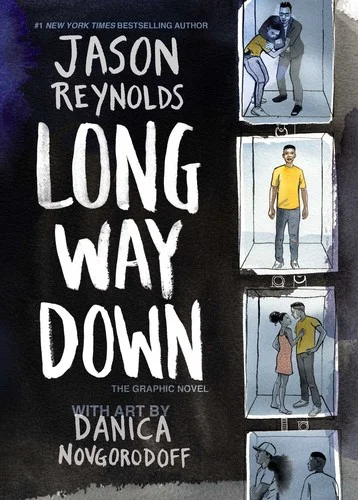
Long Way Down
- Publication Date:
- January 1st, 2020
- Publisher:
- Faber & Faber, Limited
- ISBN-13:
- 9780571366026
- ISBN-10:
- 0571366023
Why Long Way Down Has Been Challenged
Critics have targeted the novel's close, unresolved look at a teenager contemplating retaliatory gun violence, arguing it sits too near the act itself to serve as a clear warning against it. See more ↓
Challenged or banned in 2 states across 2 school districts.
Overview
Jason Reynolds compresses an entire reckoning into the space of a single elevator ride. Will, fifteen years old and reeling from the murder of his older brother Shawn, picks up the gun he's found and steps into the elevator of his apartment building, intending to follow a code he's been taught since childhood: no crying, no snitching, get revenge. The whole of the story unfolds in the sixty seconds it takes the elevator to descend.
Told in spare, rhythmic free verse, the novel turns that short ride into something much longer and stranger. At each floor, the doors open on a figure from Will's past — people lost to the same cycle of retaliation he's about to join. Their appearances are not explained away; they simply arrive, speak, and press Will toward a version of the night's events he hadn't let himself see clearly.
Reynolds keeps the language plain and the pacing tight, trusting white space and line breaks to carry as much weight as the words themselves. The result reads quickly but sits heavily, built around a single unanswered question: what happens when Will steps off the elevator.
A Reckoning With Inheritance
Long Way Down belongs to a body of work in which Reynolds writes toward young readers, especially young Black readers, without softening the stakes of what he's describing. The book is less interested in whether gun violence happens than in why it keeps happening — how grief, shame, and an inherited sense of manhood can funnel a frightened teenager toward the exact violence that orphaned him in the first place. The "rules" Will recites are never named as wrong outright; the structure of the book lets their cost accumulate, floor by floor, until the reader has to weigh them.
The novel-in-verse form, increasingly common in Reynolds's catalog and in contemporary YA more broadly, does real work here beyond style. It slows the reader down at moments of highest tension and leaves gaps that mirror Will's own incomplete understanding of his brother's death. Critically, the book has been read as both a gripping, almost thriller-paced narrative and as a quiet elegy for the dead; it resists settling into either mode entirely, which is part of why it has been assigned widely in classrooms as an entry point for discussing cycles of violence.
Why Long Way Down Has Been Challenged
The elevator's ghostly visitors recount, in fragments, the shootings and retaliations that took their lives, and the gun in Will's waistband is never abstract — its weight, its presence, and his rehearsal of what he intends to do with it sit at the center of nearly every page. For some parents and administrators, that unflinching closeness to firearm violence, paired with the book's refusal to resolve whether Will will use the gun, has read as too intense or too open-ended for younger readers, particularly in middle-grade settings where the book is sometimes assigned. Objections have also centered on the story's frank depiction of gang-adjacent retaliation and street codes, with critics arguing that presenting the logic of revenge so sympathetically risks normalizing it rather than condemning it clearly enough. Language reflecting the book's setting has drawn separate complaints in a handful of reviews. In the catalog tracked here, Long Way Down has been challenged in 2 states and 2 districts, generally as part of broader pushes to restrict titles dealing with gun violence in school libraries rather than in isolation.
Where to Buy




Affiliate links may generate a small commission at no extra cost to you, which helps support this site.
Also by Jason Reynolds
Banned in Schools
Banned or challenged in 2 states across 2 school districts.
Florida 1 district
- School District of Manatee County Banned by Restriction
Wisconsin 1 district
- Elkhorn Area School District Banned pending investigation