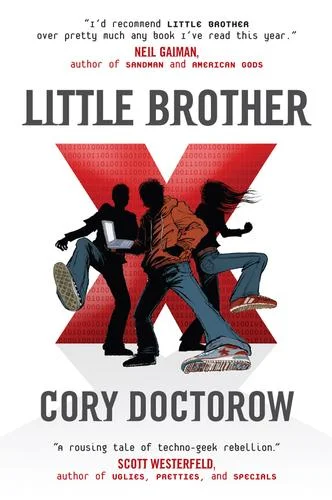
Little Brother
- Publication Date:
- January 1st, 2020
- Publisher:
- Independently Published
- ISBN-13:
- 9798556974722
Why Little Brother Has Been Challenged
Some readers have pushed back against the novel for pairing mature language and sexual content with a sympathetic portrait of teenagers actively working to outwit government surveillance. See more ↓
Challenged or banned in 1 state across 2 school districts.
Overview
Marcus Yallow is an ordinary tech-savvy high schooler until a bombing in San Francisco puts him and his friends in the custody of the Department of Homeland Security. Detained and interrogated without charge, Marcus is eventually let go, but the city he returns to has been reshaped by checkpoints, tracking, and a permanent assumption of guilt.
Rather than accept the new order, Marcus uses his knowledge of networks, cryptography, and gaming systems to build an underground communication network beyond the reach of government monitoring. What follows is a cat-and-mouse campaign in which a teenager and his peers try to outmaneuver an agency with far greater resources and legal authority.
Cory Doctorow frames the story as a hands-on primer in digital self-defense as much as a thriller, folding real techniques and concepts into the narrative. The author has also made the novel available free of charge under a Creative Commons license, reflecting its origins as an activist project as much as a work of fiction.
Technology, Civil Liberties, and the Post-9/11 Novel
Published in the shadow of post-9/11 security expansion, the novel examines how emergency powers, once granted, tend to persist and spread into everyday life. It positions its teenage characters not as passive victims of this shift but as citizens capable of understanding and contesting the systems built to watch them, a stance that has made the book a touchstone in discussions of digital literacy and youth activism.
Within Doctorow's broader body of work, the novel sits alongside his other writing and advocacy on copyright, surveillance, and open technology, and it helped popularize ideas about encryption and privacy for readers who might not otherwise encounter them. Its reception has been shaped by this dual identity: reviewers and educators have praised it as an accessible entry point into computer science and civics alike, while others have treated its instructional detail as cause for concern.
Why Little Brother Has Been Challenged
Profanity and frank references to teenage sexuality appear among the objections raised against the novel, with some readers judging the language and content too mature for the school-age audience likely to encounter it on a reading list. The book's unflinching portrayal of interrogation and detention has also unsettled some reviewers, who view its depiction of government authority as unduly harsh or one-sided.
A further line of concern centers on the novel's technical content: because it walks readers through real methods for evading surveillance and encrypting communication, some have argued it could be read as a how-to guide rather than fiction, raising worry about teaching circumvention of lawful authority to young readers. Others have objected on ideological grounds, reading the book's skepticism toward security agencies as an anti-government message inappropriate for a classroom setting. In total, the novel has drawn 1 state and 2 district challenges among those tracked in this catalog, reflecting a relatively narrow but pointed set of objections tied to its politics and content rather than widespread rejection.
Where to Buy



Affiliate links may generate a small commission at no extra cost to you, which helps support this site.
Also by Cory Doctorow
Banned in Schools
Banned or challenged in 1 state across 2 school districts.
Florida 2 districts
- Clay County School District Banned
- Escambia County Public Schools Banned pending investigation